
Relic Tycoon Development Diary 1: The Black Market

A simple forest scene.

So, I said I’d make this development diary fortnightly, and (roughly; who’s counting) a fortnight later here’s the first update. In this post I’ll be talking in a little more detail about some of the game’s central mechanics.

The Basics, or, So You Want To Be a Relic Trader:

In Relic Tycoon you, naturally, trade in relics: sourcing them on the cheap, then trying to sell them on at a substantial markup. The city’s awash with fellow traders looking for an opportunity, so you’ll be able to sell anything you own at almost any time. But since the black market – like any real-world market – is highly unpredictable the choice of when to sell is rarely an easy one. Prices will fluctuate unpredictably over time, forcing players to be careful about what they buy and sell, and when.

A campfire at night.

But it’s not just a case of waiting and praying that prices change in your favour – you can be far more proactive than that:

Insider Trading

Sometimes you’ll be able to source insider information – perhaps a contact tells you that a wealthy, eccentric gourmand is planning a huge dinner party, allowing you to buy up all the food-based relics on the market before word gets out and prices rise.

Unique Individuals

In addition to selling to other black market traders, you’ll occasionally encounter people who want to purchase specific relics for some particular use: a group of pilgrims want to use a holy shroud as a sail for their ship. A semiologist is going to explore ancient crypts, and will pay good money for your Gnashing Wisdom Teeth. These people are unique, and they’ll usually offer better prices than
other relic traders will. But they don’t hang around forever, and they might not always have the best of intentions in mind.

Supernatural Powers and How To Sell Them:

A glass of Lethean Stout.

So that’s the basics. So far so rudimentary economic simulation with a couple of twists. But Relic Tycoon isn’t about trading stocks, or simple commodities. Being relics of a holy or otherwise preternatural nature, the items you buy generally hide some hidden power – the power to talk to rats, the power of slowly inflicting madness, and so on.

For example: if your newly-purchased bottle of Lethean stout isn’t in high demand you have several options. You can store it and hope for a change in the market, you can send it off to the municipal museum to get it evaluated, or you can withdraw to your offices and try to unlock its secrets yourself.

Evaluating Relics

For a fee, the relickers at the museum will take a look at whatever you send them: both tinkering with the relic itself, and poring through historical and theological texts to determine if it has some particular significance.

wayfarer_skulls

A pair of Wayfarer Skulls.

Evaluating relics has three possible outcomes, (outcomes 1 and 2 sometimes occurring together):

1. Some historical information is discovered. For example: the relickers find that your vial of supposedly holy blood contains the genuine sanguine of the prophet Astrea. This may increase the item’s price, and/or it might unlock secret content.

2. Some hidden property is discovered: For example, the relickers find that your Lethean stout has the power to make any who drink it totally forget the recent past. This allows you to use it in various situations, perhaps even to defend yourself in a future police raid (more on police raids in a future update). Additionally, this might also cause changes in price, and/or unlock secret content.

3. Your relic is declared a counterfeit. For example, the genuine Fetid Bandages of Margaret of Strzyzów you bought for four hundred shillings are actually nothing more than cheap forgery – simply pieces of old fabric treated with cow’s ichor.

So, while the information you gain is usually worth the relatively small cost of the evaluation, it does have risks. Once a relic is declared a counterfeit word gets around fast, leaving it worthless. So if you can already make good money on a trade, it might be safer to sell the item on before placing it under the careful eyes of the relickers.

An icy hellscape.

In Conclusion: I Digress

The goal of Relic Tycoon is to make enough money to buy yourself into retirement before the government cracks down on the trade and manages to throw you in jail.  But sometimes simply making money isn’t always the best long-term decision. If a relic is worth a lot it’s generally because it’s useful in some way. Selling your Dream-Anchor might make you a healthy profit, but you’ll be regretting it when the doppleganger you accidentally brought into existence invades your dreams, itching for a fight.

In other words, relics can give you important benefits outside of simple profit. They can give you +1 points of bravado, or cause rats to respect you, or allow you to sponsor an expedition to the Dead Taiga, or cure you of the blindness that you were stricken with when you foolishly looked into the Mirror of Blinding for no good reason.

They can improve your abilities, unlock new areas, unlock new uses for other relics, cause you to make terrible mistakes, save you from jail time, and teach you about the strange world of Relic Tycoon.

So while the buying-and-selling mechanics outlined in this update are a central part of the game, they wouldn’t be much alone. The writing, the world, and the choices available to the player are the most important parts of Relic Tycoon. More on them in a later update.

A fading campfire.
Posted in Games Blather, Relic Tycoon Development Blog | Leave a comment

Announcing: ‘Relic Tycoon’ – A Videogame For Your PC

SphereC64Doom CroppedI may have mentioned recently that my next game would be The Salesman, and that it would be a dialogue-driven business simulator inspired, in part, by Arthur Miller’s bloody amazing Death of a Salesman. Well, it’s not, I changed my mind. The Salesman has been put on the back burner for the moment while I work on something else

That something else is Relic Tycoon – a text-based fantasy game about the trade of exotic, tremendously illegal artefacts, set in a world partly inspired by Early Modern and 19th century Europe. That’s the elevator pitch as it stands right now, at least. All right, okay, it might need some work. But now that I’ve got your attention *closes tab* let me explain in a little more detail.

Relic Tycoon is a business simulator in which your business is magical artefacts. The scapula of a long-dead prophet. A consecrated Hand of Glory. A Bishop-fish. A trepan for boring into a person’s soul. Rat-King soap. And so on.

Some of these objects can grant you great power and wealth, while others can shatter your mind and leave you unable (or unwilling) to pick up the pieces. Every new relic is an opportunity for profit, but also incredible discovery and/or incredible physical or spiritual harm. You can choose to keep your head down, simply buying and selling these relics for profit, or you can take the risk and try to unlock their secrets without losing an eye.

Sphere 1 Cropped

But due to the illegal nature of your occupation the job of buying and selling isn’t entirely risk-free. The government is cracking down on the black market, and you’ll need to make use of your stock of relics to protect yourself from police raids. When the constables do come you’ll have to defend yourself using whatever relics you have to hand. However, the world of Relic Tycoon isn’t a world of magical sword and enchanted rings, so defending yourself is easier said than done. When the constables knock down your door you might only have a severed golem’s head and a bottle of Lethean stout, so if you really want to stay out of jail you’ll have to get creative.

Finally in addition to buying and selling artefacts, doing field research, and bonking constables on the head with priceless holy relics, you’ll be able to sponsor expeditions to the far reaches of the earth. As a well-respected relic dealer of some means you can recruit expedition parties, equip them with powerful items, and send them off on perilous journeys into unexplored places. Places like The Midden Pits, The Windward Tomb, The Marsh-Marches, and more. Make sure your party is well-prepared for the harsh dangers they’ll face, or, failing that, at least make sure you’ve purchased an adequate insurance policy (actual feature).

That’s Relic Tycoon, then. I’m currently working on a small prototype for the game, so look out for that in the coming weeks. I’ll also write more posts about Relic Tycoon as development continues – most likely a fortnightly development update right here on the blog.

For now, though, here are some more basic details:

Major Inspirations: Planescape: Torment, The Luminaries, Fallen London, The Elder Scrolls III: Morrowind, Welcome to Night Vale, Ultra Business Tycoon III (THE best game of 2013), VALIS, the S.T.A.L.K.E.R. seriesWolf Hall.

Sphere Invert Atari Cropped

Platform/engine information: Relic Tycoon will be playable on a PC, whether that ends up meaning ‘in a browser’ or ‘as a download’. My current prototype is built in Twine, but I’m planning to migrate that over to another platform soon.

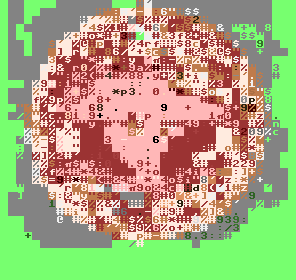
I’ll be making all the game’s art using JP LeBreton’s awesome ASCII art tool EDSCII. The disjointed art style you can see dotted throughout this post is roughly what I’m going for, with minor or major changes depending on things look down the line. But expect the game’s art to be rather minimal – this is a text-based game at heart, and the writing will take centre stage.

Intentions for the game: I want to make a game that’s about exploring a strange new fantasy world without having it all be about biffing orks and giant rats in the face. Relic Tycoon is basically an excuse to build an interesting world that the player explores through unconventional means. But that exploration will be conceptual rather than geographical. Relic Tycoon is a game where you explore a brave new world from the confines of your offices above a pub. And, occasionally, the pub itself.

I want the game to be very open in terms of player choice. Relics can be researched, played with, broken, combined with one another, occasionally melted, or donated to the local museum for societal favour and a smug sense of self-righteousness. One playthrough of the game will be entirely different from another – not because I demand that everyone plays the game dozens of times, but because it’s a game about discovery, and I think it’ll be more interesting if your decisions are the driving force behind those discoveries.

Anyway, I’ll finish off for now. Like I said, more updates and more information soon. Hopefully every fortnight. Now, here is a picture of my face made in EDSCII:

portrait1

Posted in My Games, Relic Tycoon Development Blog | Tagged , | Leave a comment

Sorted, Mate: A Foreigner’s Guide to Japanese Communal Baths

I recently went to a sentō (a Japanese communal bath) for the first time. I went to Funaoka Onsen (‘onsen’ meaning ‘hot spring’ in Japanese, though it’s often just used as a synonym for sentō), in north-western Kyoto. And while it was a fun, relaxing experience, it was sometimes a little confusing. There are some unexplained rules and customs, and as a foreigner it can be difficult to know what you are and aren’t supposed to do. That combined with the fact that few westerners have any experience whatsoever with communal baths means that the whole experience can be something of a trial by fire (or should that be ‘a trial by water’? (no pun intended)). 

Luckily, I navigated this ablutionary minefield so that you don’t have to. Read on for my How To tips on successfully going to a Japanese communal bath with your dignity intact. That’s right – it’s time for another edition of Sorted, Mate.

All the following tips are taken directly from my own experience at Funaoka Onsen, so I think they’ll be especially helpful and applicable to your own first experience, wherever or whenever that may be. However, as most sentō are segregated the applicability of some of these tips will vary based on your gender.

1. DO immediately go into the wrong changing room

If you’re heading for the changing rooms and you see two doors: one with a pink sign and the other with a blue sign, both featuring identical Japanese writing (neither featuring the kanji for man or woman), you may feel some doubt as to which one is the correct changing room for you. If the man at the counter then turns to you and says “Pink is for men” you may start to question him. But it’s extremely important that you just go with it: I did, and I can tell you that that moment of ignorantly stumbling into the wrong changing room is an important foundation for any sentō experience.

2. DO identify the oldest, frailest man in the changing room and fixate on him as a symbol of your own inevitable mortality

In any sentō experience you’ll be sharing the baths with a large number of old men. It’s important that as soon as you enter the (correct) changing room you identify the most existentially terrifying old man and fixate on him for a good couple of minutes. Bonus points if, when you accidentally but inevitably see them while they’re fully undressed, they not only look like they’re falling apart in a very real physical sense, but that their clothes were the only thing ever holding them together in the first place.

It’s very easy to forget, but any good bathing experience should be first and foremost a memento mori.

3. DON’T forget to wash yourself before you get in the baths

Once you’re fully undressed (no swimming trunks allowed) you can make your way into the baths proper. But you’re not supposed to get into the water immediately. Japanese custom is to wash yourself down before getting in the baths, so that no dirt or grime gets into the water. It can be a little difficult to know exactly how to wash yourself properly, but fortunately tip number 4 will sort you out:

4. DO blindly copy what other people do like you’re in some kind of cargo cult

You can bet that the Japanese people using the baths will know what they’re doing. Therefore, the natural solution to most problems you’ll have in the communal baths it to copy whatever it is someone else is doing, even if you can’t fathom the purpose. Are they cleaning themselves in front of a big sink? Why not do that? Are they putting their little towel on their heads when they get in the water? Sounds like a plan. Are they getting into a pool of water without checking how hot it is first? Well…

5. DON’T test the temperature of different pools before you get into them. Are you some kind of wuss or something?

Just get in the water. Just do it. It doesn’t matter that it appears to be literally boiling. All the pools in the sentō are different temperatures. The point is to pick one at random and hope it isn’t hot enough that it melts your dental fillings.

6. DO drop your towel into the water and then pretend like you didn’t

You only get a little towel to dry yourself off with, and you’re supposed to carry it around with you. While you can put it to the side when you get into one of the pools there aren’t many dry places. Most people fold their tiny flannel-like towels and put them on their heads. As this is all new to you you may not be confident that you won’t drop it into the water. Repress that thought.

You will drop your towel into the water at some point. It’s inevitable, and it’s part of the fun. But people will definitely not notice if you quickly flop it back on your head and act like nothing happened, even as the residue water drips down your face.

7. DON’T have a tattoo

Japan has something of a problem with tattoos. Tattoos are still largely linked (at least in the popular consciousness) with the Yakuza – the Japanese mafia, and even foreigners with visible tattoos may be asked to leave certain public establishments. This is especially true in sentō, where every tattoo is a visible tattoo.  

8. DON’T show the guy with the giant, probably-Yakuza back tattoos how nervous he makes you

Remember: Yakuza members are more afraid of you then you are of them. While eye contact is usually seen by Yakuza as a sign of aggression, a big, welcoming smile and a thumbs up do wonders at letting them know you’re not a threat. This is especially applicable in a public bathhouse.

However, if you do think you’re in danger you need to be very careful. Don’t make any loud noises or sudden movements. Stand your ground – if you run away they’ll see you as prey and start the chase. Try to make yourself appear bigger than you are.

9. DO walk into the sauna and immediately sit down on the bare stone bench, no matter how hot it may be

Saunas in sentō are sometimes far, far hotter than the saunas you may be used to in the west. It might even make you feel like you’re going to faint from the heat. The solution to this is to pretend that you’re fine. Sit down and nod at the old man sitting across from you. Try not to think about how the stone bench is searing your flesh. Even after you realise that there are foam pads you’re suppose to sit on keep sitting on the stone as if you meant to do that in the first place. If he chuckles at you under his breath it’s probably because he’s incredibly impressed at your resistance to heat. 

10. DON’T worry. You’ll do just fine.

It can be a little intimidating. Everyone’s naked. You’re naked. But everyone’s in it together, like some kind of naked tontine. You may feel embarrassed, or you might be sure that you’re going to break some delicate rule of propriety, but don’t let that nervousness stop you from experiencing a sentō. It’s a fascinating cross-cultural experience, and so long as you follow these important tips you won’t do anything embarrassing. Or at least you won’t realise that you have, which is very nearly as good.

Posted in Japan | Tagged , , , , | Leave a comment