Announcing: BiblioTech/PortFolio – A New Game Side Project (Part 2)

(welcome to part two of my announcement of my new side project, tentatively codenamed either ‘BiblioTech’ or ‘PortFolio’. If you haven’t read part one year, you can do that here. In this post I’ll write a little bit more about the plan for development, and I’ll explain why exactly I’m announcing this game right now.)

the pentateuch

The Plan for Development, and Why I’m Announcing This Now:

Development on this side project isn’t going to start until at least April. Even then, it’ll be a very slow, very-very part-time thing, as I focus on The Red Market.

So why am I going to be working on this at all? And why am I announcing it now?

Well, The Red Market is great, but at the moment I’m primarily working on it as a piece of text-only interactive fiction. The goal is to eventually remake it as a fully graphical game, but I’ll need to improve my programming/Unity skills a lot before that’s possible.

So in the meantime, I’ll be working on this side project as a way of learning, and improving those necessary skills. I don’t just want to sit there and work my way through tutorial videos (though I’m sure there’ll be some of that too) – I want to learn by doing. As such, there’s absolutely no predicted release date for this project. It’s 100% ‘see how it goes’.

the fifth book of wonders

But why announce it now if there’s not going to be anything to show for such a long time? Well, uh, to be honest I’ve been thinking about and planning this game for about six or seven months, and then a couple of weeks ago the amazing Weather Factory devs semi-announced a follow-up to their game Cultist Simulator where you play as a librarian, and ‘books arrive in your occult library and you just examine, catalogue and arrange them, then provide them to visitors’.

When I saw Alexis Kennedy writing about this game I thought “Ah, bollocks”. It actually doesn’t seem all that similar to my idea, apart from the basic concept of ‘you deal with rare books and give them to people’, but considering (a) I’ve always been very influenced by Kennedy’s games, and (b) I internshipped and then worked at Failbetter for a very brief period when Kennedy was still CEO there, I started to worry.

So, while I’m still going to work on this game, I figured it would make sense to announce it sooner rather than later, so that when people inevitably say ‘oh, you just copied Weather Factor’s idea’ I can point them to this blog and say ‘Actually, Ithinkyou’llfindIhadtheideamonthsbeforetheyannouncedanything’ and that’ll shield me from all negative comments and interior feelings, obviously.

the black book of magic


Anyway, that’s all from me today. There won’t be a regular dev blog for this game – at least not for a long while. But I hope it sounds interesting to you, intrepid reader. If you want to follow updates on The Red Market you can hit ‘Follow’ at the bottom right of this blog. And if you want to follow me in general, you can find me on Twitter here.


Posted in BiblioTech/PortFolio, My Games | Tagged | 1 Comment

Announcing: BiblioTech/PortFolio – A New Game Side Project (Part 1)

As you may know, I’ve been developing a game in my spare time. If you don’t already know about my game, here’s a quick elevator pitch: The Red Market is a narrative monster hunting game where you track down strange and wonderful creatures, then asell them for a profit/cook them into a horrifying stew/release them into the wild/be consumed by them bones and all.

You may like The Red Market if:

  • you like story-heavy games like Sunless Sea and 80 Days
  • you’re interested in folklore and mythology and strange monsters hiding under your bed
  • you don’t mind being mildly scared and/or spooked

(You can play the in-development version here)


Anyway, I didn’t bring you here to pitch The Red Market at you. I brought you here to pitch a new game at you. I came here to announce a new side-side project, (don’t worry – The Red Market is still my primary project, as I’ll explain in Part 2, coming later today) that I’m tentatively code naming either ‘BiblioTech’ or ‘PortFolio – Rare Books for the Startup Age’.

Look, I know they’re not great names, but I’ll almost certainly (maybe) come up with a better name long before release. For now, let me explain the game:

gospel, acts and epistles lectionary (ms1194)

BiblioTech /PortFolio:

is a 3D first-person game about sourcing rare books from decrepit old libraries and selling them on to fabulously wealthy customers. You play a loyal employee independent contractor with pension and generous benefits absolute job flexibility, working for a new tech startup dedicated to ‘taking the stress out of building your rare book collection’.

Set in modern-day Britain, the game sees you scouring estate sales, bankrupt book shops, and funding-starved public libraries for books, having tea with your wealthy customers, (make sure to laugh at all their jokes – gotta keep up those 5-star reviews!) and trying to connect the right customer with the right book for massive modest profit.

The Hunt for Rare Books:

Players will explore simple 3D levels to search for rare and valuable books on shelves/in display cases/hidden away under floorboards, then return them to your shipping box, all under a strict time limit. Not going to make it to the shipping box in time? Throw that book as hard as you can and hope it lands true. (Any books not landing in the patent-pending BiblioTech / PortFolio padded shipping container will likely become damaged, and your negligence in this matter will result in your pay being docked)

Do you take the time to read through the books you find, and get a better idea of who will pay top dollar pound sterling for it, or save time – just skimming the title and blurb, and hoping for the best? Time’s ticking down, and there are other distractions and obstacles in the buildings you explore:

  • Avoid leaking ceilings and creeping damp, or else your priceless books may become damaged, losing collector value
  • Navigate around nosy butlers, who will insist on serving you tea and biscuits (and wasting precious seconds)
  • Keep your footing on those just-waxed floors…
  • And more – each building you visit will have its own twists and challenges

the voice of the silnce being extracts from the book of the golden precepts

Something Approaching Leisure Time:

When you’re finished with your shift, you can spend your precious evening hours reading through some more of your finds, allocating who to sell which books, making social calls to your illustrious customers, or even engaging in hobbies for their own sake. (yet never escaping that nagging feeling that you could – you should be doing something productive right now)

Create Your Very Own Independent Contractor:

New members of the BiblioTech / PortFolio family are invited to take a mandatory Personality and Private History Test. This will let us know about the unique skills you can bring to the team:

  • Were you the Speed Reading Champion of North Lincolnshire (1998-1999)? Save time on your shifts and read those pesky books much faster.
  • Did you set your school’s Sixth Form shot put record? Hurl those books further, harder, and with more accuracy.
  • Did you study the classics at Swansea University? You’ll find those Latin texts much easier to deal with.
  • Did you apprentice at a builder’s firm just before the financial crash hit, leaving you out of work? You’ll find it easier to discover hidden alcoves and rooms hiding valuable books, and you may even be able to fix that persistent leak before the room is flooded and all the nice books get completely ruined.

a new light on the renaissance

Meet Your Customers:

As you deal with your customers you’ll learn more about them, and have a better idea of what books they will and won’t like.

Here are some customers you might meet:

  • Cardinal Wolfram – an avid collector of apocryphal Christian texts. (but make sure not to try selling him anything outright blasphemous)
  • Matilda Oubliette – an up and coming painter with a hidden interest in the occult.
  • The Florence Institute – a Christian sisterhood dedicated to the spiritual education of the children under its care.
  • Tomoka Matsunami – the cooped-up daughter of an eminent diplomat, who’s absolutely desperate to read about that wide world just beyond her reach.

Pour Over Strange Tomes:

As you work you’ll encounter countless new books to read. These won’t be long text-dumps, though. Instead you’ll read them in parts – one intriguing snippet at a time. (think more Dark Souls item descriptions than Skyrim books) Or ignore the reading all together, and just focus on the finding and the selling and the polite conversations over lunch.

Here are just a few of the books you might find:

  • The Bronze Bull of Praha (in the original Czech)
  • The Earth: Definitely Not Flat?
  • Tombs of the Pharoah: Caroline Epping, Her Work, and Her End
  • All Quiet on the Western Bundt: 100 Baking Recipes for the Modern Home
  • Peeling Back the Caul
  • The Learned Goose, and Other Clever Beasts
  • An Illustrated Children’s Hagiography (Saints N-S)
  • Febrile Waters: Sightings at Night in the Black Sea
  • A Full and Frank Encyclopaedia of Bee Law From the Roman Age to the Modern

And more…

online catalogue


That’s it for now. You can read part two of this post here. There I write a little bit more about the plan for development, and why exactly I’m announcing this game right now.

In the meantime, if you want to follow updates on The Red Market you can hit ‘Follow’ at the bottom right of this blog. And if you want to follow me in general, you can find me on Twitter here.

Posted in BiblioTech/PortFolio, My Games | Tagged | 1 Comment

The Red Market Dev Log #10: The Bishop-fish Approaches

In today’s fortnightly dev log: a bit of information on the next update for The Red Market, and the strange new monster that update will bring.

Hi! Long time no see, right? Sorry about that. I took the first two weeks of January off, and probably should have mentioned exactly how long I’d be away. But I’ve been hard at work these last two weeks, and we’re nearly there on the next big content update for The Red Market. So let’s talk about that for a bit…

The Bishop-fish Update:

bishop-fish

The bishop-fish, as featured in Johann Zahn’s 1696 work Specula physico-mathematico-historica notabilium ac mirabilium sciendorum. Truly one of the underappreciated classics of 1696 Speculative Zoology.

The next update will bring a new monster for you to hunt down: the Bishop-fish! Loosely based on the real-world mythological Bishop-fish, this disconcerting mix of human and fish parts was one of my favourite things to write in The Red Market so far:

“Then, slowly, a small form crests the surface of the water and you find yourself eye-to-eye with a man’s face. Or rather, a fish. Or rather, a fish with the eyes and face of a man. Its mouth is below the water, murmuring silently.

A fin moves, articulating in parts like the digits of a hand.”

The Bishop-fish is also kind of a mission statement on what I want the game as a whole to be: a set of simple game mechanics hiding countless little secrets. You can find the Bishop-fish, bring it home, then sell it off for a profit quite quickly and easily. But dig a little deeper and you’ll find loads of extra things to do with this horrible little monster.

Hiding Secrets In Your Game:

One of the big things I’m trying to do with The Red Market is make secrets actually secret. That’s kind of tricky to do in a (non-parser) text-based game.

In a traditional graphical game you can make secret areas, or have mechanics interact in cool, unexplained ways.

In a parser-based game (i.e. games where you type out what you want to do, rather than select from pre-written options) it’s similarly easy to hide secrets for the player to find: if the player never thinks to ‘USE MAGIC KEY ON TABLE’ not only will they never see all the amazing magic-key-on-table content you wrote, but they won’t even know it exists.

But with choice-based games (like The Red Market) where everything the player can do is visible as a selectable option, it’s much harder to make things secret. If the player sees the giant button labelled ‘USE MAGIC KEY ON TABLE’, they’ll immediately think “Well, I guess something happens if you use the magic key on the table for some reason.” What happens when you use the magic key on the table may still be interesting, or funny, or useful, but it’s no longer surprising.

the_sea_monk-1

More good pictures for you to enjoy.

There are plenty of tricks to make secrets actually secret in choice-based games, but one of the things I’m trying to do is to give player a bunch of default always-available options, and hide the interesting secrets behind those options.

Say the player has the magic key in their inventory. Instead of a ‘USE MAGIC KEY ON TABLE’ option appearing whenever they approach the table while holding the magic key, there’s an option called ‘USE AN ITEM’ that allows them to select from any item they’re currently holding, even if using it on the table does literally nothing. This option appears any time they approach any object in the game, so instead of immediately being shown exactly what they can do, the player has to think: “Which of my items might be useful right now?”

Suddenly ‘USE MAGIC KEY ON TABLE’ becomes something the player will only do if they heard about the magic table from the wizard in the previous dungeon, or they remember that the person who gave them the key mentioned something about tables, or they just get a really good hunch.

image-1

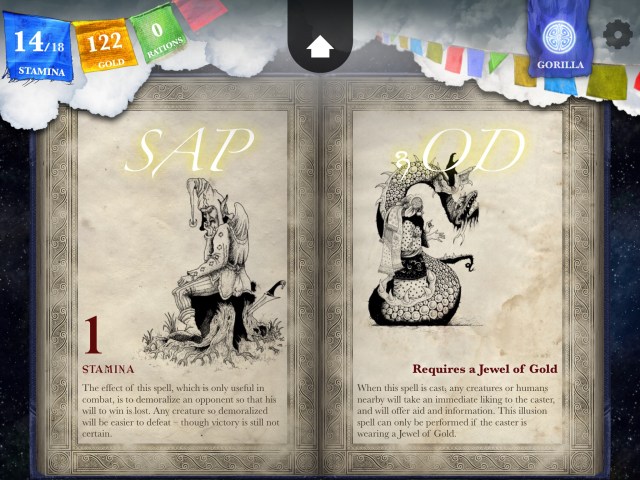
The spellbook in Inkle’s Sorcery! series. 10/10 good stuff here.

Inkle’s wonderful Sorcery! series of games does this so well. By giving you dozens of spells, and then allowing you to select which ones to use in a given situation, it means the player is constantly thinking ‘which of my spells would be useful right now?’, which allows for both rewarding creative thinking on the part of the player, and lots of fun little secrets to discover.

Maybe casting a fireball opens a hidden passageway. Maybe casting ‘speak with animals’ will allow you to talk down the angry snake. You’ll never know until you try. And suddenly the world feels alive with possibilities, and you feel creative and smart and devilishly good-looking for finding them.

Hopefully The Red Market manages to capture some of this same magic. It’s a game built from the ground up to be about finding secrets. Sometimes just to see something cool, and sometimes because those secrets can be exploited to your advantage. The ‘replay the game several times, steadily building up knowledge of how to turn every situation to your advantage’ mechanic that will eventually be included is also very important to this sense of secrets hiding just beneath the surface. (and is also lifted almost wholesale from Inkle’s incredible Sorcery 2, as it happens)

495px-japetus_steenstrup_sea_monks-1-

A third and final picture of these good wholesome animal-men.

I’ll talk about that time-rewind mechanic in more detail in a later post, as this one is already far too long. Next time, though, we should be talking about the Bishop-fish update in a bit more detail. That update should (barring death or other disaster) be launching in two weeks.

Talk then!

Nick

(And remember, you can follow me on the dystopian hellsite Twitter by clicking here. The current early version of The Red Market can be played online here, if you haven’t already.)


Posted in My Games, The Red Market | Leave a comment