I’m not convinced there’s a better way to start this review than by stating my opinion outright: Spec Ops: The Line is one of the most important games of recent times. It has its share of problems, sure, but it does what pretty much no game revolving around war and killing has ever done – it says something about war, something about killing. It tells the story of good intentions getting corrupted, of men falling apart in the crucible of combat, and it takes you, the player, and makes you complicit in what ensues.
We enter Dubai, months after violent sandstorms killed thousands and cut off all contact to the outside world. A detachment of the US army, led by one Colonel Konrad, went in to keep order and save the city, but six months passed without any news. Finally a radio message is intercepted, detailing a failed and bloody attempt to evacuate the city, and with this the US sends a Delta force team in to find out what happened.

I won’t delve into specifics, but as Captain Walker, the leader of the three-man squad, you discover chaos in the city – failed martial law, summary executions, the US military fighting civilians, and the US military splintering into factions and fighting itself. Throughout the game Walker and his squad, and you the player, fall deeper and deeper into the mad logic of this post-disaster Dubai. Walker’s sincere desire to help gets warped and damaged. Atrocities are seen, atrocities are committed, and through circumstance his – your – attempts to save lives and bring Konrad to justice lead to nothing but further suffering.
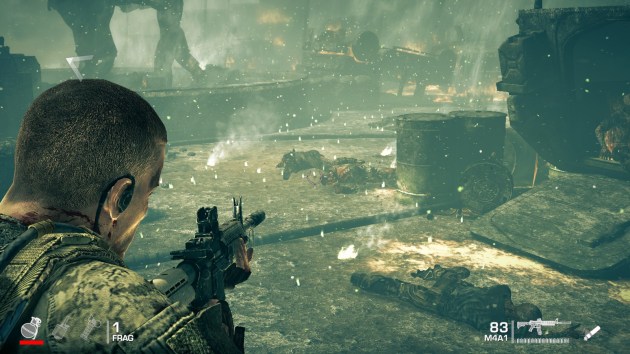
It plays as any other third-person military shooter, with a fairly robust cover mechanic and the ability to occasionally give your squadmates cursory commands. As a third-person shooter it’s more workmanlike than anything, and the tight, well-paced skirmishes of the early game eventually give way to larger, messier, and far less well-structured encounters. If you take it as a regular third-person shooter you’d be right in thinking that it does little that’s really interesting. But if you play through Spec Ops: The Line and take it as a regular third-person shooter you’d be missing the point to such an extent that it’d be like reading Animal Farm and seeing it as nothing more than a weird story where farmyard animals kick the shit out of each other for a hundred pages.

Spec Ops: The Line never tries to be an exciting, revolutionary take on the act of shooting people in a modern military setting. Instead, it’s attempting to make a statement, both about warfare and about the people who play violent games about warfare. In other words, people like you and me. Perhaps Yager, the development team behind the game, didn’t have the funds or the technical capacity to make a game that rivalled the top shooters on the market and so tried to do something different in order to stand out. That would explain the somewhat lackluster handling of the later, more complex set-pieces. Perhaps if they had had all the money in the world they would have made it exactly how it is now. I don’t think it really matters. What matters is that Spec Ops: The Line is a deliberately unsatisfying thing.
As the game progresses and the story becomes more unhinged, with Walker’s situation becoming more desperate, the balance of the game’s combat shift accordingly. Fights become more and more chaotic and drawn out, with more and more enemies swarming you mercilessly. Encounters become chaotic, and increasingly difficult for the player to contain. You often fail to get this kind of ludonarrative consonance with shooters – they often use smoke and mirrors to give the impression of chaos while facing the player with much the same challenge as before. This isn’t anything like that. This is a crack team of soldiers getting caught in a warzone, getting separated, fleeing blind through sandstorms, being surrounded, and lashing out like the vicious, cornered animals. As the story degenerates and Walker’s team becomes increasingly fractured the game you’re playing, not simply the game you’re watching in the cutscenes, changes.

I said it gets messy and unsatisfying, and it does. And while it sometimes does get frustrating as you’re killed over and over again, that’s not the kind if unsatisfying that I mean. By ‘unsatisfying’ I mean that there’s no smooth progression of mechanics, no satisfying interplay between steady empowerment of the player and steady ramping-up of the difficulty of the game’s encounters. Instead, during combat you face increasing chaos – draining, unfulfilling chaos – just as the characters in the cutscene do. And eventually you look back and you realise that everything has changed – in mere hours, and almost without your noticing, those quick, clean skirmishes have given way to featureless bloodbaths, and your once-disciplined soldiers, including Walker himself, are roaring in atavistic rage as they pull the trigger.
You’ll do horrible things in this game. You can’t not – you literally can’t choose to avoid willfully committing atrocities if you want to continue playing. Sometimes you’ll be given choices, though the morality of your actions here is neither black and white nor shades of grey – it’s nothing but black and black almost all the way through. Sometimes you won’t be given choices, and you’ll do what the game tells you to do only to get that thrown back in your face. Some critics have said that this is a mistake – that the game shouldn’t force you to commit a war crime and then shake its head at you for doing so. I disagree, about as strongly as I can, for two reasons: first, because this is the story of a man, Captain Walker, and his choices. And despite how most people seem to be taking Spec Ops as solely a commentary on videogames, this story is important and groundbreaking even when entirely divorced from any such commentary. Second, because even if you take the game as solely a commentary, the moments where the game forces you to act are important to the point that it’s trying to make.

These moments, and others beside them, point right at contemporary shooters. Spec Ops: The line asks you, tells you, and sometimes outright forces you to do terrible things. And when you do terrible things it shows you the consequences – from the innocent person you killed in a moment of surprise to the man shouting at you, calling you a murderer and trying to shoot you as if you were a rabid dog. All along the game asks you why you’re doing any of this, why you’re still playing a game where you do these kinds of things, where you’re forced to do these kinds of things. Why you play games like Call of Duty, Medal of Honour, and Battlefield, where remarkably similar things occur, only without comment on the consequences
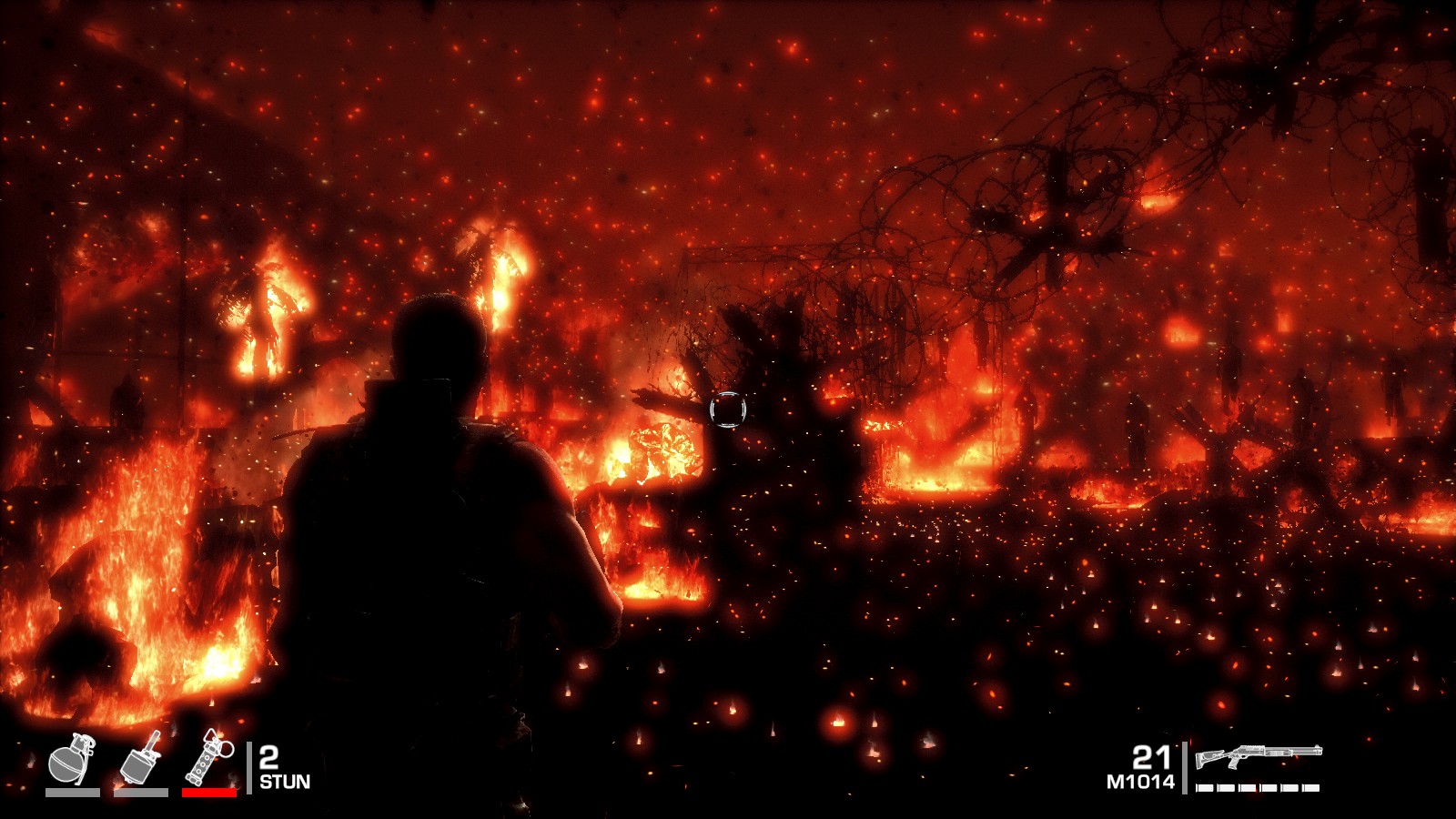
The game’s aim, as well as I can make out, is to do pretty much the same thing as these big-budget, mainstream, hugely popular games do while stripping out all the glossy emphasis on violence, all the jingoism and the dehumanisation of an enemy portrayed almost exclusively as nothing more than mindless Russians, or Arabs wearing face-masking headdresses. And by doing this, by forcing you to commit war crimes, Spec Ops: The Line holds a mirror up to these games that thrive on consequence-free player-led violence and atrocity. Here the game tells you to do the same kinds of things as other games, but for once you’re deliberately shown the consequences of such actions. In the way it treats you after the fact. In the way that the people you’re shooting at are American soldiers and starving, desperate refugees. In the way that Walker, at first clean and professional, slowly turns into something scarred, burned, and wholly broken. In the way that, just as shooters so often focus on creating beautiful, hand-crafted worlds in which you can do nothing but kill, all this horror is taking place in the opulent hotels, department stores, and rooftop swimming pools that make up the ruins of Dubai.
So it’s a game about shooters. But it’s also a game about the real world – about violence, warfare, and the corrupting influence of the two. And as with any piece of art dealing with topics like war massacre and crimes there’s a fine line to be walked between tiptoeing meekly around the subject and lighting up that subject with a dozen glaring floodlights. Spec Ops should be lauded simply for trying to walk this line at all, since few games, and almost no shooters, have attempted the same. But while the game largely succeeds, it does struggle with itself at times, especially towards the end. It does great things, genuinely great, medium-defining things, but those things are so challenging, and about such sensitive issues, that I’m pretty sure the development team started worrying about the whole thing.
There are times where the game loses confidence in its ability to get its ideas across, where it begins to worry that it’s being too subtle and, in trying to compensate simply belabours the point. A good example of this problem can be found in the game’s loading screens. At first they follow standard videogame conventions of giving snippets of backstory and recaps on your current objective (and by giving you basic instructions insultingly late into the game). But as things become more unhinged the loading screens start to actively goad you into thinking hard about what you’ve just seen, even going so far as to ask you questions like “Do you think you’re a good person?” And though it’s clear that these questions are aimed more towards Captain Walker’s cracking psyche than the player, at times like these you’d be forgiven for repeatedly saying “I know, I get it” aloud to their screen. The game gets its point across so well, so consistently that these moments, and a few moments like them, feel patronising – like the developers were worried everything might go over the player’s head and so did their best to be as obvious possible. Fortunately these few moments do little to impact the power of the rest of the experience.

But there are other moments where the game seems to be in conflict with itself. For instance, important details of the narrative are sometimes unclear on first telling – who’s who, what their motives are, and why they want Walker to do what they ask him to do – and an important twist (that works extremely well when properly explained) loses some of its impact because of this. Now, I’d argue that for its entire duration the game is being deliberately unclear. It’s obvious that Walker and company don’t really know what’s going on in Dubai, and a huge part of the horror that they encounter (and contribute to) results from this confusion. Mistaken identity, misplaced trust, and wildly inaccurate assumptions return as the cause of great tragedy again and again, and a lot of the confusion that you might feel comes as a result of this. The game even seems to take your hand and lead you into this maze in the hope that you’ll get lost. This deliberate muddying of the waters does conflict with the requirements of the narrative twist later in the game (which relies to some extent on a clear understanding of events) but it isn’t wholly a mistake on the game’s part. Because apart from a few missteps it’s employed for very good reasons.
It serves as a way of drawing you into the mindset of Captain Walker, of allowing you to to understand the logic behind his decisions and how his good intentions are warped by ignorance and misunderstanding. Some people have argued that Spec Ops: The Line is the story of an insane man coming to understand his true self, but I disagree – I think it’s the story of how circumstances can make men into monsters. I think the way the game portrays Walker and company’s early responses to the chaos around them supports that view – they’re not evil men, and they genuinely try to help. But they have little real understanding of what’s going on, and (at least in the beginning) that’s the driving force behind a lot of their harmful actions. These mistakes then snowball and lead to further harm. Soon Walker and his team come to understand what they’ve really done, and the consequences of those actions, and that knowledge starts to change them. Eventually they reach the point where they’ve killed so many men out of necessity – out of self-preservation necessitated by mistake after deadly mistake – that it starts to lose its meaning. They get tunnel vision, and all that starts to matter is finishing what they started – finding Konrad. They become so desensitised to the necessity of killing out of self-preservation that they become willing to make vast moral compromises – to do harm not to stay alive but for a greater purpose – to reach their goal. Finally, it’s the consequences of these moments of willful harm – with one action in particular acting as the turning point – that finally breaks them and sets them on the path towards madness.

And my god, some of these moments the game presents – the acts of moral compromise, the tragic mistakes, the instances of intense fear and chaos – are nothing short of stunning. The increasingly clear reflection of Walker’s face in a computer monitor during a willful infliction of evil. The mad rush into an incoming sandstorm. A moment alone, injured, and cut off from your team. The ending sequence that perfectly shows off the fierce intelligence behind the game’s writing, backed up by the incredible acting talent of both Bruce Boxleitner and Nolan North. And perhaps the most important of all – a moment where barely-contained violence threatens to spill over and change everything. These moments are without doubt some of the most important I have ever experienced in a game, and they are the game at its best – where the developers stand back and refuse to get involved, to comment, or to tell you what to do or think.
Play for long enough and you might find that the way the game strings these moments together makes it feel less like an interactive, narrative experience and more like a fever dream – one that’s so intense and so draining that you’ll sometimes wish it would just end. But it locks you in with Walker’s team and forces you to watch their slow descent into what can only be called madness, and could perhaps be called genuine moral evil. They get ground down until there’s nothing left, and only then does it end. Once you step away from the computer you may feel that it’s taken a fair amount from you as well. But while that feeling soon fades Spec Ops: The Line lingers in your head. Not just because of how uncomfortable and distressing it is, but because this is a game worth thinking and talking about for years to come. It’s lingered in my head for nearly six months now, and I’m not sure it’s ever going to leave.









 Haruspex Games