RPG Autopsy #8: Vampyr (Part Eight – Funeral Bites)

(Welcome to part eight of our mini-series on Vampyr. If you missed part one, you can find it here. Today we’ll be learning more about vampires, attending funerals, and confessing our sins.) 

83b13658f32fedd861793cb756f265895c63ec92

With Nurse Crane out of the way, we’ve finally solved Lady Ashbury’s blackmail problem – no longer will she have to fear anyone spreading rumours about her feeding on the hospital’s patients. Which, I’m sure you’ll agree, was worth turning Nurse Crane’s brain to soup, and completely gutting her clinic (you know, the one that provided vital medical services for the poor and downtrodden of London).

When we walk in to tell Lady Ashbury the good news we find her…feeding on one of the hospital’s patients. Reid acts bafflingly surprised, considering (a) she’s a vampire, and (b) Nurse Crane literally told us Lady Ashbury kills patients that’s what this whole thing was about Reid.

She tells us that she only feeds on those hopeless, already-dying patients, so it’s probably all fine really. At this point I trust her about as far as I can throw her, but she’s our only contact in the vampire world, so we can’t really afford to get on her bad side (also, Reid probably fancies her, because of course that’s a thing that’s going to happen).

42

Lady Ashbury, seen here drinking someone’s blood in a busy, crowded hospital, later lectures us  repeatedly on the importance of discretion.

In return for our efforts in clearing her good name, she gives us some important information about vampires, and this whole vampire situation we’ve found ourselves in. As always with Vampyr, these worldbuilding bombs are short, sharp, and genuinely interesting, and while I did sometimes feel frustrated when Reid decided not to ask some particularly obvious follow-up questions, this long conversation works well (it also helps that a lot of these points are things that we’ve seen hints of before, meaning this conversation feels less like a lore dump, and more like finding the answer to juicy mysteries).

She clarifies some things we’ve been guessing at, such as:

  • the nature of vampires (vampires as we know them = Ekons. Other species of vampires = exist. Skals = deformed offspring of ‘lesser’ vampires, that are ‘slaves to their base instincts’)
  • the Guard of Priwen (an ancient secret society dedicated to destroying all vampires, lesser now than they once were), and
  • miscellaneous vampire facts (vampires create new vampires by giving a mortal some of their vampire blood to drink, but it’s very frowned upon to sire new vampires without then showing them the vampire ropes, so Reid’s creator must be a bit of a dick).

We also tell her about the voice in our head, and ask if it might be the voice of our creator. She tells us to keep this a secret, as only Incredibly Powerful Vampires can telepathically speak to their progeny, and that means there’s an unknown Incredibly Powerful Vampire skulking around London (which is not good for vampire high society).
43

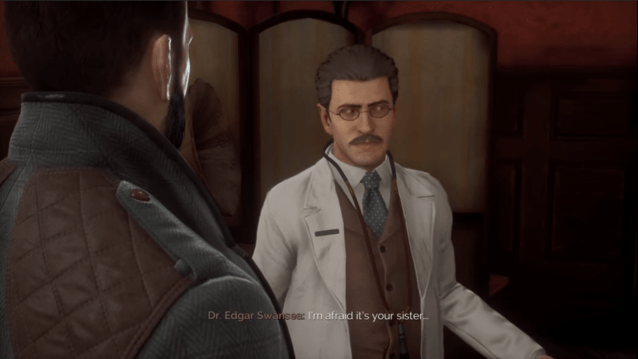
Dr Swansea breaking the news of our sister’s death to us, our sister’s killer.

After our chat, we analyse the blood we took from Nurse Crane’s patient, and learn that while he did have the Spanish Flu, his blood also had that same unstable nature we previously saw with Skals. Which makes sense, considering the epidemic seems to be creating lots of Skals. Like, hundreds upon hundreds of Skals on the streets of this borough alone. Has no one else gone outside recently?

We report our findings to Dr. Swansea, who, while intrigued, also has some bad news for us – our sister Mary is dead. We know this, obviously, since we killed her, but in something of a dick move, we don’t tell Dr Swansea (who seems very uncomfortable being the bearer of bad news) that we already know.  Regardless, the funeral’s being held soon at the local ceremony, and Reid decides to attend.

So we head to Stonebridge Cemetery, and fight half the population of London on our way there.

44

Don’t ever say this game doesn’t isn’t good at framing a shot.

I may have said it before, but this game really has a problem with this kind of thing. You’re constantly moving around the city between quests, and every time you do so you bump into dozens of enemies. Either you choose to fight each group you encounter (all of whom are incredible damage sponges on hard mode), which takes time and provides genuinely pathetic rewards (around 8xp for killing a group of enemies, in a game where the smallest upgrade costs 300xp), or you do the smart thing and just learn to run past them all.

THIS WEEK’S INSIGHTFUL GAME DESIGN LESSON: 

Every combat encounter in your game should be to a purpose. If a combat encounter is ‘give the player something to do while they’re travelling back and forth between quests’ then that combat encounter’s purpose is ‘wasting the player’s time’

Regardless of how interesting your game’s combat is (and Vampyr’s is B- for an RPG), your players will get bored of it after the fifteenth time they’re forced into combat on the way to their next quest.

By all means, fill your game with interesting, authored combat encounters, but there’s no reason to make players fight random goons over and over again. It’s not interesting, it wastes time, and it just makes your game world feel strangely small and artificial. 

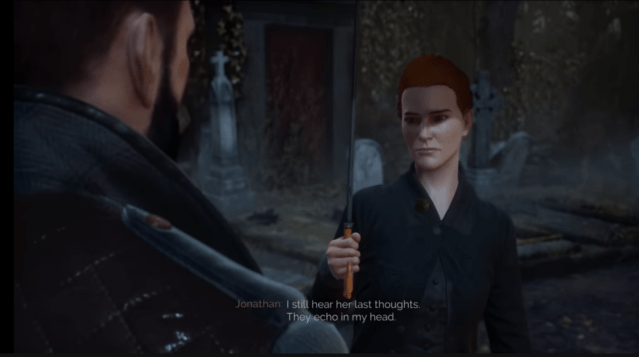
After decimating the population of London’s East End, we arrive just in time to pay our respects to our dead sister Mary – making sure to watch from afar, as Reid decides this probably isn’t the best time to let our grieving mother know we’re back in London.
46

Lady Ashbury tells us not to abandon our humanity, a few minutes after draining all the blood of her latest victim for her undead sustenance.

After the funeral, Reid heads to Mary’s grave and begins to half grieve, half beg his sister’s forgiveness for accidentally vampire murdering her. Almost immediately we’re interrupted by Lady Ashbury.

She warns Reid to hold onto his humanity, but she also warns us that our ‘enemies’ (!?) want us weak, and that we’re weakest when we’re consumed by guilt and grief. Continuing her attempts to tell us exactly how we should be responding to the death of our sister, she suggests we make a confession at Saint Mary’s Church (forgive me, but I think it might be a bit heavy-handed that the church shares Mary’s name).

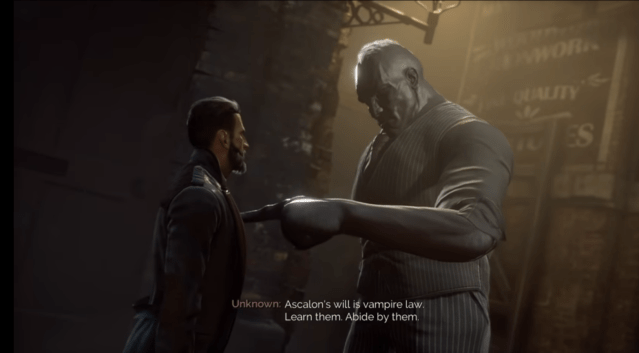
On the way to the church we’re accosted by a frankly gigantic grey man, who introduces himself by telling us we ‘reek of guilt and pointless compassion’ (again, harsh), and talks mysteriously of ‘Ascalon’ – a name we’ve heard before, but have no real context for just yet.
47

We’ll be seeing more of Big Grey Man later, don’t you worry.

After gently threatening us with a smashing if we don’t abide by Ascalon’s laws that we know nothing about and that he doesn’t explain, he vanishes into the night. Slightly shaken by our encounter with…whatever that was, we make our way to Saint Mary’s Church.

There, we talk to the vicar, and Reid kind of freaks out a little bit, immediately trying to back out of this whole confession thing. It’s a great scene, and Reid’s voice actor consistently sells his delicate, unsteady state of mind very well. It’s clear that not only is Reid struggling to deal with his sister’s death (and his own role in it), but that he also is having a really tough time throwing aside his sceptical, materialist worldview and opening up to the possibility of religious forgiveness.

48

Good stuff. Good lighting. Great nose.


Next week we’ll be continuing our investigation into the epidemic, and heading back to find out more at the docks.

For now, though – as always,  you can follow me on Twitter by clicking here. And if you like RPG Autopsy – why not be lovely by supporting me on my newly-opened Patreon?Alternatively, if you hate RPG Autopsy – why not spite me by supporting me on my newly-opened Patreon? Find that Patreon here.


Posted in Games Blather, RPG Autopsy | Tagged , , , , , | Leave a comment

Is the Indie Game Development Scene ‘Stagnant’? (and other questions whose answer is ‘No’)

download

A few days ago the website gamedaily.biz published an interview with veteran indie developer Jonathan Blow (best known for (a) 2D puzzle platformer Braid, (b) 3D open-world puzzle game The Witness, and (c) saying something mildly inflammatory on Twitter every 3-4 months). In it, Blow argues that, at least in terms of creativity and innovation, the indie game development scene is largely stagnant – “There’s a small number of people who I would say actually do creative stuff, but everybody else is trying to be like a cheap AAA game.” 

This has, predictably, caused a fairly big backlash on indie dev Twitter. Many people responded to the interview by posting examples of recent creative, innovative indie games (I’ll be doing the same throughout this post). Others responded by calling Blow willfully ignorant, disconnected from the indie gaming scene, and (again, predictably) a dick.

capsule_616x353

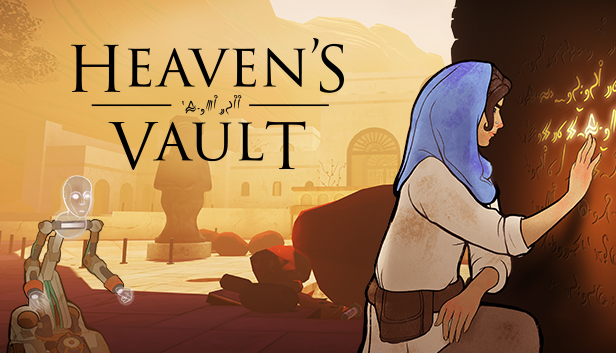
Heaven’s Vault (Inkle, 2019) – a game about archaeology and translation. Its way of handling and presenting information to the player, as well as turning translation of a dead language into a central game mechanic, are just about as innovative as games can get.

I should put forward right now that I disagree pretty strongly with what Blow said. But while I think he’s wrong, I don’t think what he’s saying is the result of willful ignorance, a disconnect from the indie scene, or being a dick. And while I’ve seen lots of responses to Blow’s claims, I’ve yet to see one that actually gives him the benefit of the doubt that he’s not either (a) an awful monster, or (b) an old man yelling at kids to get off his lawn.

So yeah, let’s do that.

I think Blow’s claim that indie games are largely creatively stagnant – either just trying to be follow market trends, or copying older games the developer really likes – is unfair, but I can kind of see where he’s coming from.

If you look at the vast wave of games being published on Steam nowadays, it’s hard for your eyes not to glaze over at some point. A while back I started following a Twitter account called Steam Trailers in 6s, which shows clips of the trailer for every game released on Steam. At first I was excited by the idea, but I quickly noticed that roughly 90% of all the games fell into two camps: ‘barely finished prototype; or ‘oh, it’s a RTS/deckbuilder/RPG, only the twist is that there are no twists’.

header (1)

Hypnospace Outlaw (Tendershoot, 2019) – a game about surfing the World Wide Web in your dreams, in 1999. The humour, creativity, and player freedom of its investigation-and-puzzle-driven world is really something special.

But “ninety percent of everything is crap” , so it’s hardly fair to judge all indie games by the hobbyist devs putting their first game project on Steam. What about actually finished, actually respected and (occasionally) actually financially successful indie games?

Well, again, while I disagree with Blow, I can kind of see where he’s coming from. I’ve grown increasingly wary of slick-looking indie games that slot easily into a specific, popular genre, because I often find them to be initially exiting, then deeply, deeply boring. More than once I’ve found myself playing the first hour of a 15-hour indie game, and realising: “Oh, the next 14 hours are just going to be ‘perform this same gameplay loop again and again while incrementally unlocking upgrades that marginally alter the experience’“.

A lot of indie games do chase market trends, and a lot of indie games are focused on making a fairly unoriginal gameplay loop as compelling as possible (while making sure the visuals/music/etc. are slick and enticing enough to draw attention), at the expense of doing something new or surprising. And that’s, well, fine. But there are so many games that are so much more.

There are loads of games coming out at the moment that are weird, creative, and innovative in a dozen different ways. So for Blow to make his claims that indie games are stagnant, he must either be so busy making his own game that he’s not paying attention what anyone else is making, or he’s working from a wildly esoteric definition of the terms ‘creative’ and ‘innovative’.

header

Pathologic 2 (Ice-Pick Lodge, 2019) – a reimagining of cult classic Pathologic. Ice-Pick Lodge are the masters of using sadistic, player-unfriendly gameplay systems to capture an atmosphere or dread and hopelessness.

A lot of people have said that Blow is ignorant of the current indie gaming scene, and that, as a member of the indie dev Old Guard, his perception of today’s indie games is unfair and unlikely to change. But while I think there’s a grain of truth there, I think the real reason for Blow’s claims of stagnation in the face of countless innovative indie games is that he has a weird understanding of what ‘innovative’ means.

Blow comes from a scene that values game mechanics, and mechanical innovation so highly it basically sees them as the be-all and end-all of game design (and gives little more than disapproving glances towards the term ‘story’).

His statements in the past pretty definitively put him in this camp, but we can also see it throughout this interview. Take, for example, his lauding of Stephen’s Sausage Roll as a shining example of modern game design (I’m not saying it’s not, just that it fits with the ‘a great game is a platonically perfect set of systems and mechanics’ view of games).

Also, just look at some of these quotes:

“‘…to make a game about some idea’ where ‘some idea’ is like a fiction idea, and it’s an idea that would have been better if it was a book, or film, or a song, and not a game. I think that happens a lot. For some reason nobody notices this problem or works on it. “

“Games are good at making settings, they’re good at establishing mood. What they’re not good at is plot, so why are we copying these storytelling structures that have plot?”

e5715d9664c39e1102c05847920307cf465bfbf2

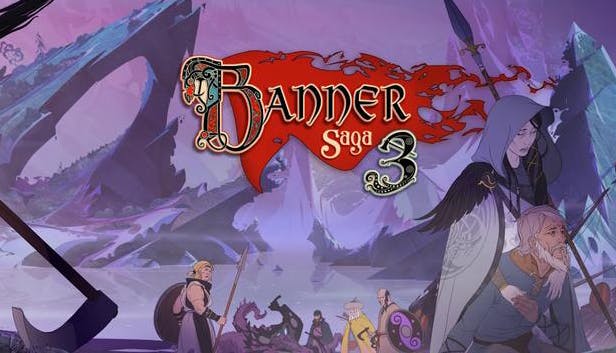
The Banner Saga 3 (Stoic Studio, 2018) – The final entry of Stoic’s epic, depressing ‘the world is ending but with Vikings’ saga. The way the series handles choice and consequence is worthy of study, and the combat system is really good I swear to god I will fight you all.

“For some reason nobody notices this problem or works on it.”

This is the point where I start to get genuinely frustrated with Blow, because it’s so tiring to hear people rehash this argument over and over again. I’m 100% done with people repeatedly claiming that games cannot tell stories well, and that anyone trying to crowbar stories into games is misguided – while every passing year sees the release of more and more games that tell stories really well.

The conflation of ‘games that are trying to tell stories’ with ‘games that are just trying to ape movies’ is also incredibly tedious. Games have made so much progress over the years at telling stories in non-filmic, ways – ways that are unique to games. Yes, we have David Cage and Naughty Dog trying to make interactive movies, but we also have The Void, 80 Days, Sunless Skies, Cultist Simulator, Ultra Business Tycoon III, Cart Life, Frostpunk, The Beginner’s Guide, etc. etc. etc.  – i.e. games telling stories of one kind or another through the medium of games, using the unique possibilities of interactivity to do so.

Blow seems so preoccupied with the concept of platonically pure and perfect gameplay mechanics – seeming to view innovation of purely mechanical gameplay systems as the only true innovation – that he ignores or dismisses the countless talented studios doing amazing, creative things in other areas.

Subnautica_Header-780x447

Subnautica (Unknown Worlds Entertainment, 2018) – Subnautica captures the feeling of pushing deeper and deeper into a terrifying, unknown world better than any other game I’ve played.

Inkle’s genuine, groundbreaking innovations in UI, dialogue flow, methods of displaying text, and the handling of information the player knows and doesn’t know – these all count as innovation.

Weather Factory’s work in making Cultist Simulator a game where figuring out how to play the game is 80% of the game is also unique and innovative, by any measure.

The way Mountains play with tiny fragments of interactivity Warrio Ware-style to tell the story of young love and heartbreak in Florence is a perfect example of mechanical innovation that I expect wouldn’t get a nod from Blow.

There are so many more examples of people doing genuinely innovative things in games that at this point it’s just boring and obviously wrong to claim that indie games are stagnating. Sure, a portion of the scene is focused on making slick, shiny things that aren’t particularly new or exciting, but there’s so much great stuff going on.

Hell, even if we take the overly narrow ‘mechanics and systems and innovation in that field only’ view, Blow is still wrong. Just look at recent mechanics-minded games like Baba is You, Return of the Obra Dinn, Engare, and the like.

C4JfoOrWMAAp5PO

A House of Many Doors (Pixel Trickery, 2017) – a Sunless Sea-style explore-and-story game set in a parasite dimension that steals things, people, and places from all over the multiverse.  Full of imagination, wonderful writing, and the best damn ending in all of games.

So, moral of the story? Some people have ultra-specific views of what games should be that can lead them to make claims that seem obviously true to them, but obviously wrong to others. If you agree with Blow, take heart in the fact that there actually are lots of modern indie games doing innovative work with game mechanics. If, like me, you disagree with him, then hey – don’t ever let somebody tell you what games should be.

Enjoy the games you enjoy. Make the games you want to make. And always remember – not engaging, and not getting angry with someone who’s wrong on the internet is a superpower we’re all blessed with, and should make use of more often.


If you’ve read this far – thanks! As always,  you can follow me on Twitter by clicking here. And if you like what I do, why not be lovely by supporting me on my newly-opened Patreon?Alternatively, if you hate what I do, why not spite me by supporting me on my newly-opened Patreon? Find that Patreon here.

Posted in Games Blather | Tagged , , , | Leave a comment

RPG Autopsy #7: Vampyr (Part Seven – Redmail in Redchapel)

(Welcome to part seven of our mini-series on Vampyr. If you missed part one, you can find it here. Today we’ll be messing up really badly, and then writing five hundred words about how it’s not our fault. Today’s post title is a play on the Vampyr chapter ‘Blackmail in Whitechapel’, because blood is red. I will continue writing these terrible puns – you can’t stop me.) 

83b13658f32fedd861793cb756f265895c63ec92

I finished last week’s post with some high praise, so in the interest of balance it’s time for some serious mud-slinging.

We’ve just discovered Nurse Crane’s secret medical clinic, and helped her in her (doomed) attempt to save a patient’s life, but now it’s time for the business that brought us here: her blackmailing of Lady Ashbury. 

Turns out Nurse Crane is using the blackmail money not for her own benefit, but to fund this very clinic. On top of that, she doesn’t actually know that Lady Ashbury is a vampire – instead thinking that she just murders patients at Pembroke hospital for her own sick enjoyment. But I suppose blackmail concerning non-vampiric murder is still pretty damning, so much as I (a) think a free clinic for London’s destitute is pretty good, and (b) trust Lady Ashbury about as far as I could throw her, we’re unfortunately not given the option of backing off and letting Nurse Crane go about her business.

Instead, the game gives us three choices for how to put a stop to Nurse Crane’s blackmail: (a) kill her, (b) let her keep her clinic but force her to leave Pembroke Hospital, or (c) use our vampire mind powers to make her forget all about Lady Ashbury:

39

With great vampire mind power comes great vampire mind responsibility.

I chose to use my vampire mind powers on her to wipe her memory of Lady Ashbury. It seemed like a no-brainer: let her keep working at the clinic (albeit with fewer resources) AND at Pembroke Hospital – just remove her memories of Lady Ashbury killing people. Win-win, right? Well…no.

What happens next was quite confusing – instead of making her forget Lady Ashbury’s dark secret, Reid decides to make Nurse Crane forget everything about not just Lady Ashbury, but also Pembroke Hospital and this free clinic of hers. Why? Well, I’m actually not sure – it doesn’t really make sense, and it’s certainly not what I imagined Reid would say when I moused over ‘You will forget all about this’ on the dialogue wheel.

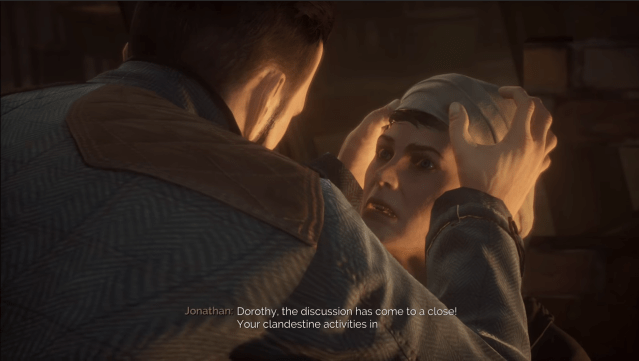
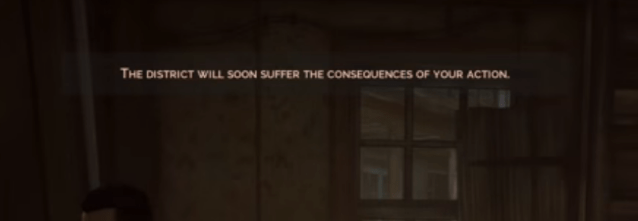
Either way, Reid attempts to mesmerise Nurse Crane, but she does her best to resist us, and when we’re done she seems confused; punchdrunk – barely able to speak. Just as I’m standing there wondering what happened, the following text pops up on the screen: ‘The district will soon suffer the consequences of your action’. Hmm…

When we next rest and level up, we find out that Nurse Crane has gone missing. Hmmmm……..

33

Reid’s acting as he breaks Nurse Crane’s resolve is top notch stuff.

I was really confused here. What did my mind powers do to her? Why only now, and not with other people I’ve used them on in the past? And why did she disappear all of a sudden? Well, spoiler alert: it turns out that using your vampire mind powers on someone who’s extremely strong-willed, and who attempts to resist you, can actually end up kind of sort of breaking their mind…permanently. Nurse Crane is extremely strong-willed – moreso than other citizens I’ve spoken to – and she did her best to resist me. Now her mind’s gone, and it’s not coming back.

How do I know this? Well, turns out there’s an optional note on a desk somewhere all the way back in Pembroke Hospital that describes this unfortunate possibility. Never having read that note, I didn’t know about the risk, and didn’t think twice before mesmerising Nurse Crane.

Now, this is a actually really cool idea – place optional-yet-important information around your game world so that diligent players are rewarded with all the necessary information they need to make good decisions, and the well-intentioned decisions of less diligent players end up backfiring on them without warning.

It also doesn’t feel like an unfair ‘gotcha’ moment for our mind powers to backfire here – these are magic vampire powers, and Reid became a vampire like yesterday. He still knows next to nothing about his condition, so of course there could be weird dangers he’s unaware of.

40

I messed up.

So this has all the ingredients to be a great twist-the-knife moment. Unfortunately the way Vampyr handles it is kind of terrible. I’ve already mentioned the problems with Reid’s decision to wipe so much of Nurse Crane’s memory, and it’s worth noting that this weird choice wasn’t even necessary for the moment to work – if Reid had just tried to erase her memory of the blackmail (like I assumed he would), the mind-breaking-vampire-power outcome would have been the same.

But the real problem here is that while it’s fine – and actually very cool – to punish a player for not exploring by withholding information necessary for certain story choices,  if you’re going to do that, the player has to understand that you did it in the first place. In other words, if the player doesn’t ever go on to learn about that optional, missable information they won’t know why the bad outcome happened, and they’ll just end up confused.

I never found the note that warns about the risk of breaking strong-willed people’s minds, so I really had no clue what happened. One moment I’m mesmerising people left, right, and centre – the next moment I’ve permanently broken somebody’s brain. And no one ever explains why.

It’s only after I read about this moment on the internet (while trying to figure out what happened) that I learned about the note. Once I went and read it on the Vampyr wiki I thought ‘Ohhhh, that makes sense. Damn, I should have been more careful.’. But unless the player happens to stumble upon that one note later on, or look things up on a wiki, Vampyr never gives them the context that lets them understand what exactly happened, and why.

41

We’ll find out what happened to Nurse Crane later, don’t worry.

If, for example, I had chosen to mesmerise Nurse Crane, broken her mind, and then later been told by Lady Ashbury or Dr. Swansea: ‘Oh, I guess you didn’t know about the risks of mesmerising strong-willed people. Well…‘, then I would have immediately thought ‘Ohhhh, that makes sense. Damn, I should have been more careful.’. Instead of spending the next few hours of the game frustrated and confused, repeatedly thinking: ‘I still have no idea why that happened’.

This leads nicely into…

THIS WEEK’S INSIGHTFUL GAME DESIGN LESSON: 

When you play around with how much information you give the player, you have to be extremely careful. 

When the player is making a choice it’s perfectly reasonable for the consequence of that choice to be unclear, but the choices should be clear as day. If the player has no idea what the player character will do when they select an option, you’ve messed up, and any potential emotional impact of the choice will be lost.

Similarly, if the player can make a bad choice because they lack information, you have to provide them that information later on, or any impact of that twist will be lost.

More generally, if you withhold information from the player and then use it against them, you have to make sure they understand that information was withheld. You have to provide the context they originally missed, otherwise they won’t understand that there was even context missing in the first place, and will just think the game is delighting in throwing arbitrary curveballs their way (in other words, if the player’s response to a bad outcome is ‘huh?’ you’ve messed up big time).

Imagine playing an RPG, and at one point one of your party members betrays you, kills another party member, and runs off. There was an optional sidequest you missed earlier in the game that would have given you a hint that they were actually a double agent working for your enemy, but you never found that hint. And then after they betray you they never show up or are heard about again. Think about how weird and confusing that would be.

Now imagine that after they betray you there’s a quest that re-shows you some version of that original hint you missed. It wouldn’t negatively affect people who found the hint originally, but it would provide crucial context for players who missed it.

Vampyr doesn’t provide that context for people who missed it the first time, and so the impact of this moment – this moment that should be amazing – is completely lost.

42

The kind Lady Ashbury.

Regardless, we leave the near-catatonic Nurse Crane, and exit the clinic. On the way out we’re waylaid by a gang of Priwen vampire hunters, but they don’t really put up much of a fight. It’s time to head back to Lady Ashbury and give her the good news that we destroyed a woman’s brain and doomed her many patients to various slow deaths. Read next week’s post to find out how that goes (I’m sure it will go really well).


For now, though – as always,  you can follow me on Twitter by clicking here. And if you like RPG Autopsy – why not be lovely by supporting me on my newly-opened Patreon?Alternatively, if you hate RPG Autopsy – why not spite me by supporting me on my newly-opened Patreon? Find that Patreon here.
Also, I’m going to be away in Kyoto attending BitSummit next week, so RPG Autopsy is going to take a week off. See you in two weeks time!

Posted in Games Blather | Tagged , , , , , | Leave a comment