Some thoughts on ‘End Boss’

End Boss - Title

So I made a game. It’s called End Boss, and you can play it here if you haven’t already.

It’s 5-10 minute long, and it’s made entirely of words. If you like words, or slightly disturbing themes, or things that are just 5-10 minutes long then give it a try.

If you’ve already played it you have a choice: either (a) go straight to the comments section of this post and angrily exclaim ‘It’s not reallygame though, is it?’ or (b) keep reading for a few of my thoughts on the game.
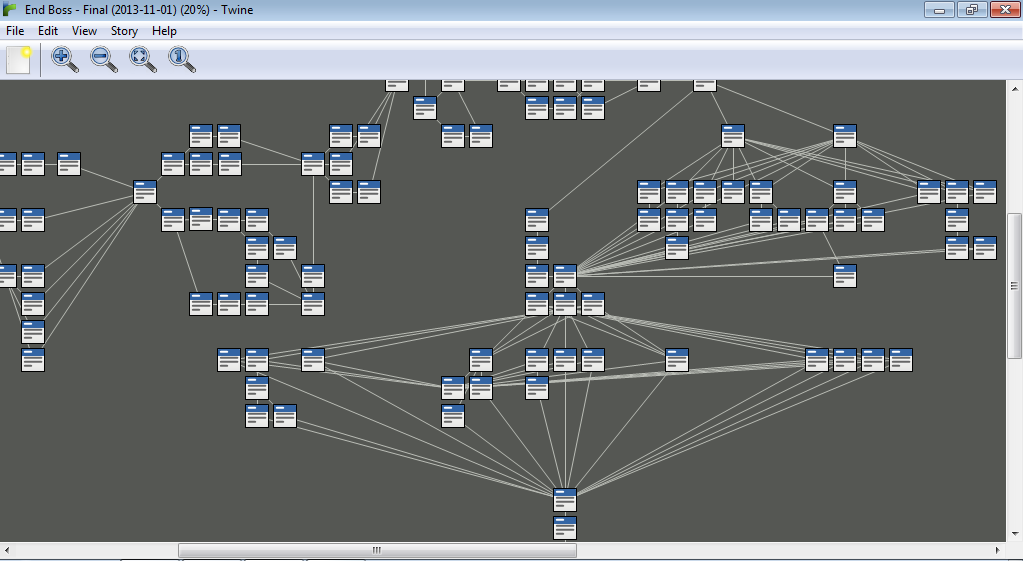
I approached End Boss looking to make a game about choice. You may be surprised to hear that, because as you can probably tell it’s a very linear game. The decisions you make don’t lead to loads of branching paths, or alter the game’s story in any real way. But that’s kind of the point – I wanted to make a game about choice rather than a game about consequence.

I feel like most games that purport to offer players significant choices only really offer significant consequences. The decisions you tend to make as a player are interesting because of where they lead – which character you save, which city you choose to visit – and not because the choices are meaningful in and of themselves.

What’s interesting, meaningful, important about the choices we make – where they lead us or what they say about us? Well both, clearly. Both are important, both are interesting, but games rarely put much emphasis on the act of choosing, so focused are they on crafting interesting consequences.
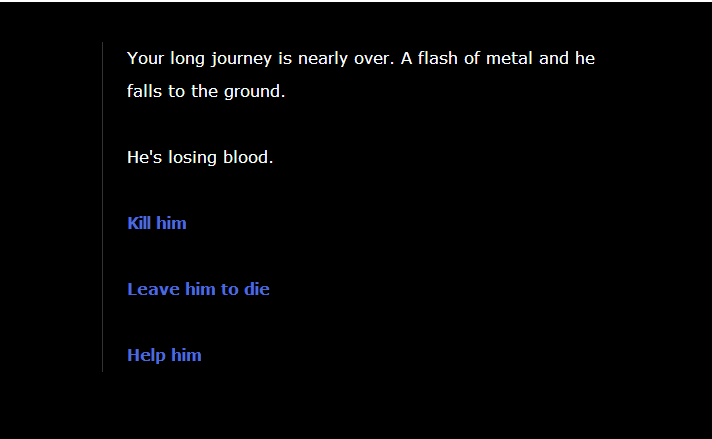
From a purely narrative standpoint, consequences are often what makes a choice interesting. But from a human standpoint – a character standpoint – consequences generally aren’t all that important. It’s the decision itself that’s of interest; the context, the thought process, the mistakes and the weaknesses and the sheer humanity that goes through our heads when we think desperately about what to do. Think Sophie’s Choice, think Breaking Bad, think Telltale’s The Walking Dead.

I wanted to make a game all about that moment of choice, one where the consequences of your choices are of secondary importance, or absent. entirely In the end I decided to make a game not about choosing to do something, but choosing why you did something.

End Boss tells you that your character some pretty awful things at some point in the past, and then asks you why. It’s not trying to make you feel personally bad for these things, because you – the player – obviously aren’t responsible. Instead it asks you to justify your character’s decisions as a way of building up your own personal narrative. The hows are unchanging, but the whys are up for grabs. Who is your character? Are they a cynical political manipulator? Do they believe themself to be a remorseless instrument of fate? Are they overcome with regret for their mistakes? Are they something altogether different, or more complex?
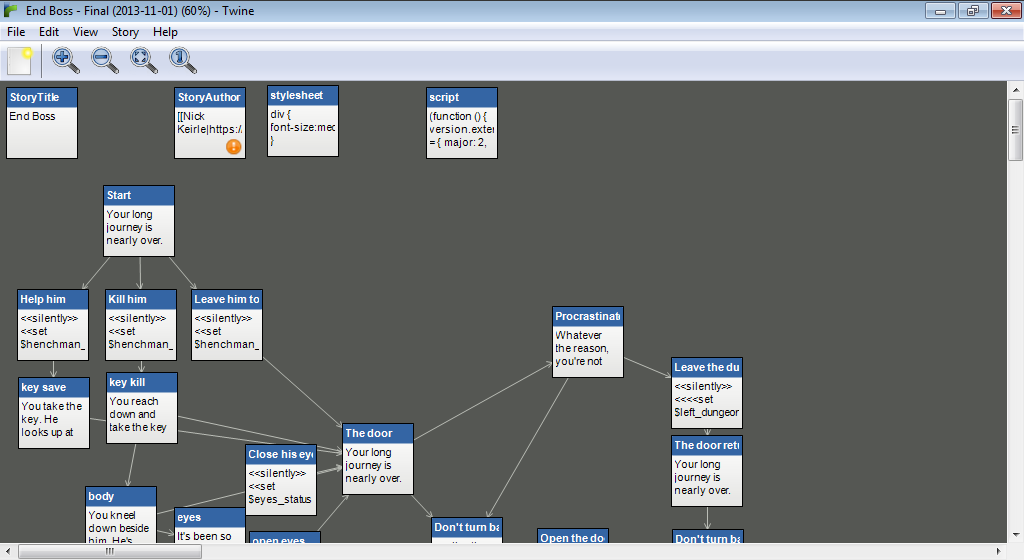
Your choices in End Boss don’t determine much of what happens, but as the game goes on they do give you a pretty huge level of control over who you are. Not because of what you chose to do, but because of why you chose to do it.

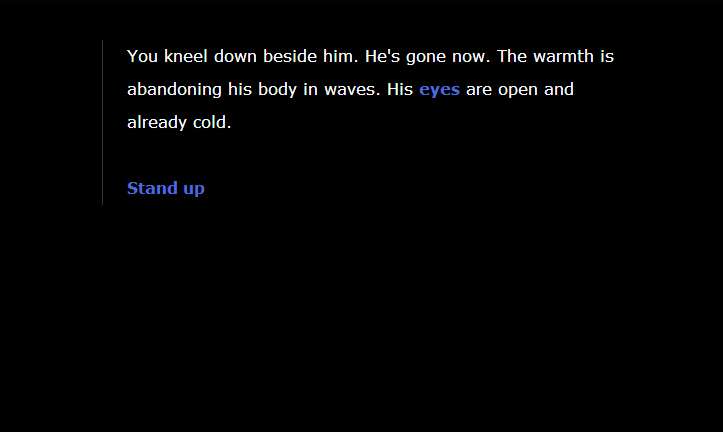
As a game it’s a reaction against the short shrift most games give to the act of choosing. You might notice that the only real action you can take in the game is deliberately given absolutely no context, and only really becomes meaningful later on, when you’re tasked with justifying the choice you made.

But the game’s also a reaction against the way morality is presented in most games. You don’t choose your moral alignment or lose Morality Points by stealing gruel from a cute little orphan child. You don’t have a binary choice between becoming a shining paragon of virtue and becoming the moustache-twirling CEO of BabyHarm Inc. Instead it tries to get you to play around in the spaces between wholly good and wholly evil, and to come to your own conclusions about who your character is.
Hopefully it works on some level, for some people. This is the first game I’ve made, and I knew that it was never going to be perfect. To be honest, I’m reasonably happy with it, even though it’s flawed, and the writing is scrappy, and it could be far better. But the core idea is solid, and I don’t think I did it too much of a disservice.

Well, anyway, I hope you liked it. Here’s to the future, and here’s to improving.

Posted in Games Blather, My Games | 7 Comments

The Eurogamer Expo 2013: The Show Floor

eurogamerexpo-logo1

The Eurogamer Expo of 2013 was far more my kind of thing than The Eurogamer Expo of 2012. The indie visibility was way up. The booth babes were gone. And there was so much raw, unguarded enthusiasm on display, both on the part of the developers and the players, that anyone would struggle not to get into the spirit of things.

Now, without further dithering, here are my thoughts on some of my favourite games of the show:

Myriad

Myriad took me completely by surprise. A twin-stick shooter, it quickly distinguishes itself from others in the crowded genre in two main ways: (1) visually, it’s like nothing you’ve ever seen – all pastel colours and chaotic exploding shapes, and (2) You don’t just move around, shooting at enemies. You can also take control of enemies and parts of the environment, moving them around the screen to relocate dangers, shift obstacles, and more.

It’s a little hard to explain, partly because I found it so hard to get to grips with. The visual style makes the action pretty difficult to parse sometimes, and the game explains exactly nothing to the player. Watch the video above if you want to make things (only a little) clearer.

I’d have to spend a couple of hours really learning how Myriad works, but there were a few things that stood out to me right away. First, I loved the constraints the game places on movement. You can only move out of the colour you occupy for a few seconds at a time. This forces you to make smart decisions about where and when you’ll move, instead of flailing around the entire screen to avoid enemies. Second, moving enemies and shapes around opens up a huge possibility space during play. Again, the game is so abstruse that it’s kind of hard to explain. Third, the way shapes and colours explode across the screen isn’t just an aesthetic flourish – because your movement is so affected by the placement of those shapes and colours it drastically alters the way you play on a  second-to-second basis.

Tomb of Rooms

tomb-of-rooms-screenshot01

First off, Tomb of Rooms is not a good name. It’s an amazing name, obviously. It’s probably the best name I’ve ever seen. Tomb of Rooms. Tomb of Rooms. It’s both redundant and gloriously unevocative. It tells you all you need to know and so much less.

Anyway, Tomb of Rooms is actually pretty damn good: it;s a 1-2 player game of exploring and ascending a procedurally generated dungeon/tower/tomb of rooms. It’s at quite an early stage at the moment, but it’s already got a hell of a lot of potential. I’m also fairly sure that the name is a joke. It might not be.

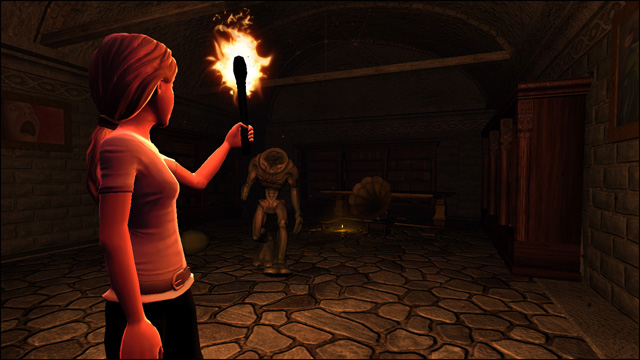
So far, at least, it’s extremely simple. You walk around a bunch of procedurally generated rooms, always trying to reach the next floor. You might find items, such as a flashlight, or a one-shot, searingly loud rifle. You might encounter traps. At one point I turned a corner to see a creature with spindly limbs and even more spindly fingers walking slowly eversoslowly towards me, its hand outstretched. I sat there, stunned and horrified for a second before sprinting away and shooting it in what can charitably be called its head.

There are some lovely touches throughout. The switch from third to first person when aiming the rifle feels instantly claustrophobic, and the lack of weapon crosshairs, combined with the extremely long reload times, makes every pull of the trigger feel impossibly tense.

My favourite touch is the ability to draw on the walls in chalk. I used this to mark doorways I’d been through to avoid becoming lost. I suspected that others used chalk to draw a giant cock, and according to the developers literally the first person who played the game did indeed draw a giant cock.

One last thought: there are unnerving portraits throughout the dungeon – a woman smudged by blood, an open-mouthed screaming face, and so on. And while they were reused over and over again across the procedurally-generated levels, that repetition kind of worked for the creepy vibe the game’s going for. Because here you are in a place where someone or something has seen fit to display their collection of dozens of identical paintings of the same screaming face.

Tomb of Rooms should be entering some form of early access in the next couple of months, and I’m excited to see where the developers take it. I really, genuinely hope they don’t change the name.

Skipping Stones

skippingstones - screenshot 1

Skipping Stones has a very simple premise: you look out and skim stones across the water. Each time a stone hits the water it generates a musical note. As time passes poetry fades in and out on screen. Over time we edge from morning to afternoon, to twilight, and to nightfall, watching the colours and the lights of nature changing.

It’s a restrained experience, though the developer told me that the full game allows players to explore the landscape a little before settling down at one of a few bodies of waters to skim stones.

It reminded me of Proteus, in the sense that it consists of little more than quietly observing nature. But like Proteus its portrayal of nature is absolutely gorgeous, and sometimes downright mesmerising. The skipping stones is somewhat uninvolved, and the poetry ranges from gently touching to gently mediocre, but as a whole Skipping Stones was a charming, relaxing experience. There wasn’t a great deal to do, but I didn’t really need anything to do. It was quite nice to just sit there, watching the world turn.

MirrorMoon EP

MirrorMoon EP - Screenshot 2

Speaking of worlds turning (yup), here’s my game of the show. MirrorMoon EP is already out, so once you’re through reading this go away and buy it.

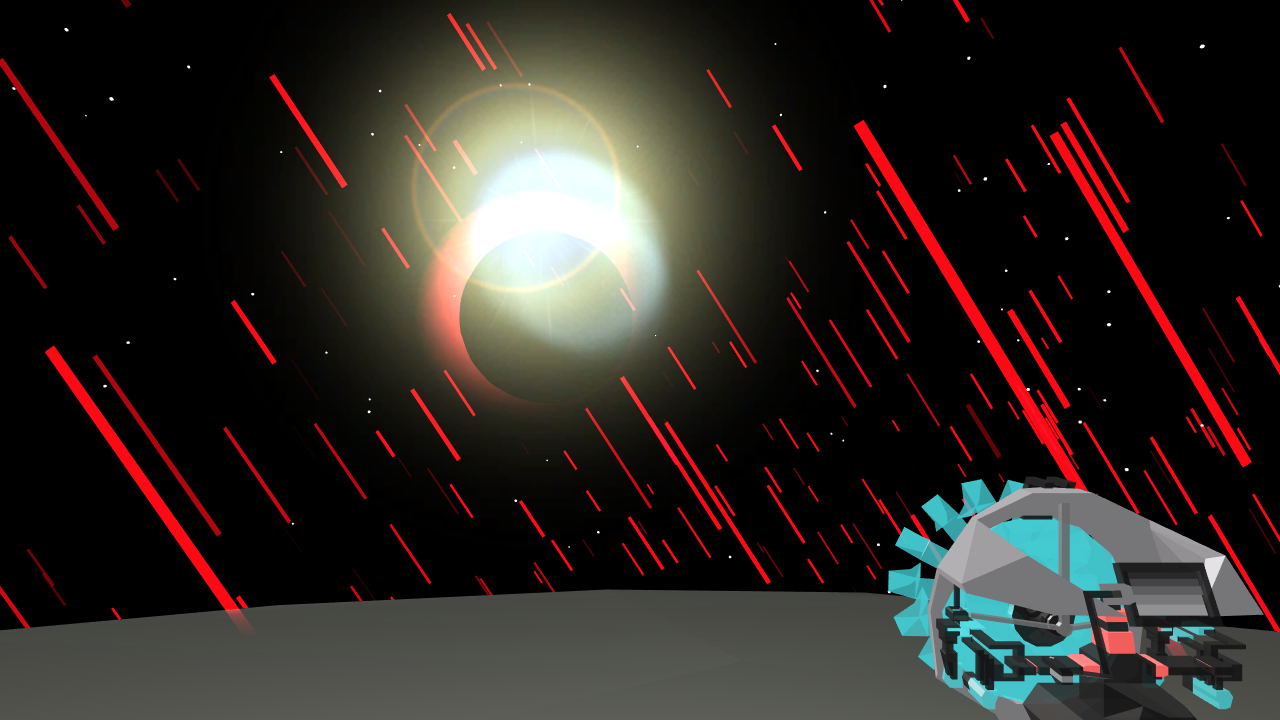
MirrorMoon EP s one of those rare, astonishing games where nearly every moment is a moment of discovery. It teaches you nothing. You start off facing a mysterious control panel, the function and purpose of which are unknown. You start pressing buttons and flipping switches at random, and things come alive. Obviously you press the big red button first, because it’s a big red button and it lives to be blindly pressed for no good reason. When you’ve finally got things working you find yourself on the surface of a small planet, at night, with a huge moon in the sky. Again, you’re not told what to do, but again you quickly, silently begin to find out.

You have a tool that lets you interact with that moon, and you start to see that the moon and the planet you’re standing on are linked in strange ways. You rotate the moon, you move it across the sky, you fire beacons of light onto its surface.

Describing what happened in the demo would be to destroy much of its wonder. This is a game about doing something and discovering what you just did. It’s a game about suddenly seeing something wonderful happen, and just sitting there in awe for a second.

Like many puzzle games, MirrorMoon EP asks you to solve puzzles based on weird dream logic. Its physics is not our physics. Your actions will have impossible consequences, and you’ll need to do things that aren’t just odd, but that don’t make any sense to the uninitiated. Most games that do this suffer as a result – they have something of that sense of wonder, sure, but often it gets overwhelmed by that sense of ‘What am I supposed to be doing?’. One of the things that’s so impressive about MirrorMoon EP is that, unlike all these other games, here the weird dream logic just makes sense. Without words or instruction you piece together what you’re supposed to do based on simple experimentation. You do one thing, then you do another, and then another, all because they make sense as a logical progression of your actions and exploration in an illogical, impossible world. That’s an incredible thing for a game to do; surprise you time and time again with strange, otherworldly occurrences, but allow you to seamlessly make progress without any need for explanation.

My experience didn’t leave me thinking of it as a game about puzzles, but instead a game about discovery, and awe – about interacting with unnatural things and, not quite coming to understand how they work, but coming to understand that they work. Seeing a simple red planet and its moon unravelling into so much more, seamlessly, in front of your eyes. All with a sense of wonder in your heart, like a child seeing an eclipse for the first time, or a baby learning what a cat is. My god I want to play more.

Posted in Games Blather | Leave a comment

The Games of 2012: Analogue: A Hate Story

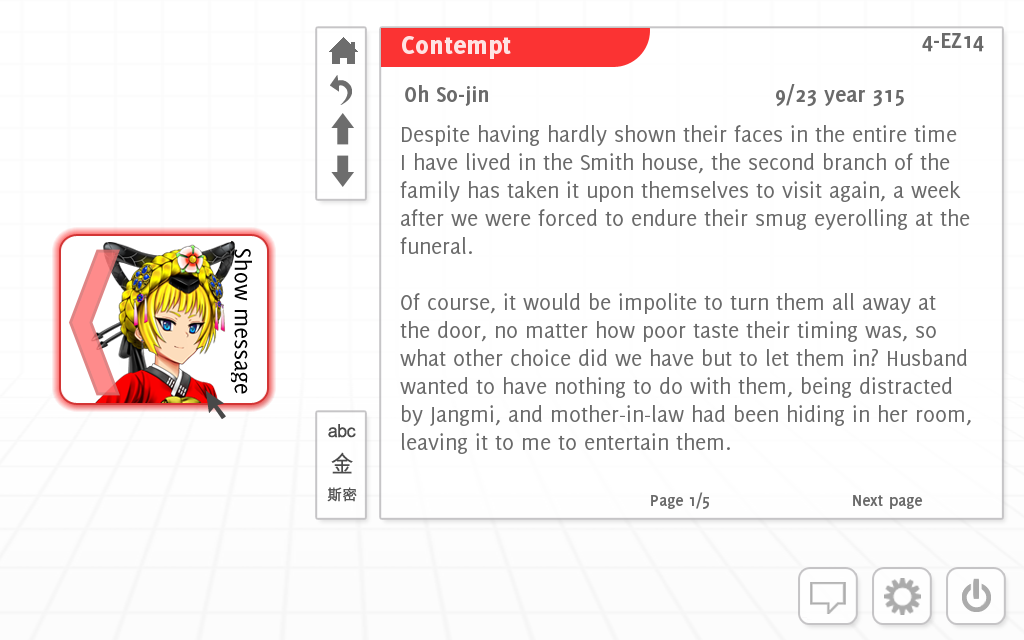
2013-06-13_00001 We find ourselves, as we so often do, in the distant future. Someone has finally found the Mugunghwa, a South Korean generation ship that was lost in deep space centuries ago. It’s floating lifelessly in orbit around an out of the way star, and you’ve been sent to figure out what happened.

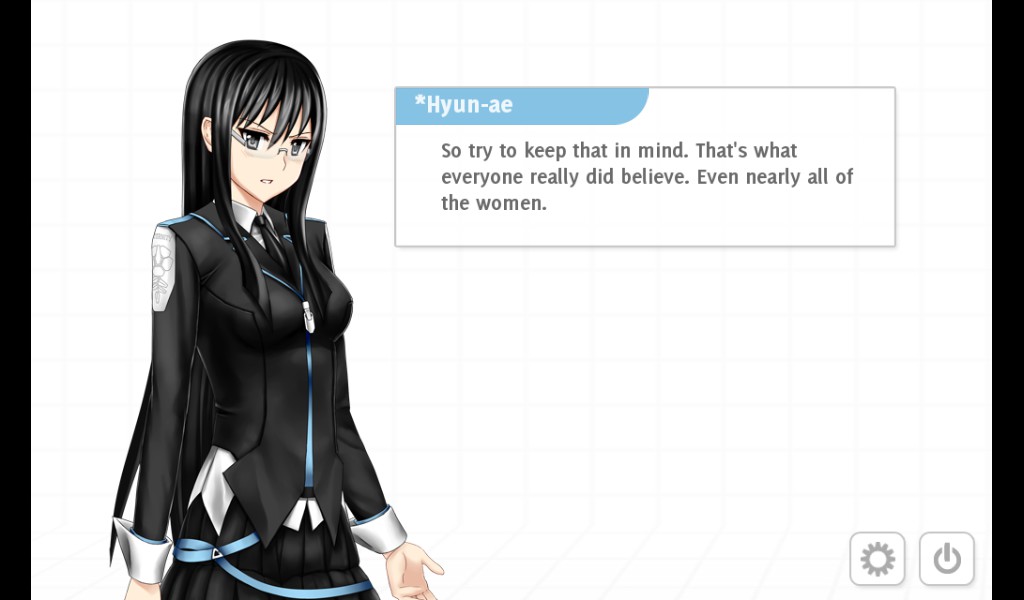
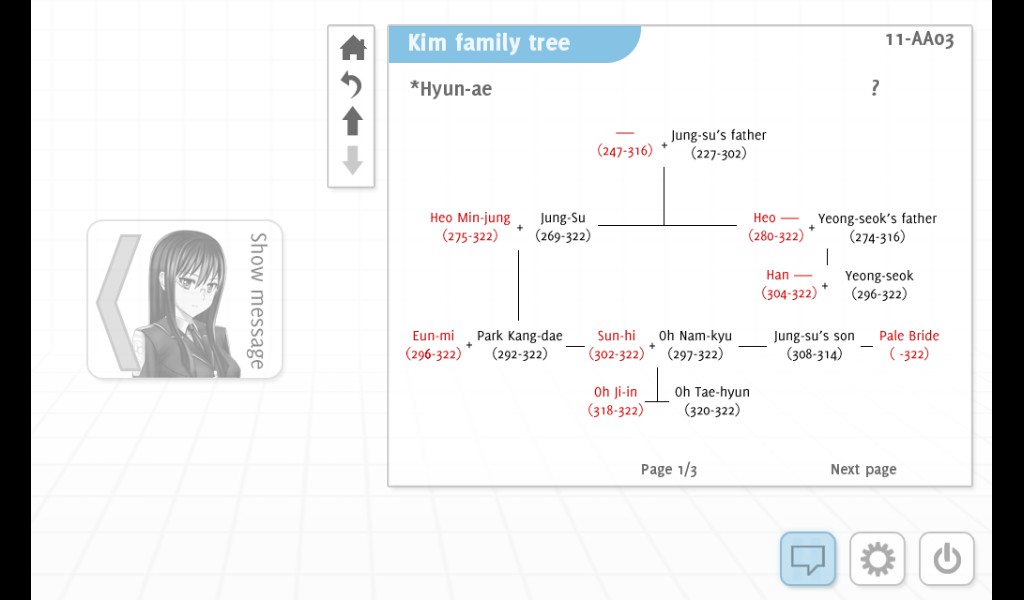
Now, normally this would be the setup for a surprise!-everyone-on-the-ship-died-and-is-now-a-zombie horror game, but Analogue: A Hate Story uses it as a setup for a game about being a space historian. Everyone on the ship died at the same time over six hundred years ago, leaving the spacecraft and its systems itself intact. And with the help of a chirpy, talkative AI named *Hyun-ae, and later the security AI *Mute, you start reading through the ship’s logs to find out why.2013-06-13_00004
However, a convenient problem with the AI’s interfaces means that while you can see and hear them, they can’t see or hear you. As such, your only means of direct communication is choosing between the binary conversation options they occasionally present you with.

The rest of the time, barring a couple of puzzley forays into the ship’s override terminal, you’ll be working your way through the letters and diary entries of some of the most important people in the ship’s last days, including members of the ship’s three most powerful families – the Kims, the Smiths, and the royal Ryu dynasty. Bit by bit the things you read allow you to make sense of not just how they died, but how they lived before the fall.

It soon becomes clear that the Mugunghwa underwent some radical cultural changes during the its centuries-long journey, eventually regressing into an intensely patriarchal, honour-obsessed society more reminiscent of the Joseon Korean dynasty than an advanced spacefaring civilisation. And while you may initially only be interested in solving the grand mystery of how everyone on the ship came to die, the stories of how they lived – how this oppressive culture operated, and the the situations it forced people into – are just as interesting.

2013-06-13_00003

Most of the files you read are concern with the ordinary lives of the nobility – the rivalries, the political manoeuvrings, and the desperate keeping up of appearances – but your reading often won’t paint any single, consistent picture. The people writing these files aren’t always reliable. They all have their own idiosyncrasies and biases that affect both what they say, and how they say it. And after a little while you’ll start to understand the people behind the documents. You’ll begin to make connections between events, recognise previously unfamiliar names on a family tree, and start filling in some of the blanks yourself.

And as you learn about life on the Mugunghwa there’s a good chance you’ll get more and  more disgusted with the things that took place there. We see intelligent, capable women systematically being pushed to the sidelines and ignored, or married off and expected to stay quiet for their husbands. They’re baby-makers or servants or prostitutes, and we see otherwise decent men and women embrace this way of life with a disturbing readiness.

The stories you begin to uncover – the long-running feuds between the Kims and the Smiths, the mystery of the Pale Bride, a secret and dishonourable love – are invariably fascinating reading, shaped at all times as they are by the limitations and the harshness of the culture of the Mugunghwa‘s. And Christine Love (Analogue’s creator) has a real talent for speaking in the voices of the varied characters that make up these stories. The strong, rebellious women, the stony patriarchs, and everyone in between – all of them are believable, and understandable as human beings shaped by the wider cultural framework they inhabit. Many of them are horrendous people, but I found them so human – in many cases so pitiable – that I couldn’t bring myself to judge them.

10930431729558618112_2013-04-24_00005

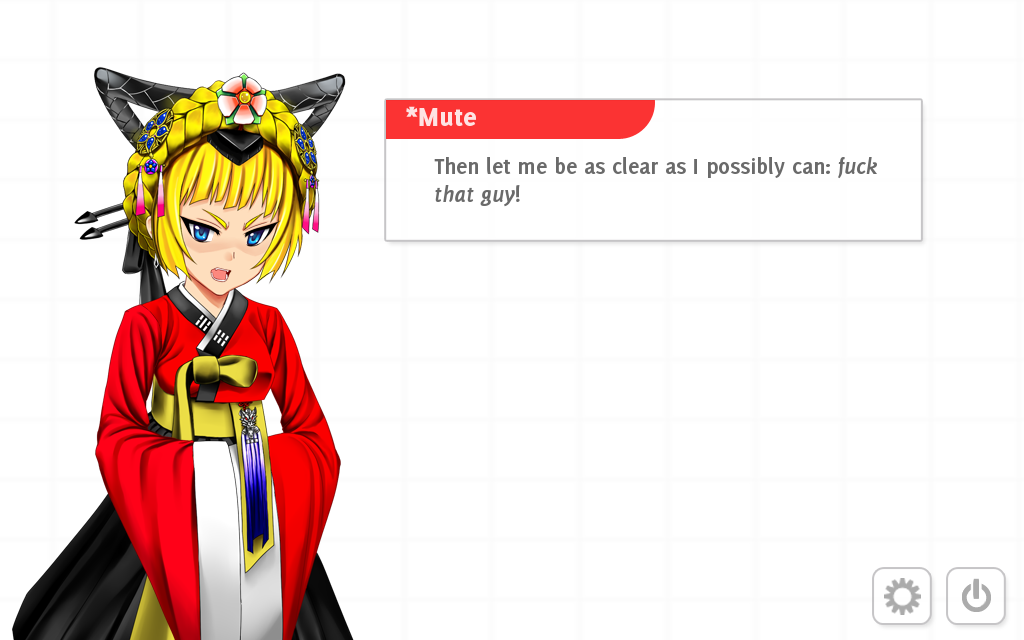
But while I may not have been able to pass judgement, the AI companions *Hyun-ae  and *Mute are all to happy to react with strong judgements of their own. They take the stories you read and, by reacting to them, each casts them in a different light. The former has nothing but contempt for the culture and the people of the Mugunghwa, and the latter vociferously defends the status quo, including the way people were treated aboard the ship.

And while mostly you’ll simply listen to what they have to say to you, the handful of times you’re allowed to respond feel extremely significant for the game as a whole. Your input in a heated, emotional moment, though limited to agreeing or disagreeing with something they’ve said, has a big impact on your relationship with the characters. These decisions can change how each character treats you, and will help determine which of the game’s five endings you eventually receive.

Most importantly, it changes the tone of the game drastically. Agree with *Hyun-ae that someone should be pitied rather than vilified and you’ll feel her warming to you. Challenge *Mute’s deeply engrained prejudices, and her contempt for you will be palpable, especially if you have the temerity to have happened to play the game as a woman. Your actions can lead to an enduring feeling of camaraderie, or a grinding sense of tension that lasts for the rest of the game.

2013-06-13_00005

You may not have a great deal of ability to direct the flow of the narrative, but your choices drastically alter the way to experience it, and that’s what’s so important about the choices you make. They’re not there, as some have suggested, to lift Analogue up from being ‘just’ a game about reading (as if that’s an inherently bad type of game). They’re there to give you the agency to express your opinion about what you’ve witnessed. And the opinions you offer – the judgements you make – radically affect how the game feels.

It’s not really about traditional ‘choose path A or B’ branching narrative – though there is indeed some of that. What the game does is give you full control over how you experience the fairly linear path you’re given. The way you talk to the AIs, and which one you tend to listen to, changes how the game feels. And the way you approach the myriad of letters and diary entries you encounter has the same effect: you can blast through them looking to unravel the mysteries, or you can take your time and really try to understand the people you’re reading about. You can go back and forth between documents, building up a better and better picture of their lives, and coming to genuinely care about their stories.

I could write entire essays about countless different aspects of Analogue. Its treatment of *Mute and *Hyun-ae. Or the impressive setpiece at the halfway mark.  and the way it forces you to deal with the huge consequences of a potentially unwitting choice. Perhaps its position as a game that feels like doing the world’s best, most thrilling piece of historical research. Or how it relates to the classic science fiction of writers like Isaac Asimov and Daniel Keyes – science fiction that uses its unreal elements to tell a story about something very real, and very human. I’d certainly like to write some of those essays, but for now I’ll leave it with one last sentence to serve as a summary: it’s a vastly impressive game, for many different reasons, and it stands as one of the very best this year had to offer.

10930431729558618112_2013-04-24_00006

Posted in Games Blather | Tagged , , | Leave a comment