RPG Autopsy #2: Vampyr (Part Two – In Cold Blood)

(Welcome to part two of our mini-series on Vampyr. If you missed part one, you can find it here. Today we’ll be taking in the sights at the East End docks, meeting the colourful locals, and murdering our way through a warehouse or two.) 

83b13658f32fedd861793cb756f265895c63ec92

After messing around with the game’s upgrade system (I chose Bloodspear, by the way, because obviously I did), we’re forced once again to flee from Reid’s vampire-hunting pursuers. In the process we get our first real taste of the game’s combat system with the gloves off.

The combat in Vampyr is hardly a revelation – it works for what it is, and there’s enough variation that it doesn’t wear out its welcome for a good few hours. But Bloodborne it is trying to be, and Bloodborne it is not – for all its enemy variety and special attacks and weapon upgrades, it does eventually start to feel very samey.

Add to this the fact that every time we travel across the map we’ll encounter patrol after patrol of enemies, and it’s hard not to wish that Vampyr showed a bit more restraint. This game’s strengths are in other places – we shouldn’t have to go through fight after fight just to get to the interesting bits.
18

Fortunately, by now Reid has very nearly come round to the fact that he’s obviously a vampire.

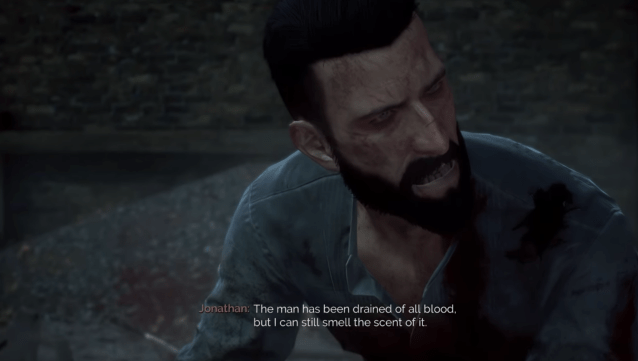
That’s grumbling for later in the game, though. For now, having made it across the Thames, we find a corpse on the riverbank – one completely drained of blood. Guessing that this might be the work of the vampire who created us, we make our way through the deserted streets to our first sign of civilisation – the Turquoise Turtle Pub.

It’s here that we meet the first people we don’t immediately fight and/or eat. First there’s Tom the pub owner, who’s only moderately concerned about our wild-eyed, blood-stained appearance. He tells us a little about a recent string of murders, and lets us know that someone (possibly the vampire we’re looking for?) is staying upstairs.

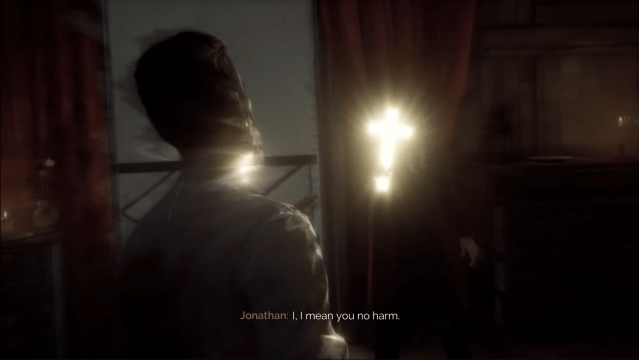
After heading up to confront this mystery person/vampire, we overhear a man and a woman arguing in one of the rooms. The woman – obviously a vampire, and an incautious one at that – eventually senses us listening to their very loud conversation about her being a vampire, and flees into the night. The man invites us in, and when we enter we’re stopped in our tracks by a burning crucifix.
11

Vampire Lore #3: religious symbols = bad.

The sudden shock of the crucifix wracking us with crippling pain, the haunting music that suddenly kicks in, and the skillful voice acting of both Reid and his mystery interlocutor combine to make this moment another 10/10 Vampyr cutscene.

This man, who we soon find out to be one Dr. Edgar Swansea (the poshest man alive), is not our vampire creator, nor even a vampire at all. He’s just a kind of vampire enthusiast. He’s also understandably suspicious of us. But after a while he puts down his crucifix and we have a chat.

It turns out he’s also investigating the recent string of murders, and while he isn’t quite ready to trust us, he wishes us luck with our search. With this we head back down to the pub to interrogate the locals, and to try to find the location of the murderer.

We talk to Dyson – the local drunk, who’s rude and unhappy, and really not much help. Next, there’s Sabrina – the pub’s waitress, who really just wants to get rid of us. But she does tell us about William Bishop – a local who recently showed up sick, and acting erratically. She tells us to ask Tom for more information.

12

Dr. Swansea is the best. I can’t decide if he’s going to betray me for some reason later in the game.

The dialogue in Vampyr is one of the main pillars of the game, and mostly does what it’s trying to do very well. Whereas most RPGs tend to focus on a small number of well-fleshed out characters, Vampyr goes all out on its most minor NPCs, with a frankly staggering cast of well-written, (mostly) well-acted characters to converse with.

The most impressive thing is how good a job the game’s writers do of capturing an NPC’s personality (and laying out an interesting backstory, for each), considering quite how many hours of in-depth (mostly optional) conversations the player can have with quite so many NPCs.

Vampyr is definitely helped by its real-world setting here – it’s far easier to make me care about a depressed, shell-shocked veteran of World War One than it is to make me care about a depressed, fantasy-shell-shocked veteran of the Great Dragon War – but the writers shouldn’t be given short shrift – this is really good stuff.

14

At this point we can also peruse the game’s various menus. This is the Citizen Menu. It tells you which citizens are still alive, and which have ended up on your menu.

What’s not so stellar is the nuts and bolts of the game’s dialogue system itself. While the lines themselves are generally strong, the connective tissue holding them together is a tad weak. Most of what you actually do boils down to clicking an ‘ask about [topic]’ button for every topic until you’ve heard everything the NPC has to say.

There are also surprisingly few points where you can respond with an opinion of your own, and when these moments are present they’re often just slightly too vague to really know what you’re choosing to say.

The dialogue also doesn’t flow as well as it could. You’ll spend a lot of time switching between conversation topics, and it feels awkward and unnatural every single time. Here’s a made-up example of what I mean:

NPC: “I guess I just couldn’t get over my father’s death, and I certainly couldn’t be there for my sister in the way she needed me to be. One day I just kind of…left. I wandered around for a few years, ran out of money, and eventually wound up here.”

Player: “I heard there were some murders around town – can you tell me anything about that?” 

13

Here’s a screen showing Tom Watts’ BLOOD QUALITY. More on that in Part Three.

This is a problem basically every game developer struggles with. Well, every game developer except Inkle (makers of 80 Days and the Sorcery! series). In my book Inkle write the best dialogue in games, in part because they have a system for varying lines of dialogue based on when they’re being said. So for the example above, the game would check ‘is this line of player dialogue being said as part of a related conversation, or apropos of nothing? If it’s the latter, preface it with something like ‘Interesting. Oh, by the way…’ 

You can watch a great talk about Inkle’s Jon Ingold talking about how they do this here. It’s great stuff. But while I wish every developer could do what Inkle does with dialogue, it’s not vital. And not only does it take time, effort, and skill to fix these minor problems – it also very expensive to do when all your dialogue is voice acted. Probably prohibitively expensive for a mid-budget game like Vampyr.

THIS WEEK’S INSIGHTFUL GAME DESIGN LESSON: 

Writing game dialogue is a labyrinthine nightmare where the best-written line of dialogue can fall on its arse for any number of tiny, barely-related reasons. Add the constraints of voice acting into the mix and we can all agree that it’s better to never try, lest we risk falling short of perfection.
15

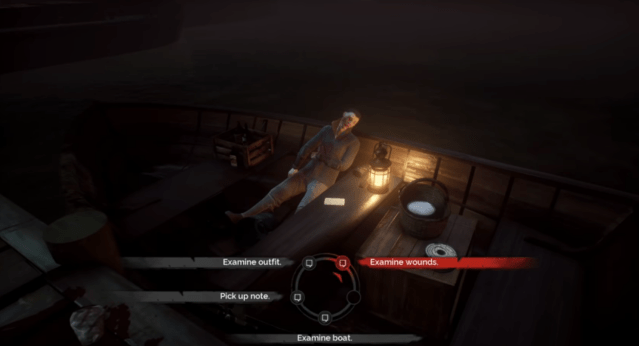
I actually don’t remember this man. I think he was already murdered before I got here.

We use our vampire mind powers (yes, we have them now, btw) to bully Tom into telling us more about William Bishop, and after doing some light investigation along the docks we track him down to an abandoned warehouse that just screams ‘IMMINENT BOSS FIGHT’. There are skeletons hanging from the ceiling, for god’s sake.

William Bishop (who appears to be some kind of zombie-vampire sub-species) is feeding on a man called Sean Hampton who’s somehow still alive. We confront Bishop in a very paint-by-numbers boss fight – dodge, stun, attack, try not to die. And in classic action film fashion, the apparently defeated Bishop gets the drop on us when our back is turned, and we’re saved just in the nick of time by…the mysterious vampire woman we overheard in the pub. She helpfully avoids telling us anything, then leaves.

Finally, Dr. Swansea enters triumphantly in a lovely little steam boat, and whisks us (and a babbling, worse-for-wear Sean Hampton) away to safety. We (the player) find out that Reid is actually a famous medical researcher (presumably Reid already knew that), and Dr. Swansea offers us a job at the nearby Pembroke Hospital.

This will let us stay safe and inconspicuous (working the night shift, of course) while we continue looking for our creator. Hopefully we’ll get a chance to take on the epidemic sweeping through the city at some point, too.


We’ll explore Pembroke Hospital in Part Three. For now, though – as always,  you can follow me on Twitter by clicking here. Also, my very own (in-development) text-based monster-hunting RPG  – The Red Market – can be played online here for the low, low price of zero pounds.

16

Dr. Swansea to the rescue in his lovely steam boat.


Posted in Games Blather, RPG Autopsy | Tagged , , | Leave a comment

RPG Autopsy #1: Vampyr (Part One – Death Pending)

(Welcome to part one of RPG Autopsy. If you’re not sure what that is, where you are, or exactly how you got here, check out our introduction to RPG Autopsy here. In a sentence, though: RPG Autopsy is a series about playing through role-playing games, and examining their game design successes and failures. This is the first part of our mini-series on the exceedingly overlooked Vampyr – a 2018 Action-RPG by Dontnod Entertainment where you play a spooky vampire in spooky 1918 London. Let’s get right into it, then.) 

83b13658f32fedd861793cb756f265895c63ec92

Vampyr is not one for slow RPG openings. After a brief, sinister, mysterious, 100% highfalutin bit of introductory narration covering such varied topics as ‘the countdown to oblivion for the once proud city of London’ and how being dead is good actually, our protagonist Jonathan Reid wakes up at the bottom of a mass grave.

I should mention at this point just how much Vampyr does with what it’s got. It doesn’t have the enormous budget or state-of-the-art motion capture of a AAA studio, but through skillful use of lighting and sound design (not to mention that holy grail of video game storytellers – a working understanding of cinematography), Vampyr makes this section work incredibly well.

A suitably appalled Reid climbs up over the bodies, and we stumble through a black-and-white industrial estate while an ominous choir sings at us. I say black-and-white, but the scenery is punctuated by bright red streaks of blood (think the girl in Schindler’s List, only with vampires).

The outline of a woman comes onto the screen. Reid complains groggily of being really very thirsty. The woman’s form is indistinct, except for the enticing red outlines of her veins and fast-beating heart. She seems to know Reid, and goes to embrace him, but before he knows what he’s doing Reid sinks his fangs into her neck, and drains her of life.

0

Think that episode of Seinfeld where a hungry Newman hallucinates Kramer as a giant roast turkey, only with vampires.

Reid, now sated by his first taste of blood, comes back to his senses. Colour and sound return to the world, and he sees that the woman he’s just murdered is in fact his own sister.

This scene, happening about four minutes into the game as it does, works far better than it has any right to. The aforementioned lighting, sound design, and cinematography come together to whip up the drama, and Reid’s voice actor Anthony Howell does great work here. The moment where Reid’s face changes from inhuman bloodlust to haunted recognition of his dying sister is also just an exceptional piece of filmmaking.

Before he has too much time to mourn, however, Reid is confronted and shot by what appear to be vampire hunters. Curiously shrugging off a bullet to the shoulder (hint: there’s a chance he might be a vampire), he flees the scene, and we’re given control once again.

1

Spoiler alert: it’s not.

I want to stop and take stock for a moment here. In the first five minutes of this game we’ve woken up in a mass grave, become a vampire apparently, killed our sister, and gotten shot by a vampire hunter. Also, we’re a vampire.

This is a million miles from the grave sins of 99% of RPG openings. In fact, it might be the best openings to any RPG I’ve ever played. No meandering hometown introductory sequences, no numbers-waterboarding character creation screens, and no overly earnest lectures about fantasy lore the player couldn’t possibly bring themselves to care about yet. Instead, the opening of Vampyr is (a) full of drama, (b) personal, yet high-stakes, and (c) mysterious as hell.

This is how you do an opening. It’s so good I’m going to make it this week’s INSIGHTFUL GAME DESIGN LESSON:

Don’t be afraid to throw your players right into the thick of things. 

Just because RPGs tend to be slow, story-driven games doesn’t mean they don’t need a sense of drama. Every piece of art needs to grab its audience, and no amount of ‘here are some stats, please choose your playstyle for the next 90 hours (no you can’t change your mind later)’ or ‘3000 years ago there was a dragon’ RPG nonsense is going to do that.

You don’t need to go straight into character creation (assuming your game has it). Throw your players into the thick of the drama. Make that drama high-stakes, and personal. Also make sure to include a (high-stakes, personal) mystery in there too. I don’t care about the fate of this fantasy kingdom you’ve just told me about. I do care about why the hell I’m a vampire now, and just who these guys trying to kill me are.

2

Spoiler alert: it doesn’t.

What follows is an introduction to the game’s combat system. Reid finds a frankly enormous machete, and we cut our way through some vampire hunters. It’s standard lock-on, dodge, and attack third-person combat. We’ll probably talk about that combat in more detail in a later post, but for now suffice to say that due to atmosphere everything feels pretty tense.

Soon enough we tussle with a vampire hunter, and get burned by a ray of sunlight. Here we learn our first piece of vampire lore – sun = bad. In a few moments a tooltip will teach us our second piece of vampire lore – fire = also bad. In mechanical terms this means that we can’t go outside at daytime, and that fire-based attacks deal us ‘aggravated damage’, which lowers our maximum health.

We escape, and find an abandoned house to hole up in. Once safely hidden inside, Reid sees some flashbacks, including his time as a field surgeon in a war we later learn to be the First World War. He also finds a dead woman, and then does the first thing anyone would do in such a desperate situation: he start rooting about in cupboards for crafting supplies.

4

Amazingly for a video game story, this life-defining moment of character development isn’t dropped soon after and then never spoken of again.

Here we also find our first ‘collectible’ – a letter written by the leader of something called ‘Priwen’ (more on that later), which goes into more detail about vampires, sunlight, and fire.

These lore tidbit collectibles, like the writing in Vampyr in general, are very good. They’re short, full of interesting flavour, and they tend to be written with a specific voice, from a specific perspective. They’re also helped (as with the story in general) by the game’s vampire setting. Everyone knows the basic vampire rules – blood, sunlight, wooden stakes, an eternity of hellish damnation, etc. – so when Vampyr plays with those rules, it makes us sit up and pay attention. 

We all know, for instance, that vampires are killed by sunlight. But here we learn that no, they actually aren’t. Instead, while sunlight gradually burns them down to a charred husk, they’ll start slowly regenerating the moment the sun sets. Which is incredibly metal. And it makes us start to wonder: ‘what are the rules of vampires in this world?’.

5

Enjoy reading the text on this, a letter written for ants.

By introducing this mystery, then gradually drip-feeding us answers, Vampyr makes us feel like we’re a sleuthing, blood-drinking Sherlock Holmes, even though all we’re really doing is reading a piece of text handed to us. This isn’t lore and worldbuilding as nerdy codex filler, this is lore and worldbuilding as answers to pressing mysteries. This is how you do it.

In the next post we’ll get to the bleeding heart of Vampyr – the chats with its various NPCs around London, and there too (due to a combination of accomplished writing, leveraging of mystery, and some clever gameplay-story interactions) we’ll feel like detectives when all we’re actually doing is clicking on all the options in a fairly simplistic dialogue tree.

Getting back to Reid, though: we find a dead man, and take his gun. However, not cottoning onto the fact that he’s a vampire just yet, Reid is convinced he’s hallucinating, or having some kind of terrible nightmare.

9

Also, we keep having visions of this mysterious figure, who I figure is probably our sire (i.e. vampire dad).

We’ll hear again and again later on that Reid is a rational man – a man of science. So naturally he does the most rational thing one can do in this moment of doubt: he lies down in a bed and shoots himself in the chest.

It’s a bit silly, but as always its shot and acted well enough that it works, and I do like how you have to pull the trigger yourself. I thought that maybe I could avoid shooting myself if I waited long enough, but you have to do it. You pull the trigger. Reid shoots himself.

And that’s Vampyr. The. End. Kind of a short mini-series, I know, but you play the hand you’re dealt. Next week we’ll be starting a new mini-series about our next game…

6

Rational thinking only.

No, not really. We cut to the title sequence, and Reid (being a vampire, which is what he is (he’s a vampire)) obviously doesn’t die. Instead he wakes up in a pool of his own blood, treated to eternal, nocturnal, cannibalistic life.

And we’re treated to a level up screen. One that’s actually really cool – at first you only have a few options, but you can look at the whole unlock tree right now if you want. Our first (mandatory) unlock is ‘autophagy’ – a nice ability where we consume our own blood to heal our wounds. Then we can choose between a close-range claw attack, a long-range attack called BLOODSPEAR, for god’s sake, and an area-of-effect attack called Shadow Mist.

It’s all very stylish, and very enticing- much more so than standard ‘make a ball of fire, or make a ball of ice, or make a ball of lightning’ RPG fare. Each ability’s unlock tree also has a nice bit of flavour text attached, which, as always with Vampyr, is well-written and evocative.

And that’s it for the prologue. Reid has lots of questions, and in next week’s post we’ll set out to find the vampire who created us. Join us, and see just how that goes.


For now, though – thanks very much for reading this far. As always,  you can follow me on Twitter by clicking here. Also, my very own (in-development) text-based monster-hunting RPG  – The Red Market – can be played online here for the low, low price of zero pounds, in case you’re interested.

10

Think a spear, only with blood.

Posted in Games Blather, RPG Autopsy | Tagged , , | 9 Comments

RPG Autopsy #0: An Introduction

Welcome to the zeroeth edition of RPG Autopsy: a new series that’s half Let’s Play, half fussily-extensive dissection of role-playing game design. In this (hopefully short) introductory post I’ll explain the concept of the series, ask the (hopefully short, hopefully non-interminable) question ‘what is an role-playing game?’, and then wrap things up by letting you know what our first game will be.

If you just want to get straight into the content, here’s the elevator pitch:

RPG Autopsy is a series about playing RPGs, then cutting them open, and digging around in their soft, squishy bits to see what makes them tick. It’ll take the form of deep-dive, full-length playthroughs of all varieties of RPGs, with a focus on:

(b) which parts of the game work, and which don’t (and why)

(b) what these successes and failures can teach us about good (and bad) RPG design.

Which games will get the role-playing fame? Which will get the eternal role-playing shame? And which will get taken to role-playing small claims court? Find out every Saturday in RPG Autopsy.


What is RPG Autopsy?

Like many of you, I’ve been playing video games since I was a tiny, awkward child. I loved many of them (Planescape: Torment, The Elder Scrolls III: Morrowind, Final Fantasy 9), and hated others (Pillars of Eternity, Pillars of Eternity, Pillars of Eternity 2). And while I enjoyed all different genres, RPGs have always been my one true love.

As I’ve grown older that love has evolved from the innocent, childlike love of ‘this is my favourite toy and I love it and it’s the best in the world’, to a weird, reclusive uncle’s love of taking apart his 1978 Mustang and putting it together again every weekend.

In other words, over time I’ve become more and more interested in not just playing RPGs, but figuring out (1) how they’re made, (2) what makes some of them great, and (3) what makes the Pillars of Eternity franchise so incredibly bad.

RPG Autopsy is an attempt to answer these questions in a way that will hopefully make for fun reading. I’ll choose an RPG to play through to completion, and write about my experience week by week – talking about what works, as well as what doesn’t, and then rounding out each post with a game design lesson we can take away from that week’s play.

This way, we’ll have fun AND learn at the same time. What could be better?


What is a role-playing game?

We can’t even properly define things like ‘art’ or ‘game’, so what hope could we possibly have of rigorously defining the term ‘role-playing game’? More importantly, who cares?

No one, that’s who.

I did a degree in philosophy. I’m not going back to that place again. And I wouldn’t wish it on you, either. Instead, I’m going to give a vague overview of four things I think are generally important to most (not necessarily all) RPGs.

(1) RPGs generally involve player choice about creation and/or advancement of a player character. 

  • The player character can be a blank slate create-your-own (e.g. Dungeons and Dragons), it can be a specific person with their own personality (e.g. The Witcher), or it can be some mix of the two (e.g. Mass Effect).
  • Player characters generally advance/level up in some way – whether that be getting physically stronger (e.g. 90% of all RPGs ever), getting physically stronger but in a slightly different way (e.g. see previous parentheses), or getting better at writing esoteric poetry (see A House of Many Doors)

(2) RPGs are in some important way systems-driven games.

  • In other words, RPGs generally aren’t just choose-your-own-adventure binary choices with consequences and goblins and space lasers. Instead, they have some combination of gameplay systems (e.g. the tactical combat of Baldur’s Gate 2, or the exploration of Sunless Sea) and narrative systems (e.g. choices lowering morale and supplies in The Banner Saga, or the complex branching of the Sorcery! series)
  • In general, narrative impacts gameplay and gameplay impacts narrative in some way (or better yet, narrative and gameplay are one and the same).

(3) RPGs allow for significant player choice and expression.

  • In other words, a first-person shooter game that branches into two possible endings because of a player choice isn’t suddenly an RPG. Having basic dialogue choices, or basic level ups also don’t automatically make something an RPG (saying that, I’m not interested in genre gatekeeping – I’m painting the term ‘RPG’ with a pretty broad brush for the purposes of this series)
  • You might be asking how I define ‘significant’? Good question! Moving on:

(4) RPGs generally have a strong focus on story/world/characters

  • Some RPGs are just excuses for combat systems (and there’s nothing wrong with that), but most are at least somewhat interested in telling a story, exploring a world, or letting the player get to know compelling characters.

I have further thoughts on these topics. They’re not interesting. Moving on:


What games will I cover?

All kinds of RPGs or RPG-adjacent games. Fiddly old-school CRPGs like Fallout and Baldur’s Gate. Genre hybrids like S.T.A.L.K.E.R.: Shadow of Chernobyl and Mass Effect. JRPGs like Final Fantasy and Dragon Quest (though I’m honestly not that into the genre as a whole). Tabletop RPGs like Call of Cthulhu and Bluebeard’s Bride. Interesting, unusual indie titles like Lisa: The Painful RPG and the absolutely wonderful A House of Many Doors.

Our first series of posts will be on the exceedingly overlooked Vampyr – an Action-RPG released in 2018 by Dontnod Entertainment. It’s about eating people (or choosing not to eat them). It experiments in very interesting ways with game difficulty, moral compromise, and NPC-world interaction. It also fancies its combat system to be a successor to Bloodborne.

Will I eat people? Do Vampyr‘s experiments pay off? Is its combat system actually a successor to Bloodborne? Find out next time in RPG Autopsy!

(spoiler: yes, yes, no)

Until next time

(And remember, you can follow me on Twitter by clicking here. Also, my very own (in-development) text-based RPG  – The Red Market – can be played online here for the low, low price of zero pounds, in case you’re interested)

Posted in Games Blather, RPG Autopsy | Tagged | 1 Comment