The Games of 2011 – ‘The Binding of Isaac’

[A brief warning: The Binding of Isaac is not for the faint of heart. The simple, stylised nature of its art-style mean that it is unlikely to shock and appall many, but at its core this is a game that doesn’t care much about your sense of taste. It contains cartoony images of and references to: drugs, satanic worship, medical gore, sexuality, abortion, and violence against children. As I said, it’s unlikely to do more than leave a strange, perhaps unpleasant, taste in your mouth, but if you consider yourself especially squeamish perhaps consider giving this a miss. Right then, on we go]

Isaac is an ordinary child, and while he is bullied at school his family life  is far more problematic. His father seems to be absent, perhaps he always has been, and his mother is remarkably unbalanced, to say the least. One day Isaac’s mother hears the voice of God, and he tells her that Isaac is corrupted; that he must be protected from the sin that runs through the world. Isaac’s mother gladly attempts to purify Isaac – she removes all his toys, possessions, indeed his clothes, and shuts him up in his room. But God speaks to her again, and demands that as a show of faith she must sacrifice Isaac. She gladly attempts to do so, her faith is so strong, but just as she is bearing down on Isaac with a butcher’s knife he escapes – down a trap door and into the basement. To safety.

You play the part of Isaac, and you need to keep him alive. The basement is vast and labyrinthine, and deep. You have to move from room to room, descending deeper and deeper into the basement, though to what fate you can’t know. You certainly can’t go back upstairs, at least. But the basement isn’t really safe – Isaac’s mother doesn’t appear to be around yet, but there are other threats that may prove just as deadly.

And they will prove deadly, because this is a hard game. Isaac only has a small amount of health, and health-restoring items can be rare. But when Isaac dies, and he will die, he’s dead for good. There are no extra lives, checkpoints, or second chances – make one wrong move and Isaac is gone. When this happens you’ll have to start the game over again, forfeiting all your progress and anything useful you may have been lucky enough to find. This makes the whole affair very tense at times, and you’ll never feel like you can drop your guard. And that’s a great thing: you’re never coasting, because you know that every room you enter could be your last. You start making plans and contingency plans, and worrying about just how you’re going to get past the next challenge. It also isn’t frustrating when you die, and there are two reasons for this: (1) even though you’ll be losing all your progress each time you die a full run-through of the game will only take between forty-five minutes and an hour, so you’re never really losing too much, and (2) it’s filled with so many secrets, items, and different possibilities that every game feels new and exciting.

Isaac is understandably upset about his situation – his mother tried to sacrifice him, the kids at his school bully him mercilessly, and even now the creatures in the basement want him dead. As such Isaac is perpetually in tears, and at first Isaac’s only way of fending off his aggressors is, in fact, to cry; his tears will damage any enemy he comes across. And as you explore the basement, and the deep caves found underneath, you’ll periodically find things of use. There are bombs, keys, and coins that can all be used to damage enemies or access new areas and powerful upgrades. There are also other items you can pick up – Tarot cards that have various positive or negative effects,  Isaac’s mother’s pharmaceutical pills, and rechargeable weapons like super-bombs, a teleporter, or your mother’s bra, which you can use to smother your enemies.

And there are also the powerful, permanent upgrades that Isaac can stumble across – he may pick up an onion that makes him cry even more than before, meaning he’ll be able to attack enemies faster, or he may find an ever-beating heart he can graft onto himself for extra health. Or a ouija board, a pair of high heels, a clothes hanger to stick through his head, a battery, a crown of thorns, growth hormones, a broken mirror, or even a miner’s hat. All these are distributed randomly throughout the map, and all have various effects on Isaac; some as simple as increasing his damage, and some as strange as bestowing Isaac with a loyal chunk of floating meat that will attack his enemies. You’ll only encounter a small number of these in any one playthrough, and since they’re placed randomly you’ll never know exactly what you’re going to come across.

Once you start a new game after dying for the first time you’ll notice that the world is completely different each time you play. The maps and the distribution of enemies and items are all randomly generated at the start of a new game, and even the bosses you fight at the end of each floor is chosen randomly from a large list. And it’s an interesting variation as well, not simply randomly generated environments for their own sake; the layout of the rooms, the placement of different types of enemies, and the upgrades you find all change the way the game plays to a large extent. So no two games of The Binding of Isaac are the same, and nor are two versions of Isaac. In one of your games you may come to develop an Isaac with a miner’s hat, a pet bat, laser eyes, and a large pot-belly. But when you play the game again your Isaac might with time come to have a third eye grafted onto his head, as well as a handy ladder for crossing gaps, tears of blood, and a pet dead cat. Each upgrade visually changes Isaac, so by the end of the game you’ll most likely be controlling some kind of grotesque, shivering abomination. And as well as finding or winning these various upgrades you may also be lucky/unlucky enough to stumble upon the devil, who’ll be happy to grant you various ungodly powers in exchange for a part of your humanity.

There’s a constant sense of uncovering new and surprising things throughout the game – you never know what the next room is going to be like, and there are so many different items and upgrades to find that you could play all the way through tens of times without seeing everything. The many types of enemies are all varied and, with a few minor exceptions, interesting to engage with. All, however, are gross, wretched things. Some, especially the most powerful, are simply monsters, but many seem to be abortive versions of Isaac. You start to wonder where all these monsters,so many bloated and crippled children, came from. The various enemies will all respond to Isaac differently; some will flee from him, and must be murdered in cold blood in order to progress, but some will attack; running at you angrily, or hobbling impotently towards you on broken and misshapen limbs.

All are disturbing in their own way – from the crying, defenceless twins of Isaac to the rotting, silent shopkeeper who is hanged open-mouthed by a rope around his neck. The art-style of The Binding of Isaac is very cartoony, as I’ve said, and it’s really quite nice to look at, but it’s especially impressive because of how it clashes so horribly and so deliberately with the themes and the content of the game itself. From the strange retelling of the Binding of Isaac biblical story, to the nightmarish enemies, to the pulsating flesh-walls of the final post-ending level (set inappropriately enough inside Isaac’s mother’s womb). Some of the things I encountered genuinely made me wince a little, and it’s clear that the game revels in making you feel uncomfortable.

It is very hard. But although a lot of the time you’ll die because there just weren’t enough health-restoring items to be found, it doesn’t feel unfair. It demonstrably is unfair, since on some run-throughs you’ll be far more ill-equipped than on others through no fault of your own. But it doesn’t feel unfair, because it’s so quick to get you on your feet once you fail, and so generous with imaginative and challenging possibilities.

It’s also certainly intriguing to play a game as bleak and dark as The Binding of Isaac. Very few games choose to go anywhere near this level of depravity (though I should reiterate that you won’t see anything visually shocking – it’s the ideas that it puts into your head that are sometimes worrying). It might make you uncomfortable at times, often it seems to want to do that more than anything else, but at heart it’s a hugely enjoyable game that is clever, imaginative, and challenging. Perhaps it doesn’t do all that it can with the themes it take on, but what it does do it does well. Very well, in fact.

When you get down to it, however, The Binding of Isaac is mostly trying to be a compelling, fun experience, and so the disturbing nature nature of Isaac and his journey may seem to be merely window-dressing. But Isaac’s story, and the grotesque nature of his experiences, feed into the feeling of playing the game – you’ll constantly feel  under threat and lacking control. And this is a game whose fiction and mechanics are all about defencelessness, as well as dealing with a violent and depraved world, and the physical and emotional trauma that entails. Like Isaac you’re thrown into a scary, imposing situation that you have to come to understand in order to survive,  and it’s a situation that’s as challenging as it is unpredictable. And even if Isaac survives all this it’s clear that he won’t experience a happy ending. He’s far too scarred and damaged for that, and this shows not only through the narrative, but through the mechanics themselves: the  only way for Isaac to grow stronger is to mutilate himself . The upgrades you find are rarely a nice hat or a handy pair of x-ray glasses. So often picking up a useful upgrade will also cause lumps to grow on Isaac’s body, brand him with the mark of the devil, or leave him lobotomised, drooling and grinning emptily. All this seems strange to say when I consider how fun the game is, and there is certainly an oddness there. The Binding of Isaac is clearly reaching towards strong, emotive places, but this seems to conflict somewhat with its enjoyable, light-hearted mechanics of roaming around, fighting, and growing stronger. I would have been interested in seeing just how far this game could have gone in abandoning standardised videogame tropes, while also developing the disturbing themes around which it orbits. As it is there is a dissonance within the game. However, it certainly succeeds at what it is trying to do, and despite this dissonance The Binding of Isaac is a powerful effort, as wonderfully disturbing as it is effortlessly compelling.

The Binding of Isaac is out now for PC, Mac, and Linux. It’s very cheap, around £5, and it’ll probably run on your crappy laptop.

Posted in Games Blather | Tagged , , , , | Leave a comment

A Look at ‘The Elder Scrolls V: Skyrim’ – Part One: Falling Out of Love

The Preamble:

The new entry in the Elder Scrolls series of fantasy role-playing games, is a sprawling open-ended adventure set in the cold reaches of Skyrim, a hostile land in the far north of this imagined world.  When you play this game, or others of its kind, you’re rarely forced down any one path – the entire world is open for exploration, and though there are quests to take on it’s always your choice to do so, and in fact you can just as easily completely ignore them all. You start the game, after a brief introduction, by creating your player-character. The character I created was a Nord, the Scandinavian-esque, mead-drinking native inhabitants of Skyrim. My particular nord was strong, sturdy warrior, but you might choose to create an archer, a conjurer of demons, a strait-laced healer, a backstabbing psychopath, or a mage sparking lightning from their fingertips. Alternatively: any combination of the above, or dozens of other possibilities I haven’t mentioned. You can create an adventurer of a great number of fantasy races (Dwarfs thankfully excluded, because seriously guys can we get over dwarfs?) and over the course of your time in Skyrim the actions you perform determine what they come to master. If you use a sword and shield your character’s ‘blocking’  and ‘one-handed weapon’ skill will increase over time, as will your character’s apothecary skill if you choose to bide your time mixing various potions and poisons. There are a large number of such skills, and as you level up you can put points into these skills to unlock certain rewards and abilities.

And you can choose to act how you like – you can join the Companions, a brotherhood of storied mercenaries, or the guild of mages, or any of the other numerous organisations found throughout the land. You can choose to take a side in the civil war, either fighting to uphold the Skyrim that the cosmopolitan Cyrodillic Empire has come to rule, or fighting for an independent Skyrim for the Nords and the Nords alone. And don’t forget that great beasts ancient beasts, the legendary dragons that died out an age ago, are returning to Skyrim. You can choose to become the hero Skyrim needs and rid the world of these terrors, or you can simply potter around hunting deer, catching butterflies, collecting plants, exploring ancient ruins, pickpocketing locals, visiting the shrines of otherworldly gods, crafting armour and weapons, starting fistfights with xenophobic drunkards, or sporadically picking on children. The point I’m trying to make here, really, is that Skyrim offers you a lot of freedom, and it’s almost entirely up to you to decide what to do with that freedom.

Skyrim is inarguably a big achievement. Its world is expansive and often aesthetically beautiful; with precipitous, winding paths up freezing mountainsides, great open plains, and sight upon visually impressive sight. There’s also an obscene amount to do, and though like any game of its ambition it is home to more than a few bugs and technical problems, it really is a place you’ll want to come back to. There are innumerable moments that are nothing less than special – from stumbling into the shrine to a dead emperor who rose into the firmaments to become a god, to letting loose one last arrow into the side of a powerful dragon soaring high overhead before watching it crash down to earth in its death throes. And because the world is so huge and filled with choice you may never see everything there is to see, or do everything there is to do. I really can’t stress this enough: Skyrim is a very good game, potentially even a great one, and it is many ways a brilliant antidote to state of so much of the games industry – whose only ambition is to make thrilling, explosive roller-coaster where there is really very for the player to actually do except get carried along and enjoy the ride. With the newest entry in their Elder Scrolls series Bethesda Softworks has shown yet again, to their biggest audience yet it seems, that high production values and impressive technology can go hand in hand with choice, imagination, and lofty ambition.

But I don’t love Skyrim. I impressed as all hell with it, and I’ve already spent much time happily engaging with its charms, but there is something, or rather some things, about it that are preventing me from really bringing it into my heart. To explain why I’ll need to split things in two. In this first part I’ll talk about some of the problems with Skyrim, and I’ll give some general ways I think the game could have improved in these areas. In the next part, coming whenever I feel like writing it, I’ll talk a bit about another game: Morrowind (in full: The Elder Scrolls III: Morrowind). It’s one of Skyrim’s precursors in the Elder Scrolls series, and it remains one of my favourite games even after all these years. I’m going to talk about Morrowind because I think that understanding what was so great about that game will be useful for understanding where and why Skyrim falters.

B4EF87034747F635F59DA4FE17848E9D3BD31142 (1600×900)

The Problems I Have With Skyrim:

So what does one do in the land of Skyrim? I’ve already listed a whole host of possibilities, but you may notice something about that list: almost everything is geared towards killing things. Killing things in a variety of ways, sure. In a variety of interesting ways, okay maybe (we’ll get to that), but killing things all the same. Now, there’s really nothing special about this when it comes to fantasy videogames (‘or even videogames in general!’ I hear you say), so I’m not sure why this grates so much with Skyrim in particular, but it really does. You’re given an expansive fantasy world, but sometimes it feels like your only method of interaction with the place is through the medium of blunt-force trauma. Sure, the world is filled with citizens you can talk to, barter with, perform tasks for, and even marry if you feel any kind of burning desire to do so, but most of the game involves fighting. Or sneaking around, admittedly, but even then the general point remains – as soon as you leave the safety of the few towns or villages nearly everybody wants to kill you. Sometimes they’ll be kind enough to give you a perfunctory warning first, but after that it’s game on. A huge part of the game can be found in exploring the ruin, cave, camp, watchtower, or other dwelling that you’ve stumbled upon in your journey from point A to point B (and I should stress that you can ignore these incidental places entirely if you really want to), but there’s remarkably little actual variety here, even if the setting and the enemies are varied enough.

Now I’m fighting bandits in a cave, now I’m fighting reptilian monsters in a somewhat darker cave, now I’m fighting mechanical spiders in a steam-powered city. But while the scenery may change quite a bit very little else does: there’s very little that’s actually different between a cave and an underground steam-powered city apart from how the two places look and how the enemies look. There will be enemies to fight, perhaps a few traps to avoid, a locked door on which to employ a lockpick if you so choose, and perhaps a few scattered notes to read. And I’m sorry, but if I’m walking through a mechanical city I expect there to be something special about that apart from the enemies that attack me and the kinds of items that I find littered about. Sometimes these various dungeons are sprawling and labyrinthine, and occasionally they contain interesting little vignettes, but by and large they just present you the same tasks and challenges in different backdrops. There are puzzles in some dungeons, but they’re the kind that feel like a moment where the developers of the game saw fit to specifically insult your intelligence – you need to match this set of symbols to that other set of pictures over there. You think you can handle that, champ?

There’s the Combat:

The combat in the game is all right. I know, ringing endorsement. Well, initially I liked the weight and the heft of the hand-to-hand fighting, but after a good number of hours I’ve become more than bored of it. Sure, it’s better than a lot of games of its ilk, and it’s certainly better than the combat in previous Elder Scrolls games, but it just never swtiches up or evolves. Enemies and allies aren’t the smartest people on earth, and any allies you happen to have fighting on your side are just as likely to stand in front of you, entirely oblivious to the world, as they are to actually get their hands dirty and help you fight some enemies. Hand-to-hand fighting does still feel pretty weighty, and whacking someone in the face with your shield is often satisfying. But it’s still merely serviceable, and you’re so often attacked by someone or something that after a while it will become a chore. And because it never evolves in any way it will never stop being a chore once you’ve gotten bored of it. The game won’t even let you go for a walk without things constantly coming out of nowhere to attack you; wolves will appear seemingly every few minutes from the undergrowth as you climb a mountain, bandits will pursue you as you cross the plains, and trolls, giant spiders, bears, and all manner of violent things will attack you without provocation.It all starts to become very draining, and I had to stop playing more and more often the further I played because I just couldn’t be bothered to enter another dungeon where I’d have to repeat almost exactly what I did in the past few dungeons I’d visited that day.

As I said, it never even tries to shake up the combat. There aren’t really any enemies that require you to change your tactics, and though some enemies will attack you from afar, some from close up, and some will posion you or freeze you in place, this generally doesn’t spur interesting encounters. This certainly isn’t the tactical combat of something like the Zelda franchise, or The Witcher 2 where every enemy is a real challenge, and every enemy has its own strengths and weaknesses you will need to exploit in order to succeed. Combat is serviceable, but it’s not anything special, and considering you’ll spend so much of your time fighting things that’s a real problem. Sure, you can choose not to fight very often, but there’s not really many alternatives.

And yes, fighting dragons is fun, but somehow, somehow, Bethesda manages to make even that become less than exciting after a while. These are dragons we’re talking about for God’s sake, but because you fight them so often, and because they aren’t actually as threatening as they look, they become just another enemy to hit in the face. Fighting my first dragon was really very exhilarating, as was each subsequent dragon-fight up until around the tenth. Then every time you see a dragon you lapse into a familiar routine that, so far, has changed remarkably little: the dragon flies around breathing fire/poison/ice on you, then lands to attack you close up, then flies away again. They do really look impressive, but unfortunately the game can’t back really back that up mechanically.

And Talking to People:

I mentioned that there are many people to talk to in Skyrim. But though there are plenty of people to interact with this interaction rarely does anything to incite intrigue, or amusement, or, god forbid, empathy. The voice-acting here is pretty good considering so, so many lines are spoken by so many different people throughout the game, but it never feels like anything other than a means to an end. You feel like you should listen to people talk, because they might give you information, or a new quest, or something of the sort, but you, if you’re anything like me, will probably never feel compelled to listen to people in the game talk purely because you feel they have something interesting to say. And I’m generally a person who loves dialogue in games – the reason I loved The Witcher 2 so much (current Game of the Year 2011, though I haven’t gotten my hands on Dark Souls yet) was mostly the conversations you’d have with characters in the game, and Pathologic and The Void, my two favourite games, are almost entirely reliance on dialogue throughout.

These non-player characters in Skyrim (NPCs) are eager to tell you their life stories, or witter on about some bandits down the road they need you to give a good seeing to, but no one ever feels like a character, and everyone’s so damn verbose all the time. Dialogue in games is a tricky business, and I don’t think I’ve thought about it as a subject enough to talk about it with any kind of confidence, and I think Skyrim performs quite poorly. In something like Pathologic you’re interacting with various characters, and everyone has their own motives, desires, and most importantly their own reasons to lie through their goddamn teeth to you. In Skyrim people are walking, talking quest-givers, shopkeepers, or lore-spouters. Bethesda Softworks put a hell of a lot of time and effort into fleshing out this world, and that’s great, but the problem is that they think you need to hear all about it all the time. They don’t realise that sometimes (read: most of the time) it’s better to hint at explanations and story, or give the player pieces of a puzzle to assemble in their minds, or even bullshit the player and confuse the hell out of them. Instead Skyrim plays almost everything straight, and though there are more than a few cases of NPCs lying to you they’re generally someone you just met, and so someone you have no reason to trust or distrust. Sometimes Skyrim genuinely does have an NPC tell you something interesting, and a lot of the back-story of the land of Skyrim is actually interesting, but at other times the game feels like that mature student at the philosophy department Christmas party who thinks that everyone wants to hear about quite how far away from the University he lives, and how far he has to drive every day just to get to lectures. Nobody cares, Skyrim.

It doesn’t help that interaction with NPCs generally takes the form of you choosing one question to ask, listening to a static, drawn-out answer, then choosing the next question, listening to the next response, and then finishing the conversation, perhaps now with more knowledge or a new task to perform. It doesn’t feel like you’re actually interacting with anyone at all – it’s more like everyone is just dumping exposition or context in your direction, and so often it feels like exposition or context without any kind of filter. Maybe I’ll write a post on conversation in games at some point in the future, because I think it’s a point that so few developers understand. Developers who bother with dialogue in games often tend to think that because they have a potentially infinite time in which to present their dialogue, unlike a movie or a play, they can take as long as they like. But dialogue, any dialogue should be fast-moving and to the point, unless you’re trying to write some kind of Shakespearean soliloquy, in which case you better come very, very strong. Skyrim straddles the two, and it’s a straddling as uncomfortable as it sounds: it’s content to throw word after spoken word at you. And it never develops characters to the point where you’d care enough to actively want to listen. In The Witcher 2 (did I mention that it’s my current Game of the Year?) when Triss Merigold tells me of some terrible experience in her past I give a crap, because I’ve gotten to know this character and she’s well-written enough that I care about her. When some peasant I’ve just met in Skyrim launches off into his Oscar Moment I don’t care, because I don’t know this character, and anyway it’s not even a particularly well written speech.

This isn’t the interaction I’m looking for. There’s combat, and that’s fine – it is a fantasy role-playing game after all, and it would take a very brave and potentially genius-level person to make one of those without any combat at all (I’ll probably love anyone who does this). But there is too much  of the already uninteresting and unvaried combat by far, to the point where it feels like a crutch for a development team who couldn’t think of any new ways to let the player interact with the world they so meticulously created. And then there’s talking to people, which feels more like tidying up your bedroom – a chore you do end up performing quite often, but only because you know it’ll probably benefit you in the long run. In real life you clean your room because you think ‘what if an attractive girl comes round and sees my bedroom?’ (your mileage may vary), and in Skyrim you talk to person after person because you think ‘what if this person has some information I might need?’. These two aspects – the combat and the conversations, make up the majority of this gargantuan, sprawling game, and they’re not good enough.

F7740221DBA69F16CFBF1E8F18A9C742F2C81A05 (1600×900)

Finally, Some Suggestions:

1. Make combat rarer, but up the ante when it is there:

I don’t understand how this isn’t well understood in the games industry yet: if you throw enemies at the player all the time the player will cease to see those enemies as significant. But if you make the player fight fewer enemies you can afford to make those enemies more difficult – stronger, and perhaps smarter.  Focus on giving the player fewer fights, but make those fights a lot more difficult, and varied. These fights will be more satisfying, both because they happen less often, and because they can, if you’ve put the effort in, be far more interesting than the swarms of standard enemies that, in Skyrim at least, the player sees again and again.

The same general point can be made with almost anything in the game: loot, for example. Throughout the game you practically hoover up various items from defeated enemies and from treasure chests – healing potions, weapons, armour, enchanted rings, etc. etc. But there are so many of these things that after a while you stop taking all but the most expensive or powerful items. Everything else becomes so much dross that you don’t even bother with. Instead, the game should focus on giving you less of these items but making them far more powerful, and far more interesting. Make potions rare but give them very powerful effects. Make it far less likely that you’ll find a new piece of armour, but make every piece of armour powerful, with special and unique properties. Players will most likely be far more excited to find a new piece of equipment, rather than swapping something out for the incremental defence bonus it gives. The Witcher 2 does this magnificently – there are very few sets of armour you can actually buy or make, but almost every one feels like a big step up from the last, or gives you strange and interesting benefits. Essentially the point is this: make things rarer, but also make them more varied/challenging/powerful.

2. Cut the number of NPCs and the number of lines of dialogue by at least a half:

People talk too much in Skyrim, and they simply don’t have that much that I want to hear. Don’t have everyone tell me about their wife, or about their farm. And don’t have so many people walking around, or else make it so that they ignore me. If I were walking through the streets of London and tried to talk to everyone there I’m pretty sure they’d just go on and ignore me, and that’s fine. My point above stands: if you have thousands of lines of dialogue the player may cease to see them as significant after a time, unless they are spectacularly well-written, but if you make the spoken word rare in your game, and make it so that every time someone says something it’s actually important, shocking, or useful then people will remember your writing and your characters. Essentially, part of the problem here is this: there are too many people for which to write compelling dialogue. And part of the answer is this: make less people and less dialogue, and focus on honing what you have.

3. Mix things up as often as you have a good idea:

Don’t make it so that every time I walk into a bandit cave I know I have to kill everything that breathes. Sometimes just give me an empty cave with signs of previous habitation (Half-Life 2 did this extremely well – you would often walk into a building and be able to come to understand what had happened to the inhabitants merely by looking at the environment – a saw blade here, a pile of clothes here, and a massive blood-stain there). Make it so that instead of having to kill bandit leader No. 4 I instead have to pursue and capture an escaped criminal. Let me talk a convict out of executing his captors. Probably make the world a lot smaller, and focus your efforts on quality rather than quantity. I understand that there’s a desire for big, open worlds, but Skyrim is mostly a land filled with levels of similarity, and though it’s a lot better than most other games of its kind (I remember the countless near-identical dungeons to be found throughout The Elder Scrolls IV: Oblivion) it’s not quite good enough.

Those are the few, general points Bethesda, or any other developer, could and jolly well should keep in mind when making an open-world game in the future. I don’t get into many specific ways to improve things because (a) I’ve gone on for far too long already, and (b) it seems foolish to reveal my secrets. I’m designing, on paper I should say, a kind-of open-world game and I’m not sharing my brilliant insights into game design theory with just anyone.

Sorry for going on so long. I would like to promise that Part 2, when it emerges, will be far less length, but really, I’m not going to promise that at all. I am going to say one more thing before the end though: I did enjoy Skyrim quite a bit, and I’m still dipping into it every so often. I’ve been quite harsh in my criticism here, but I should reiterate that it is a very good game.  I think it falls short in a number of ways, but that doesn’t take away from the fact that this is an impressive piece of work. And I imagine many people will fall quite justifiably in love with it. However, I stand by everything I’ve said above, and I think that Bethesda, if they just changed their approach a little, could have made something far better.

[stay tuned for Part 2, which will see me getting all nostalgic about The Elder Scrolls III: Morrowind, and which should hit sometime in the near/not-too-distant/actually-somewhat-distant future]

Posted in Games Blather | Leave a comment

A Look at ‘Metro 2033’, or, Virtue in a Broken World

Metro 2033 - 1

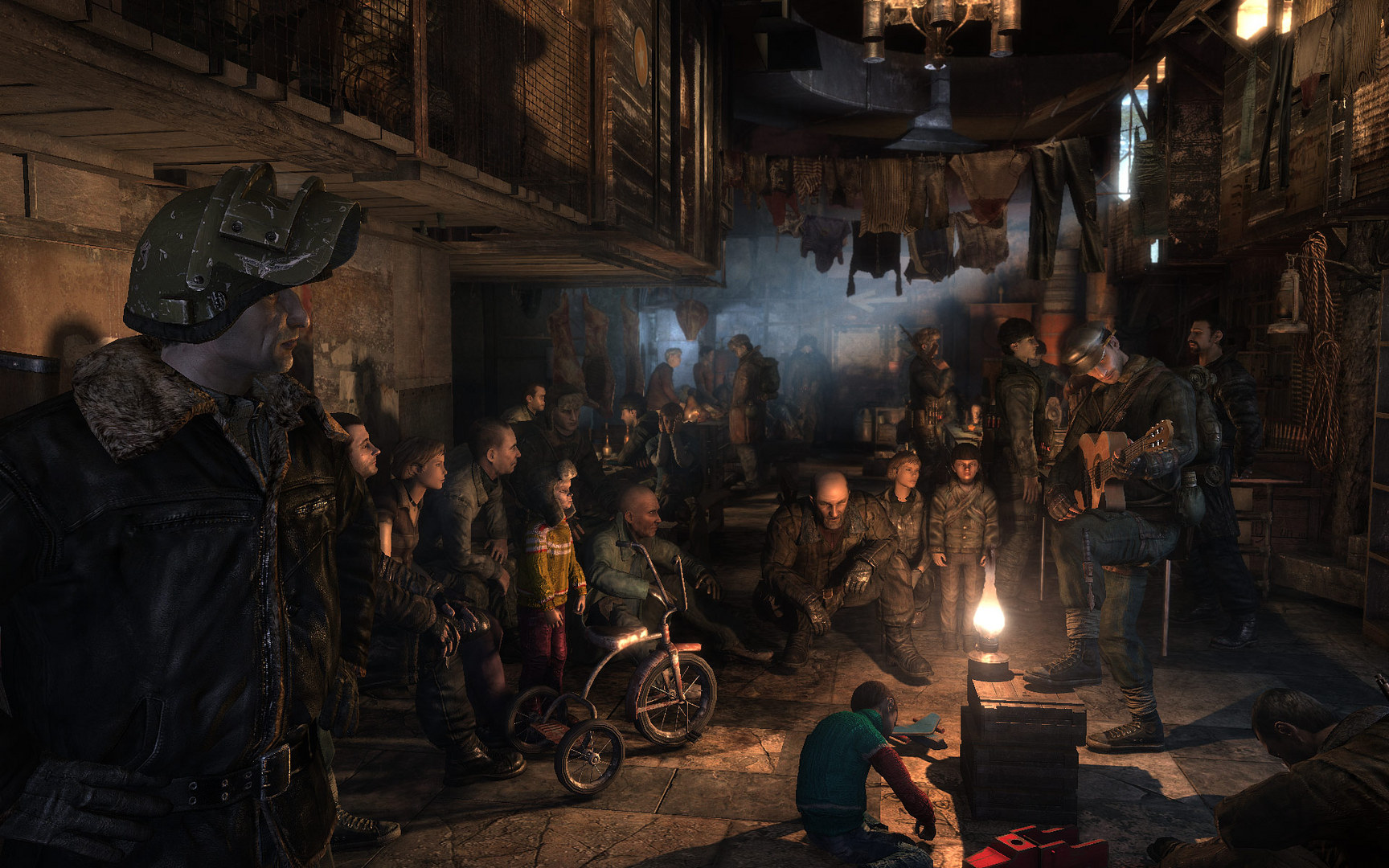
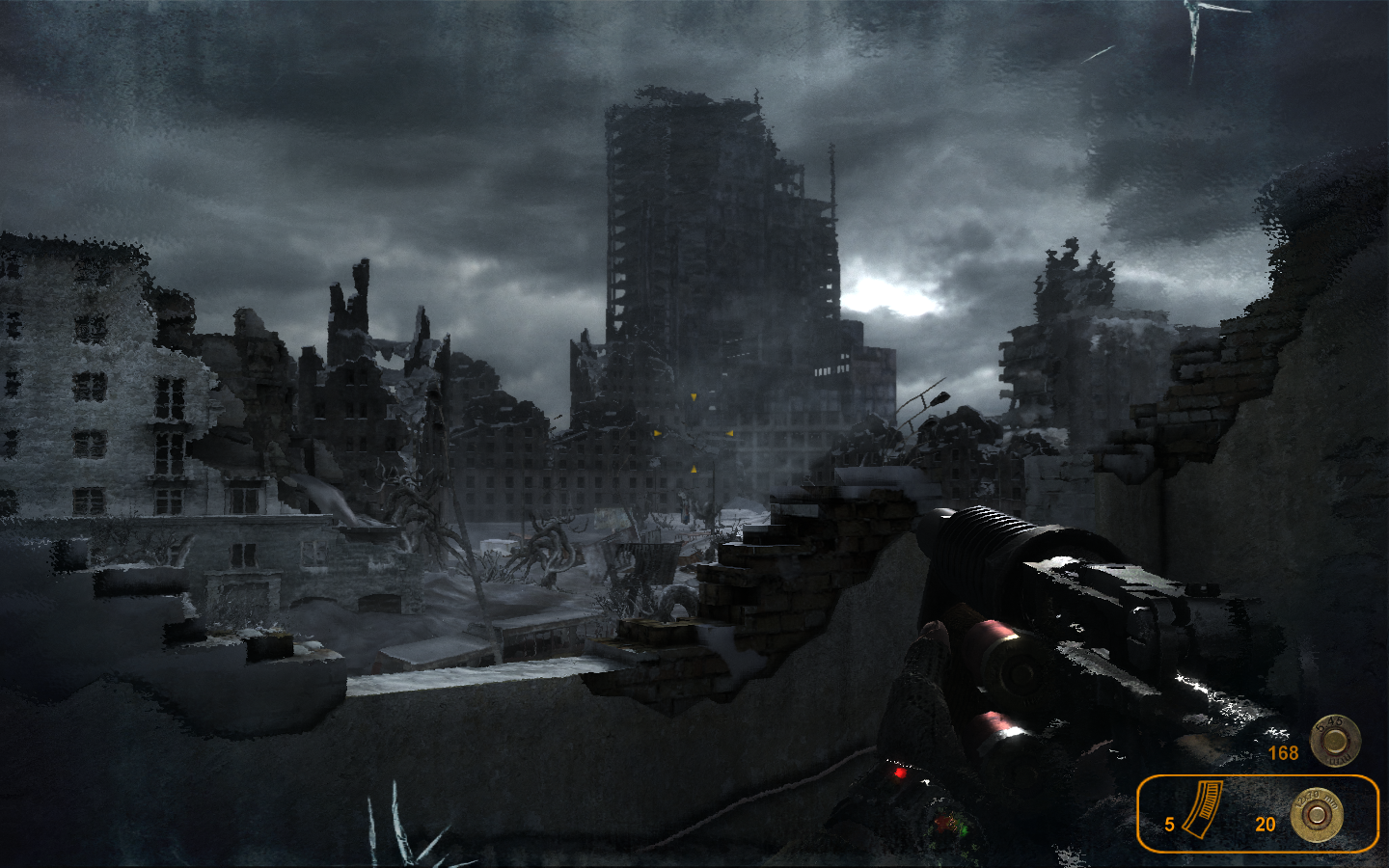
Metro 2033 is a first-person shooter set in a post-apocalyptic Moscow frozen stiff in the grip of a nuclear winter. As the bombs fell some managed to take refuge in the Moscow metro system, and today, long after that time, humanity clings to life in those tunnels. The ground above is scorched and irradiated, utterly uninhabitable, and people are forced to live their entire lives underground.

It’s a dangerous place -the tunnels have become infested with mutants, ghosts, and strange environmental anomalies: the legacy of the nuclear apocalypse. But while few willingly venture out of the safety of their home stations, some do take the risk. Among them are the Rangers – a group of highly trained soldiers who see themselves as the white blood cells of the metro system; there to identify and destroy any and all threats to its inhabitants. However, a new, powerful threat has emerged; a mutant species called The Dark Ones, named by some as Homo Novus, New Man. These mutants display terrible telepathic powers, and encounters with them have left even the strongest of warriors empty shells housing irreparably broken minds.

Into this world is thrown Artyom, a young man who has spent his life living in a small station on the outskirts of the metro. One day a Ranger named Hunter arrives at his home station during a prolonged and especially violent mutant attack. He goes outside to scout out the area, and warns that if he doesn’t return the next morning Artyom must travel to the centre stations to warn them of the threat the Dark Ones pose. Naturally, Hunter doesn’t return.

Metro 2033 - 2

You take on the role of Artyom as he traverses the dangerous metro system, occasionally venturing out into the frozen wastelands of post-nuclear Moscow. Originally this sees Artyom travelling to the central stations in search of aid, but when this fails he’s joined by the Rangers in a desperate plan to activate a long-dead missile system and bomb the Dark Ones off the face of the earth. But Metro 2033 isn’t just a straightforward shooter, with Artyom rising up to become the hero. Instead it’s a morally ambiguous affair; an exploration of simple choices, and a commentary on how those simple, often unconscious choices can change the kind of person we are, or rather the kind of person we can be.

Metro 2033 isn’t just another first-person shooter that awkwardly tries to combine power-fantasy combat with a meaningful story. In fact, a huge proportion of the game is spent in the absence of violence, and you’ll spend much of your time exploring, scavenging, trading, and sneaking through the shadows. Most of the time in Metro 2033 you won’t be firing a gun, or looking to fire a gun, or even thinking about firing a gun.

But even when violence does come Metro 2033 stands out from the crowd. Played on anything other than the lowest difficulty levels you’ll struggle to survive. In fact you struggle to even find enough bullets to load your gun. This scarcity of ammunition forces you to play the game in a way that barely resembles most shooters: you crouch in shadows trying to avoid enemy patrols, you delay firing your weapon as long as you can to ensure clean, efficient kills, and you make use of silent, reusable weapons as often as is feasible. You panic as the force of an impact cracks open your gas-mask, and then you desperately search for another usable one, feeling all the while Artyom’s pained efforts to avoid inhaling the toxic air, feeling the startling sound of his lungs.

Metro 2033 - 5

Violence is quick and brutal; the real meat of the combat is in the expectation, and the frantic guessing as to where and how numerous your opponents are. In short, the game is something wholly other to the vast majority of first-person shooters, which are to a large extent about empowerment, or rather EMPOWERMENT. This isn’t a game just about bravado and the use of overwhelming force – it’s a game about vulnerability. As such, this is one of very few games where there’s absolutely no conflict between the themes it explores and the actions you take as a player.

The game’s most interesting way of exploring its themes is through its morality system. Many games, though very few shooters, have morality systems, and few do anything particularly interesting with them. Most simply hand you binary choices between good and evil, and call them moral choices. The effects of such choices are generally either cosmetic or artificially extreme. It is very much a case of kill the puppy or pet the puppy. But Metro 2033’s system is different – not only is it surprisingly sophisticated, but it’s the only morality system I’ve seen that actually tries to say something.

If you play through Metro 2033 you’d be forgiven for not noticing that there’s any kind of morality system within the game at all. This is because the system is subtle and unstated. Only with some further knowledge of the game, either through reading about it from external sources, or through multiple playthroughs of the game, will one really come to understand what it is and how it works.

Metro 2033 - 9

Almost all games with morality systems give you some kind of indication that you have committed a good act, or a bad one; a little happy noise or a frowny face, but all Metro 2033 does is give some slight indication that something may have happened somewhere. Periodically, certain actions will cause the screen to momentarily develop a different hue, and the faint sound of a klaxon will emerge. No indication is given then that what you did was right or wrong, or even that what you just did was important.

Christ, I didn’t even know that this indication was there until my second time playing through the game. It’s remarkably easy not to notice that the game keeps track of how you act, since most moral choices are not simply presented as binary choices. While you may be given the opportunity to accept or reject a reward from an impoverished mother your choices are generally far more subtle. You gain unstated moral ‘points’ (it’s important to emphasise that that’s my term, not the game’s) for avoiding unnecessary bloodshed in certain sections, or for listening to a preacher finish his final speech to doomed front line soldiers, and you can lose moral ‘points’ for something as simple as carelessly trampling over candles in a shrine to the dead.

The first time I ran through the game like any other linear first-person shooter, mostly because I wasn’t expecting it to be anything more than just another linear shooter. The second time I took things slower, really wanting to soak up the post-apocalyptic world on show. As a result I found countless things I had previously missed. I found that I can lead Artyom into his stepfather’s office for a parting talk before leaving home, which leads to a small, poignant, and entirely incidental moment. I found I can listen to a friend talk, and then as a result be asked to spare some money for medicine for his child. I found that the game rewards you for taking it seriously, acting out of curiosity, and performing small, perhaps in many cases inconsequential, acts of kindness. That treating the game as any other first-person shooter causes you to miss a great deal of its beauty.

Metro 2033 - 6

And, mirroring my own experience, the Artyom from my first run through the game was markedly different from the Artyom of my second, more deliberate one. He doesn’t talk differently, or grow devil horns and cause villagers to scatter at your presence, but in a very important sense your tacit decision determine the character of Artyom as you play. By tearing through the game as any other shooter your Artyom is set as a man single-mindedly determined to end the threat of the Dark Ones. And by moving through the game carefully and thoughtfully your Artyom becomes curious enough, and thorough enough, to be willing to question whether the Dark Ones are an enemy at all.

The only functional effect of Metro 2033’s morality system is to push you towards one of two of the game’s endings. People often call them the ‘good ending’ and the ‘bad ending’, although I think that’s an unfair representation of what they actually represent. The standard ‘bad ending’ is reached if Artyom doesn’t gain enough of these moral ‘points’ (and it should be noted that there are very few situations where one can receive negative moral points, so if you reach the ‘bad ending’ it’ll mostly be because of how you didn’t act). In this ending Artyom and the Rangers destroy the Dark Ones with a precision missile strike. Humanity is saved, and Artyom is a hero. If you act in such a way as to gain enough moral points to achieve the ‘good ending’ you’re given a choice: you can either let the missile deliver its payload, or you can destroy the guiding mechanism you fought so hard to position, and in doing so spare the Dark Ones.

If you rush through the game with your eyes always on the next objective you’re barred from this decision; forced down a path of violence against the Dark Ones to protect the human race. And you’re not reviled for this, you’re the considered the hero of the day. But by consistently acting with curiosity and kindness you give Artyom the opportunity to grow, and to question, and to make a world-changing decision.

Metro 2033 - 8

One of the central ideas of Aristotelian virtue ethics is that in order to become a virtuous person one must perform virtuous actions. Eventually, if one follows the example of virtuous people one can become virtuous, and virtuous actions will then come more naturally.

There are two central role models in this game, each representing a different way to respond to the violent, broken world. The first is a Ranger named Miller, and the second is Khan, a quiet, thoughtful wanderer of the underground who offers Artyom another way of looking at the world. At one point Khan says the following: ‘You reap what you sow, Artyom: force answers force, war breeds war, and death only brings death. To break this vicious circle one must do more than act without thought or doubt’, and this is hugely important for understanding Metro 2033 as a whole. If you follow the example of Miller, and take the Ranger motto ‘If it’s hostile you kill it’ to heart, Artyom becomes strong, and protects his station. In other words, if you play Metro 2033 as a standard run-and-gun first-person shooter then it acts as a standard run-and-gun first-person shooter. You shoot, you kill, and eventually you annihilate the Dark Ones with a precision missile strike in order to protect mankind. It functions perfectly well if played like this, though I didn’t fall in love with it.

However, if you decide to follow Khan’s example of employing violence only when necessary, of coexistence rather than annihilation, then the game transforms: it changes from a tale of Artyom gaining the power to eliminate the threat of the Dark Ones to a tale of Artyom slowly coming to question things. Finally, you’ll be given a brief moment in which to make a world-changing decision: you stand there with your pistol in hand, facing the missile-guidance system. The Dark Ones beg for peace. The game doesn’t tell you to destroy the guidance system or to leave it standing; it just leaves you there listening to a countdown to impact. You can simply stand there and wait until the missile destroys the Dark Ones, but you can also decide to destroy the guidance system and save the Dark Ones. It may be a difficult decision, but you are not forced down either path; you have shown yourself capable of making such a choice.

Metro 2033 - 4

Posted in Games Blather | 2 Comments