The Games of 2011 – ‘Portal 2’

Portal 2 is no Portal. Let’s get that clear from the outset. The original Portal was as close to flawless as any game has come. It introduced a central mechanic of genius-level proportions, it was clever, and it was funny, and it was perfectly paced. Portal 2 is its own game, and it doesn’t try to recapture the magic that Portal bottled back in 2007. Instead it tries to take some of that magic and push it in a different direction. It’s not the small, minimalist experiment of Portal, but it does introduce new mechanics, new characters, and a new look at the world of Aperture Science. When taken on its own terms it’s a rather special game, but it does still fall, however unfairly, somewhat into the shadow of Portal.

Portal was set in the testing labs and later the maintenance rooms and office spaces of Aperture Science – a corporation focused on technological research. Chief among these  technologies was the Portal Gun, a device for crossing physical space with ease. It works like this: simply fire the gun at a flat surface to create a portal, and fire the gun at another flat surface to create a second portal. Anything that enters one portal will immediately exit through the other – the device links together those two disparate points in space. Objects will maintain their momentum when travelling through the portals, so if one portal is placed at the bottom of an impassable pit, and the other placed on a wall beside the pit, then jumping down into the first portal will see the player flying over the gap with all the momentum gained from the initial fall. This mechanic is the pivot around which both Portal and Portal 2 rotate

while there are lasers and turrets and pressure plates, the Portal Gun is your bread and butter. – The original Portal saw the player taking on the role of Chell: a test subject in Aperture Science’s Enrichment Centre, tasked with trying out the Portal Gun by traversing various test chambers, solving various puzzles, bridging impassable pits, avoiding (adorable) automated turrets, and generally trying to survive. Throughout the game the AI watching over your activities, GLaDOS, becomes more and more unhinged (think 2001: A Space Odyssey‘s HAL 9000), and it eventually becomes clear that in order to escape the facility you’ll need to shut her down. At the end of the game you succeed in destroying GLaDOS’s systems, but are ultimately dragged back into the facility to who knows what fate.

Portal 2 begins with you waking up after years, perhaps decades, perhaps centuries, of suspended animation back in the Aperture Science facility. And after that…well, actually no. No. I’m not going to say anything about what happens in the story apart from this: GLaDOS isn’t quite dead, and you’ll end up seeing a lot more of Aperture Science, and its troubled past, this time around. I don’t want to say anything about the story because a great pleasure, perhaps the chief pleasure, of Portal 2 can be found in being swept along with its twists and turns. Its surprises, and even the things that aren’t really surprises, are best approached without any prior knowledge of the game itself. So, I’ll try to talk about why the story is good without talking about the story. Which could be interesting.

Although Chell is a silent protagonist there is a lot of talking in the game. Far more talking than in the original Portal, and it’s clear that this was a big focus for the sequel – while Portal had a brilliantly minimal story, Portal 2 is deliberately far more fleshed out. And it works extremely well. Valve (the developers of the Portal games) has a fantastic team of writers, and Portal 2 is an extremely funny game. It’s probably the funniest game I’ve ever played,  even though it’s not an out-and-out comedy. But despite the comedic nature of much of the writing it’s also quite dark, and even a little poignant at times. I can’t really say more without getting into specifics of the plot, but it’s a clever, clever script, and there are countless moments where someone says something amazing, or where something really special happens – the beginning and end sections stand out especially (Best Opening of 2011 and Best Ending of 2011). Dialogue is superbly-written, the cast does a great job with the material, and there’s an undeniable sense of timing underlying the whole game. It’s a game with a hell of a lot of thought, and a hell of a lot of love, poured into the writing and the atmosphere, and all of it just works without a hitch. Just standing around looking at the sights can often reveal tiny little details that show off just how much imagination has gone into the game. I really just don’t have anything bad to say about the writing or the atmosphere – I enjoyed inhabiting the world of Aperture Science immensely. Where the game is less than perfect,however, is in its puzzles.

Portal 2 is as much a puzzle game as it is a story-driven game, though unlike the original Portal I don’t think it’s any more a puzzle game than a story-driven one. But that still leaves a lot of room for the puzzles. Though a fair bit of your time will be taken up by the running around and general exploration of Aperture Laboratories, you’ll often run into roadblocks that require the clever use of your Portal Gun, and other ancillary mechanics, before you can proceed.

The standard features are back from the first game – pressure plates that control doors and weighted cubes to place on them, turrets that lock onto you and try to kill you if you run into their line of sight, moving platforms, and   a handful of others. And many new mechanics are gradually introduced throughout the game. One of the first of these are Hard Light Bridges: solid beams of light that extend indefinitely from their source, going through any portal you place, until they hit a solid object. There are also lasers, cubes for redirecting lasers, tractor beams, and three different types of gels that have various effects on the surfaces they coat. The Repulsion Gel causes any surface to become improbably springy; allowing the player to bounce to great heights. The Propulsion Gel allows the player to move incredibly quickly over any surface the gel coats. And finally, the Conversion Gel, on which the player can create portals even when the gel is covering surfaces that usually do not allow portals to be placed. All these various mechanics are used in puzzles on their own at first, and then later mixed in with one another – interacting in novel and interesting ways as the puzzles gradually increase in complexity.

As brain-bending puzzles go, the puzzles in Portal 2 are really, astonishingly good. In general they require understanding and clever use of the overlaping mechanics (one basic puzzle might, for instance, require that you use Repulsion Gel to propel yourself into the air, and then fire a portal into the correct position to redirect a light bridge so that it catches your fall). But though these puzzles work well and are mostly satisfying there’s two niggling problems that continue to crop up throughout the game.

The first is that there’s mostly only one correct way to solve the puzzles. Now, there’s nothing inherently wrong with puzzles with only one solution, but when you’re handed a mechanic as ingenious as the Portal Gun it’s just slightly disappointing that there’s no real freedom. Though the artificial, linear nature of the test chambers is understandable, often enough you’ll be outside the test chambers running around some other part of Aperture Laboratories, and yet the problems are still artificial, and still only have one correct solution. It really is missing a trick – while Portal 2 is just about hand-eye coordination and problem-solving, it could have also presented you with puzzles that push you towards creative and jury-rigged solutions. When you have a mechanic like the Portal Gun the possibilities for building puzzles that have many, many solutions are endless, and this seems to me to be the most interesting possibility presented by the Portal Gun mechanic. But this isn’t realised, and for the most part the game’s content to present you with problems in the way many other puzzle games do. Of course, the exact nature of the puzzles is very different in Portal 2, and the puzzles themselves are of a far higher standard than most other puzzle games. But there’s still cause for disappointment because Portal 2 isn’t trying to do anything spectacularly new, even though it so clearly could.

The second problem is that, while most puzzles are so well-made that you’ll rarely be stumped for long, frustrating periods of time, every so often a puzzle has such a specific solution that it’s really very easy to overlook it. And when this happens there’s not really much to be done – the solution is sometimes staring you in the face, sometimes hiding obscurely behind something you generally wouldn’t think to do – and you’ll just run around for a while completely at a loss. Sure, this is how puzzles often work – either you get them or you don’t, but because there’s very rarely any possibility of creatively solving puzzles, and because the puzzles can get so complex – with several interlinking mechanics –  it can get to the point where no progress can be made until you notice one little thing you’ve been overlooking that is Vitally Important for the current situation. Usually solving a puzzle in Portal 2 is hugely satisfying, but when, after a good ten minutes of walking round in circles, you’ve finally noticed that you need to look there and shoot a portal exactly there it’s more frustrating than anything.

It’s not often a problem – Valve is especially good at building smart puzzles – but it does crop up a good few times, and certainly many more times in the original Portal. This is because the original game was very tight – it had only a few main mechanics, and it played around with them a lot, whilst Portal 2 has a lot of mechanics and often brings many of them together. So sometimes Portal 2 gets too specific, and too narrow for its own good. And in a way that’s understandable, and often forgiveable, but while the increased complexity of Portal 2 does help to make it a powerfully interesting puzzle game in its own right the comparative simplicity of Portal means that it’s a better, in a way purer, game experience.

That’s not to diminish Portal 2‘s achievements: this is a game with often-spectacular puzzles, and when you combine that with the clever, funny, and satisfying story that comes along with this it’s certainly a huge achievement. It’s one of my favourite games of the year, and for good reason. But I just can’t think about it without wondering what a more free-form, creative puzzle game it could have been if it had only tried. That slight disappointment stuck with me, and I worry that Portal 2 might not have learned the best lessons from the brilliance of Portal. That game often inspired creative solutions to puzzles, even if there were only ever very few solutions for any given problem – there was a higher proportion of eureka moments to oh, I understand now moments compared to this game. And while Portal 2 had more great puzzles, more fantastic little set-pieces, and far more well-written dialogue than I care to mention that unsettling comparison with its predecessor still hovers uncomfortably. and as I said, perhaps a little unfairly, above it.

Posted in Games Blather | Tagged , , , , | Leave a comment

The Games of 2011 – ‘Orcs Must Die!’

C4009B803776FCD78D7110233B348F6B19FD9EB7 (1600×900)

Orcs Must Die! is kind of a little bit genius. It’s a game about tidying up wrapped in a game about cartoon genocide. Here’s the game’s story in a nutshell: there are monsters trying to get from point A (their world) to point B (your world), and a group of smart, powerful people evidently got together and set up an order known as The Order to try to stop this from happening. You’re a brash, arrogant recruit sent to defend a Rift – one of the portals through which monsters can travel from their world (point A) to your world (point B) – and no one holds out much hope for you. Unfortunately everyone out defending the other Rifts has now died gruesomely, so it’s up to you to stop the world from being overrun by monsters. The game is wrapped in its story in an unobtrusive way, and it’s clear from the outset that this isn’t a game about a specific narrative arc – it’s a game about doing a relatively small set of interesting things in progressively more complex and interesting ways. I like games about specific narrative arcs – sometimes I like them a lot- but I also like games like Orcs Must Die!

The game is set across numerous levels, each with one or more entrances and each with one or more Rifts. Enemies come through the entrances and head towards the Rifts, and for every enemy that reaches a Rift you lose a set number of points. Lose too many points and you fail, having to start the level over again from scratch. Lose even a single point and there’s a good chance that if you’re the kind of person who plays a decent number of videogames you’ll start over again anyway, because you’ll feel like you’ve failed. So, the point of the game is to stop the enemies, who stream out of the entrance(s) in waves from reaching their destination(s). It’s never a mystery just where these enemies are going to go, because there’s generally few route they can take from entrance to Rift, and any potential route is highlighted for you. All you have to think about is how to stop them.So, you need to stop them, and there are two ways of making this happen. Well, strictly speaking there’s only one way and that’s to make them die. But there are two ways of making this happen – make them die yourself or take a more hands-off approach and get something else to do that on your behalf. The important thing is right there in the title – Orcs (and any of the other various monsters that show up) must die.

A0DDBAB7110B8BBDD7B2F0642B3D8F0F05B236A8 (1600×900)

First, making them die yourself: you control the recruit from an over-the-shoulder third-person perspective, and you have various means of killing the advancing enemies. You can hit them with your sword, or you can shoot them with your automatic-crossbow. The crossbow is indeed automatic and so it can be fired over and over again at great speeds for as long as you like, but you’ll do more damage by shooting enemies in the head. The faster you shoot the crossbow the more inaccurate it’ll become, so the longer you hold down the fire button the less control you have over what you hit. So it’s often a smart plan to hang back and snipe approaching enemies more slowly, but when you get overrun you’ll start to get sloppy and panic, spraying bolts ineffectually all over the place. The sword is a last-ditch weapon of desperation as using it leaves you open to getting swarmed, and it feels appropriately clumsy and ineffectual. Finally, you’ll also gain access to a selection of spells later on – one freezes enemies in their tracks, one shoots them with lightning, and one shoots them with fire.

The automatic-crossbow is a thing of beauty, and you really start to feel like an arbiter of life and death once you become skilled enough to line up endless streams of headshots. The feel of it as you pop off shot after measured, spaced shot easily earns it the title of Best Weapon of 2011The spells are also satisfying and varyingly useful depending on the circumstances. Funnelling enemies down a route and then hitting the packed masses with a fireball is also, like using the automatic-crossbow, a tiny little release of endorphins all in itself

So far so enjoyable third-person-action-game-with-a-small-twist. But the second way of making Orcs die is just as important, arguably more important, than the running around and killing things. You’ll only get so far on your own, since there’s often multiple routes to defend, and anyway, there are generally far too many enemies to deal with without letting some slip past. To help you out there’s a range of traps and obstacles you can set that will kill or otherwise hamper any enemies that stand on them. This is at least half the game. Things start off small, and every level you complete gives you a new type of trap to play with. So while at first you’ll be setting down simple spike traps and enemy-slowing tar pits, in the later stages you’ll be playing around with barricades that allow you to direct enemies down a desired route, walls with churning, rotating blades, automated crossbow turrets, floor tiles that can be set to throw enemies into acid pits, and quite a few more. These traps all cost money, and while you’re given a set amount at the beginning of each level you’ll also make a  bit of money every time you (or one of your traps) kills an enemy. The enemies arrive in rounds, and once all the enemies in a round are dead you’ll have a little time before the next set of enemies arrive. You can use this time to place more traps, and you can also place traps as you please during rounds if you have the time and the cash.

BA3DA0DE6A5D11FB018B4443828EA875357A70E2 (1600×900)

Initially I wasn’t too impressed by Orcs Must Die! It was fun in a mild kind of way, but it didn’t seem like it was going anywhere – certain basic tactics seemed overwhelmingly powerful, and there really was little challenge in repelling wave after wave of enemies. But soon enough the real game snuck up on me, and where before I was sitting back to watch my assortment of two or three types of traps easily slaughtering every single enemy in a few I was (in a few short hours) running about sniping flying enemies (who can simply float above most of your carefully-placed traps), freezing powerful Ogres in their place, while I hoped that my hastily-erected field of traps halfway across the level were holding back the other set of monsters storming towards the Rift. Things get hectic, and judgement starts to play as much of a role as hand-eye coordination.

There’s rarely enough money to put down all the traps you’d like, and often levels are laid out so differently from the previous one that your previous sure-fire undefeatable tactics stop working quite so well. You’ll have to think tactically and improvise constantly if you want to get a perfect score. In short, the game becomes really very clever, with different enemy-types forcing you to change the way you play, and the kinds of traps you use. The different lay-outs of levels become important as well, with many rendering certain traps far more or less useful than others. Finally, somewhere around the middle of the game you’ll be given a second possible way to spend your money – you gain access to two upgrade trees that allow you either to improve the killing power of your traps or make yourself a more efficient Orc-killer (later you’ll be given a third upgrade tree that is far more idiosyncratic). You’ll have to commit to one of these paths, locking out the others, and any upgrades you buy disappear at the end of the level. And all this variety that the game introduces builds up slowly enough that you don’t feel overwhelmed by the huge number of variables and possibilities.

The game smartly tends to only introduce one or two new things at a time, letting you grow accustomed to the new challenges and variations over time rather than foisting everything upon you at once. And it really is a joy to play around with these possibilities. You’ll probably start to favour certain traps over others, but they all have their uses, and when you set up a harmonious field of automated death-dealing there is a great sense of satisfaction. Because there’s never a single correct way to build your assortment of traps you can work out clever strategies for yourself, and you can also furrow your brow as you watch your obviously-genius plan crumble within the opening minute. But when you do succeed you’ll feel like you’ve done something clever, and though the game never gets too difficult (until you complete the game and unlock the rather-difficult new mode) you will have done something clever. You can scrape through most levels without too much clever thinking, but in order to get a good or perfect score you’ll have to think smart and play well.

It’s a strategically interesting game, as well as being a game where it’s enjoyable enough to just run around and slice Orcs to death. While most tower defence games put you in a very hands-off role part of the beauty of Orcs Must Die! and certain other tower defence games, such as Sanctum, is that they keep you in the action at all times. There’s rarely a case where you have to sit back and just watch things happen – while it’s perfectly possible, and almost always useful, to set up such an effective field of traps that you never have to lift a finger you’re always able to jump into the action yourself and kill some Orcs. And when it all starts working – when you’re flitting back and forth cutting enemies up while your traps are working in harmony – it’s endlessly satisfying. There is great, compelling pleasure in watching a messy room, filled with all kinds of monsters running from A to B quickly, efficiently, and violently become clean again. I said Orcs Must Die! is a game about tidying up, and it is; as much as it’s about killing hundreds of Orcs it’s all about clearing a loud, chaotic area as quickly and as efficiently as possible, until you get to the point where everything is tidied up and you’re left standing there admiring your handiwork.

And it’s a game with a sense of humour. It’s widespread massacre in a Looney Tunes kind of way, and although Orcs often explode and die in a shower of muscle and limbs and spines it’s all cartoon viscera. All is bright and colourful, and though the Orcs tend to moan about their job as they race toward the Rift they don’t even seem to mind getting killed all that much. It’s hard to be unhappy in Orcs Must Die!, even when you’re one of the titular Orcs and you’re in the process of being crushed, maced, shot, boiled, or frozen to death. That’s because this game is charismatic and jocular in its approach, and in its portrayal of both the bad guys and the dumb, overconfident, but eminently likeable main character (who ends up getting most of the best lines). And though the cartoony style, bright colours and witty one-liners may at first appear to be papering over the cracks of a game that hasn’t actually got that much to it, it soon becomes clear that this is a game with real depth and real smarts. 0133E174F94A9BA8CED9DFE7316E335FC888CA16 (1600×900)

Posted in Games Blather | Tagged , , , | Leave a comment

The Games of 2011 – ‘American Dream’

Increpare - American Dream 5

American Dream, a game by Stephen Lavelle, Terry Cavanagh, Jasper Byrne, and Tom Morgan-Jones, is, appropriately enough, about the American Dream. You play the part of an anonymous individual with next to nothing – an apartment and a few hundred dollars to your name. From the very beginning your goal is clear – to make your fortune on the stock market. Specifically, to become a millionaire.

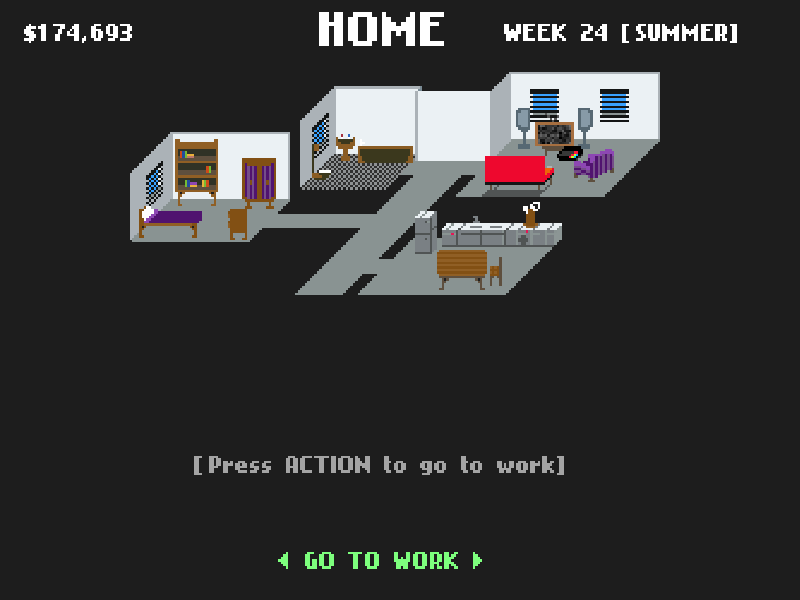
You start every week at home with a view of your apartment, and the option to buy various pieces of new and increasingly expensive furniture. Then you go to work to buy and sell stocks. Buy low, sell high, you get the idea. The market fluctuates from week to week, and it quickly seems a good idea to heavily invest in whichever option has hit its low. At this point you’re a small fry; your bank balance is insignificant and your apartment is furnished in a cheap and markedly unfashionable manner. But as you buy new and more socially accepted fitting for your apartment you’ll grow in importance. You’ll get invited to wild, extravagant parties where you’ll be given insider information about what to buy and when.
If you follow this advice and invest in something at the appropriate time you’ll see its value sky-rocket. And if you play your cards right you’ll have made a million in no time at all.

Increpare - American Dream 2

It’s actually pretty easy to make a million dollars. Stocks will rise and fall in value often, and you can be quite sure that what has just fallen will rise again after a relatively short length of time. Buy low, sell high – that’s really all there is to it. But if you lose that insider information your rise to the top will be slow and tedious.

Every so often a new catalogue will arrive, meaning all your current furniture will go out of fashion. and once that happens you’ll no longer be invited to these sordid, lucrative gatherings of the elite. It’s only when you jump through the social hoops and re-furnishing your entire apartment that you’ll regain favour. Once you do this everyone will forget your past fashion-based indiscretions, and you’ll be the life and soul of the party. More importantly, you’ll be party to those vital financial tips once again, and only by following them will you start to make big money, and be on your way to making your first million dollars

It’s compelling to play the stock market, even if it is just a simple numbers game, and there is a sense of achievement as you get richer and richer. It’s fun. However, that’s not really the point of the game – if it were it’d just be a fun little ten to twenty minute distraction. Instead, American Dream has much to say about the American Dream, and its meaning today.

Increpare - American Dream 4

Everything in American Dream is pointless, and I think deliberately so. At the start of the game you are challenged to make a million dollars, and once you do so that’s it. There is a brief celebration, and I’ll let you see that moment for yourself, but it’s really rather empty. In addition, playing the stock market is easy, and the market is fairly predictable, so after a time it becomes nothing more than moving numbers around while waiting for them to become bigger numbers. You’ll also see from the screenshot above that the stocks in which you can invest are named after various celebrities or characters, most of whom are hardly in their prime. They’re not named after corporations because what the stocks actually are doesn’t matter to you at all – they’re just names with numbers behind them, and all they represent to you is a means to expand your own personal wealth. And as mentioned before, the only way to realistically make the kind of money needed to complete the game is to get into those exclusive parties and hear insider information from fellow party-goers. Unless you’re willing to spend a long, boring time grappling with the game your victory won’t be based on your own wits or strategies – it’ll be based purely on your social position among the elites of this financial world.

And again, your social standing here, again, is not down to your merits as a person or as a player; it depends entirely on whether or not you buy all that expensive, in-vogue furniture you’re told you need. You’ll only be given one option – to buy new furniture or not, and there aren’t any choices of style or colour. It’s all just numbers increasing, and its only effect is to lubricate your movement through the social strata of this new world. Once you buy all the season’s newly fashionable items you’re immediately accepted by the right people, and you can enjoy the fruits of that acceptance in the form of depraved soirees and illicit stock market information. How you make your money never matters, to you or anyone else, and so long as you play your part appropriately things will go your way with the smallest amount of skill and acumen on your part.

Increpare - American Dream 3

So it’s a particularly bleak portrayal. It suggests that the idea of the American Dream, the promise of opportunity and success, can be understood in much the same way as success in this game; it’s not about building anything, or doing anything of some inherent value – it’s about playing the game, knowing the right people, getting very lucky, and making a lot of money for yourself. And it makes this statement purely through the interaction of the player with the game. It never comes out and says ‘all this is meaningless’. It doesn’t try to drive its point home, and instead it lets its mechanics speak for themselves.

This is one of the most (justifiably) self-assured games I’ve played. While many other games try to delivery their own political, environmental, or ethical lessons they’re so often heavy-handed, and their mechanics so rarely make a statement. But American Dream just gives you a system to play with and lets you draw your own conclusions. And if you take it at its surface level it’s a quietly positive game about becoming a financial success. It’s only be interacting with the game, and coming to directly experience its emptiness, that the message comes to you. And I think that’s quite the accomplishment.

Increpare - American Dream 1

You can play American Dream for free online at : http://www.increpare.com/2011/02/american-dream/. Check out Increpare’s other games as well if you’reinterested – they’re unique and, I think, uniquely valuable things.


Posted in Games Blather | Tagged , , , , , | Leave a comment