Videogames and Impermanence

On the 31st of May the servers for Demon’s Souls, the seminal roleplaying game developed by From Software, will be shut down for good. As a primarily single-player game it’ll still be playable after that date, but the online features of the game will cease to function. This got me thinking – videogames, moreso than the products of any other artistic medium, are often transient, ever-changing entities. This can often be a good thing, what with updates and patches adding new content or fixing problems, but it’s hard not to feel a pang of sadness when you realise that many of these works won’t live on to be appreciated by future players.

Sure, other art forms also struggle with impermanence – countless important literary and musical works have been destroyed or forgotten throughout the centuries, and many films, even some from cinema greats like Alfred Hitchcock, have been permanently lost. But while videogames do arguably face this particular problem to a greater degree than other media (much of the hardware early games were stored on has or is beginning to degrade – to the point where such a young medium is already starting to lose important portions of its past) that’s not really what I’m concerned about here. It’s not that important videogames might be physically lost or destroyed, or that it’s harder and harder to actually play older games, it’s that some games, by virtue of how they are as games, cannot last forever.

So long as there are still physical or digital copies of Casablanca we can continue to watch it and continue to enjoy it. Certainly, individual movies may become less enjoyable over time as the form evolves and as social mores change (watch The Battleship Potemkin now and just try to claim that it still stands up as one of the greatest films ever made), but Casablanca will always be Casablanca.

Demon’s Souls is a primarily single-player game, and I would argue that it’s one of gaming’s most important works so far. It’s dark, haunting, and sometimes genuinely moving, and while it isn’t filled with well-written, believable characters, or important philosophical thoughts, it has a power and a wonder that is uniquely Videogame. But, as I said, Demon’s Souls has online multiplayer as well.

The online component of the game is particularly unique, however. As you traverse the world in the game, so long as your console is connected to the internet your game world meshes with the worlds of others also playing online. As I said, it’s broadly single-player, so as you play the game you play it alone. But while you’re traversing the landscape you may from time to time experience fleeting moments of interaction with others. You may see the ghostly image of another player fighting to stay alive in their own game, and you will have no way of helping or hindering them. Occasionally you may see the bloodstain that marks a player’s death in their own world, and you can use it to see the last few moments of their life play out in front of your eyes, perhaps giving you a hint on what dangers lie ahead. And players can also decided to leave ghostly messages warning of an ambush, or a hidden treasure, or a particularly dangerous enemy, and this message will pass into the game of other players for them to see and learn from. Mostly, you cannot directly interact with anyone else, and you’re locked into your own world that only you occupy.
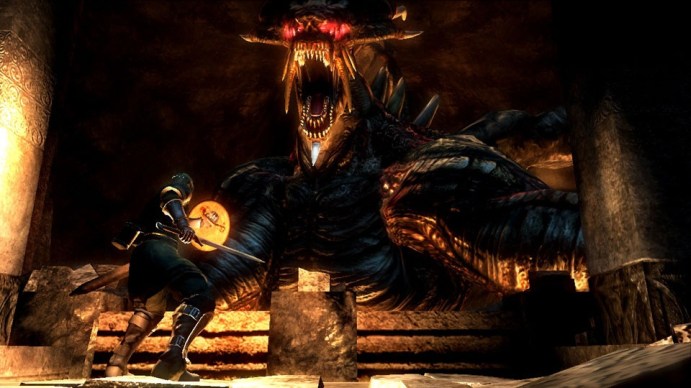
But sometimes players can cross over into another person’s game. A player can summon others into his or her world as helpful blue phantoms in order to team up to face the game’s dangers together, and a player can invade another player’s world as a black and red phantom, hunt them down, and kill them for the souls they carry (souls act as the game’s currency – gained from killing enemies and used to purchase items or upgrade your character).

These limited interactions permeate your experience as you play Demon’s Souls, even when you’re not actively seeking them out. As  you play your own game you will see the ghostly apparitions and receive useful messages from other players. Furthermore, the game has something called World Tendencies, which reflect the actions of players across the globe. Dying shifts the World Tendency towards black, which means that enemies are stronger and powerful non-player-controlled  black phantoms emerge, whilst killing bosses or invading black phantoms shifts the World Tendency towards white, which means that enemies become weaker, while unique characters and objects appear. When played offline, the World Tendency is merely the sum of your own efforts, but when connected to the internet it is the sum of the actions of every player in the world. So the World Tendency shifts as people play, changing small but significant aspects of the game for every single person online.

I’ll probably write something in the future about just why Demon’s Souls is, in part because of these factors, such a phenomenal game, but all that I really need to emphasise here is this: Demon’s Souls played offline is a significantly less impressive game than Demon’s Souls played online. It’s fantastic even offline, but the fact remains that once the servers are shut off on the 31st of May one of the greatest games of recent years will lose a powerful something.

The feeling of loneliness that comes from watching spectres flit across the landscape, knowing that each is its own individual person acting in the real world, and knowing that you cannot interact with them, will disappear forever. The uneasy tension of knowing that at any point another player could come tearing into your world and hunt you down, ensuring you lose all the valuable souls you spent a great deal of effort acquiring, will likewise disappear forever.

One time I spent upwards of forty minutes hiding from an invading player, holding over two hours worth of souls that could be erradicated in an instant if he found me and killed me. I hid in a corner behind a door frame, racked with quiet fear and tension as he skulked around the environment, looking for me. Neither of us knew where the other was, but both of us knew that he was somewhere out there. Eventually, I saw his incandescent red and black frame for the first time and I stayed as still as possible, silent, waiting for him to come through the door by which I was hiding. Soon enough he did, and I sprung my cowardly, cowardly trap: I leapt at him from behind and stabbed him in the back with my sword. In a moment he was dead, banished from my world, and I was finally safe again. He was probable swearing at his screen at all the time wasted, his momentary lapse of caution, such a dishonourable death, and the fact that I was a bastard. Those kinds of moments – those giant defeats and powerful victories, as well as all the moments of quietly joyful cooperation – will never be experienced again. And while people will always be able to play Demon’s Souls, come May 31st they will be playing a different, inferior game.

It’s a uniquely Videogame problem – in no other medium will an artistic work become significantly and permanently inferior after a certain date. And while I’m glad I had the opportunity to play Demon’s Souls during this time, I can’t help be sad that soon I will never be able to recapture that. I can always reread Slaughterhouse Five, and I can always rewatch Let the Right One In, but I can never really replay Demon’s Souls in the same way. And more generally, this is a game that won’t, can’t be fully appreciated by anyone coming new to it after the 31st of May. It’s one of the best games I’ve ever played and in a few short years it’s about to disappear. And the number of people who can be lucky enough to fully appreciate it can only ever go down.

Games where this is true are rare, of course – very few games have such unique and strange online systems. Sure, the servers for Halo 2 have been shut off now for similar, financial reasons, but if someone gets together some friends they can still play multiplayer games just as well as if they were doing so online. But not so with Demon’s Souls. Even if the servers were not shut off people will come to play the game less and less. And since the online component of Demon’s Souls relies on a large pool of players to work, with no capacity to invite friends, this dwindling of players will see the dwindling of a significant part of the magic of the game. I can’t invite friends over to play in the way it used to be – it’s just not that kind of experience. So it’s a uniquely videogame sadness that I feel, knowing that this important game is not timeless, and is instead very, very mortal. So I’m going to say goodbye, because once it gets shut off, once people abandon it, it’ll be irretrievable.

Posted in Games Blather | Tagged , , , | Leave a comment

The Games of 2011 – ‘From Dust’

Once, as a young child bored on a cold, grey beach on the barely-acceptable coast of southern England, I saw a tiny stream of water flowing from a tide pool back into the sea. Armed with just a bucket and my two hands I decided to become the god of this small world. I took handfuls of sand and placed them over the craggy rocks to divert the flow down new paths, I dammed the whole stream and watched the water spill out into new rivulets, and finally when it was time to go I looked back and saw the effect I’d had on this realm of mine – from one small channel of water I had made lakes, waterfalls, and whole diverging rivers.

One of the worst things about growing up is that you’re expected to pretend more and more often that you don’t want to play in the sand, that you don’t want to spend a day exploring a set of woods, building forts out of sticks and logs, and that you don’t want make and reshape islands out of the bubbles in your bubble bath. One day I’ll use my children as an excuse to brazenly do these kinds of things again, but in the meantime From Dust is a wonderful substitute. It’s a game that takes this childlike drive to experiment and reshape nature and allows adults to experience it without facing the kinds of looks a fully-grown man sitting in a log fort typically receives.92992F4FCC4B2DAC21E6FFCBC41765910E168379 (1600×900)

You play as a god of a small tribe that’s trying to follow in the footsteps of their ancestors, who left their homeland and took great power to reshape the earth with them. Throughout the game you steadily rediscover this lost power and make use of it to protect the people and help them continue their journey. Your basic power allows you to draw up a great chunk of matter, move it about, and place it somewhere else. This may involve picking up a mass of earth and using it to dam the source of a river, sucking up water and dropping it on a forest fire, or taking molten lava from an erupting volcano and cooling it in the ocean to build a footpath from one island to another. These basic interactions, picking up and relocating earth, lava, and water, form the core of your experience. As you progress in the game you unlock new powers that can radically alter how you interact with the environment. One temporarily solidifies all the water in a stage, for instance, while another evaporates the water, leaving riverbeds and lakes dried up for a short time. Each has its own use, and you’re free to experiment with them at your leisure.

The game is divided into discreet stages, each containing a passage leading into the next.  This pathway is sealed at first, and to unlock it the tribe must activate all the totems in the area. You can order members of your tribe to travel to a totem, and by activating the totem the people form a small village around it. Most totems grant you a new power to use in that stage, so long as the village isn’t destroyed by the elements. Some are in hard to reach areas – at the bottom of a lake, on top of an inaccessible mountain  – and some are in dangerous locations – in the shadow of an active volcano, on the shore of an island periodically hit by tsunamis – and it’s your job to make sure that your people reach them and maintain them safely. To do this you simply use your available powers to reshape the land.

24A382E8934C8898DB010EF58590B49062383DD0 (1600×900)

The real joy in From Dust doesn’t hit you until a good while into the game. At first you may just plough through stages using the same methods over and over again, and the game will seem a little disappointing. It’s undeniably fiddly, and there are a good number of technical annoyances to boot. For instance, when directed to go some place the members of your tribe might take an unnecessarily long route, or get stuck on a gentle incline and refuse to move for no good reason. Drawing up and setting down matter is also more cumbersome than it needs to be, and it never really feels like you’re able to pick up enough quickly enough.

Unfortunately the game simply doesn’t do enough to lend your actions a satisfying tactile friction, and so it’s only the effects of your actions, not the actions themselves, that are compelling. Precise activities such as building a bridge out of cooling lava, or removing small puddles of water in order to place a totem on fully dry land, are often frustrating, in part because the camera itself doesn’t make it entirely clear exactly where on the map your cursor is. And the camera as a whole is simply unsatisfying – it’s a static affair of being either zoomed all the way in or out, whilst the requirements of the game, and the wonderful detail in the game’s environments, call out for a camera you can move about and angle freely.

F5F1653D8E51859158F556E16218145B9A0D6277 (1600×900)

So, what’s so special about the game – why does it rise above the interface hiccups and technical oversights? In a word: emergence. The relatively simple interactions between the elements in From Dust conspire together to lead to impressive complexity. A volcano may erupt, spilling lava down into the sea so that it cools and completely alters the layout of the land. Plants grow and spread so long as earth is supplied with water, and from a single village flora can spread across an entire level, climbing over mountains, clumping around lakes, and crossing land bridges you construct to colonise distant islands. Fire spreads as lava reaches forests. Rivers spring up from underground sources as you remove earth and find paths to the sea, or form lakes based on the topography of the surrounding region.

Once you start to notice all this the game has a tendency to alter your way of thinking about it. You stop building bridge after dirt bridge to reach all the totems in the level as fast as possible, and instead you start to play around with all the elements in your chemistry kit, all the sand in your sandbox. You wonder if you can use lava to divert the flow of a huge river, if you can force rivers into volcanoes to neutralise their danger, and you immediately go about testing these ideas out. The game stops being a rather humdrum matter of escorting AI with pathfinding problems and becomes a playground where everything can change, with or without your input, in significant and visually arresting ways.

DE0A42C1C7D64241E2DFBB922089A6B59CE65FC1 (1600×900)

And yes, the game looks incredible. The artistic style – approaching photorealism before veering off at the last minute – is wonderful almost without exception. Everything that happens looks impressive, and since almost everything that happens in the game is unscripted, this is all the more impressive. Certainly, it’s not perfect – the edges of the map are marked by odd and unnecessarily visible lines, characters sometimes move over terrain in a shonky fashion, and tsunamis lack a certain visual fluidity – but this is by far one of the most beautiful games of the year.

From Dust gives us a sandbox and asks us to play, and several levels, especially towards the end, give you inspired conditions to work in. One puts you in a barren desert where hundreds of little sources of water lie under the sand, ready to spring up wherever you remove earth, leading to a swiftly changing landscape of bubbling rivers, pooling lakes, and flourishing plant-life. Another places you in the caldera of a giant volcano where lava periodically floods the area, leading to constant, varying efforts to get your people to higher ground. While not all levels are as clever each offers you the opportunity to find new ways of sculpting the landscape in useful or merely entertaining ways.

1EDBD271642DAF71C008D9C68C1871469F83CA1E (1600×900)

The game ends with perhaps my favourite sequence in a videogame this year – after hours of playing a small-time god that can only alter, not create, you’re faced with a blank stretch of sea and left to your own devices. Suddenly, instead of merely being able to pick up and move pre-existing matter you can create from nothing. With the press of a button land rises from the sea. You raise mountains, carve out valleys, tell fresh spring water to shoot out of the ground. You can call forth plants or sweep the land into a barren desert. You summon volcanoes and tidal waves and sink whole islands into the sea forever. All this for your own pleasure, with no directions or goal. It’s the perfect ending to a game about being a God, about being a child playing with sand and water on the beach. It takes you back to that young dream of sculpting nature to your liking and reintroduces you to the pleasure of unstructured play, the joy of emergence, that is all too easy to forget.

F1E5E65DDCCA1E1CE8E5105EB723D7EAF8B1A0A6 (1600×900)

Posted in Games Blather | Tagged , , , , | Leave a comment

The Games of 2011: ‘Dead Space 2’

9141F279E50AD9821AB14559A953FEC8B00B001F (1600×900)In Dead Space engineer Isaac Clarke found himself trapped on the USG Ishimura, an interstellar mining ship designed to rip apart whole planets for the vast resources within. The inhabitants of the ship had mostly been turned into gruesome monsters, and Isaac had to find a way to (a) rendezvous with his scattered companions, and (b) get the hell away from that ship. This involved a somewhat slow trudge through the ship, fighting monsters, managing scarce supplies of ammunition and medication, and generally being ordered around via radio by his startlingly unhelpful crew-mates.

Well, spoiler alert but at the end of the game Isaac managed to get away in an escape pod after everyone else died. Dead Space 2 takes place years later, after Isaac is finally picked up from the depths of space and taken to Titan Station, a colony built on the remains of one of Saturn’s moons. A new Marker, one of the terrible alien artefacts from the first game, has mysteriously appeared on the station, and as such people are once again being slaughtered and turned into twisted masses of angry necrotic flesh. Isaac is apparently one of the last human survivors, and the drive of the narrative is this: destroy the marker, escape. All other matters are secondary. 78A1BC1F2BA3BCF3B92300813AFE91B16C2C3D4B (1600×900) As with the first game, the enemies in Dead Space 2 can’t be dispatched as easily as you’d like. Shoot them in the chest and all you’ll do is stun them momentarily. These are masses of anonymous dead flesh – you’re not going to hit a vital organ here. The only way to survive is to rip the enemies apart limb by limb. Shoot the bog-standard enemy in one of its arms a couple of times and the arm will burst off. Shoot it in the legs and it’ll have to crawl its way to you. Shoot it in the head and it’ll become blind, wildly running to and fro, swinging its deadly appendages about. So, uh, don’t shoot it the head. Years of violent videogame experience has taught us to always go for the head, and here that tactic is either useless or actively suicidal.

At first you’ll be able to mess up quite a bit without dooming yourself. But soon you’ll have to be smart, and you’ll have to develop a steady, patient hand, because it’ll start throwing all manner of monsters at you in large numbers, each requiring different tactics. If you panic and start firing wildly you’ll use up your already-inadequate resources, you’ll waste those precious few seconds of safety, and you’ll be dead before your decapitated head hits the floor, which makes sense really. You’ll need to learn to prioritise target, and prioritise exactly where on each target you want to shoot in order to thin the enemy’s ranks quickly and efficiently. A smart, well-placed shot can save your life, and a particularly stupid shot can end it spectacularly.F7C037849B34D9F9F853DBD4C84F119C261AF5E8 (1600×900)

This is a sequel that makes rather big changes to the formula of the first game. Gone are the semi-open levels of the Ishimura, and mostly gone is the slow sense of fear and dread that came from edging your way around these imposing levels. Dead Space 2 s an action game, not a survival horror game. You don’t feel like the lowly, panicking engineer Isaac was in the original game, and instead you quickly start to feel something of a super-soldier. You’re always in serious danger, especially if you play at higher difficulty levels (where the game really shines), but it’s more action hero danger rather than horror movie danger.

But though I really liked the first game I don’t mind this big shake up. I don’t care that the game funnelled me down one unwavering path with little to no opportunity for exploration. And I don’t care that it isn’t at all scary. Because this simply isn’t trying to be that game. It’s trying to be an action game, and it turns out to be a pretty great action game at that – filled with challenging, complex combat, and countless impressive set-pieces where big things smash into one another in satisfying ways. The combat does get out of hand once or twice during the game’s length, however, and there are moments of feeling like you’re running up against an automatic door over and over again until it arbitrarily decides to open. The final boss fight in particular puts you in an unfair, drawn-out, and downright annoying situation, and for me at least there was no option but to lower the difficulty level briefly in order to complete the game.

7D3BF5E369CE0E6709DFB8A13499FCC445D90FD4 (1600×900)

However, there is one thing I really miss: the tense horror of the first game’s zero-gravity sequences. There are still parts where Isaac goes out into the blackness of space, but because his suit now has the ability to fly around in zero-gravity all of the tension is gone. There’s no longer the risk of mistiming a jump, colliding with the station’s hull, and floating helplessly off into space. Combat doesn’t really work in these sequences either, and it seems that the developers realised this because you’ll almost never have to fight without both your boots set firmly on solid ground.

So, it’s a bombastic action game with frantic, interesting combat. But it also places quite a big emphasis on its story. Some people say that the writing in Dead Space 2 is schlock, but I say that it is damn great schlock. It’s hardly going to win awards for originality or for the depth of its characters, but it tells a good tale, and its small cast of characters are well-written and well-acted. Unlike in so many hopeless-horror settings I actually cared about and liked the survivors, and I was genuinely worried whenever it looked like things were going to end horribly for one of them.

It’s as compelling a game as the first Dead Space, though it’s arguably a less imaginative and original output overall. The game’s combat and resource-management remained compelling throughout, and I was consistently taken aback both by how much I cared about the characters, and by how much I wanted to find out what was going to happen next. I really wasn’t expecting to like Dead Space 2 so much considering the new action-oriented direction it was taking the series in, but it continued to impress me, if not shock or terrify me, until the very end.
Posted in Games Blather | Tagged , , , | Leave a comment