The Games of 2012: Super Hexagon

221640_2013-04-26_00001

Terry Cavanagh’s ‘VVVVVV’ was Haruspex Games Official Game of the Year 2010. It was brief, it was smart, and every aspect of it was unbelievably tight. It was very nearly perfect. Super Hexagon is perfect. It’s a single idea refined over and over until it simply couldn’t work any better, with a simple, clean interface, and three looping musical tracks that will burrow into your brain and lay their eggs there.

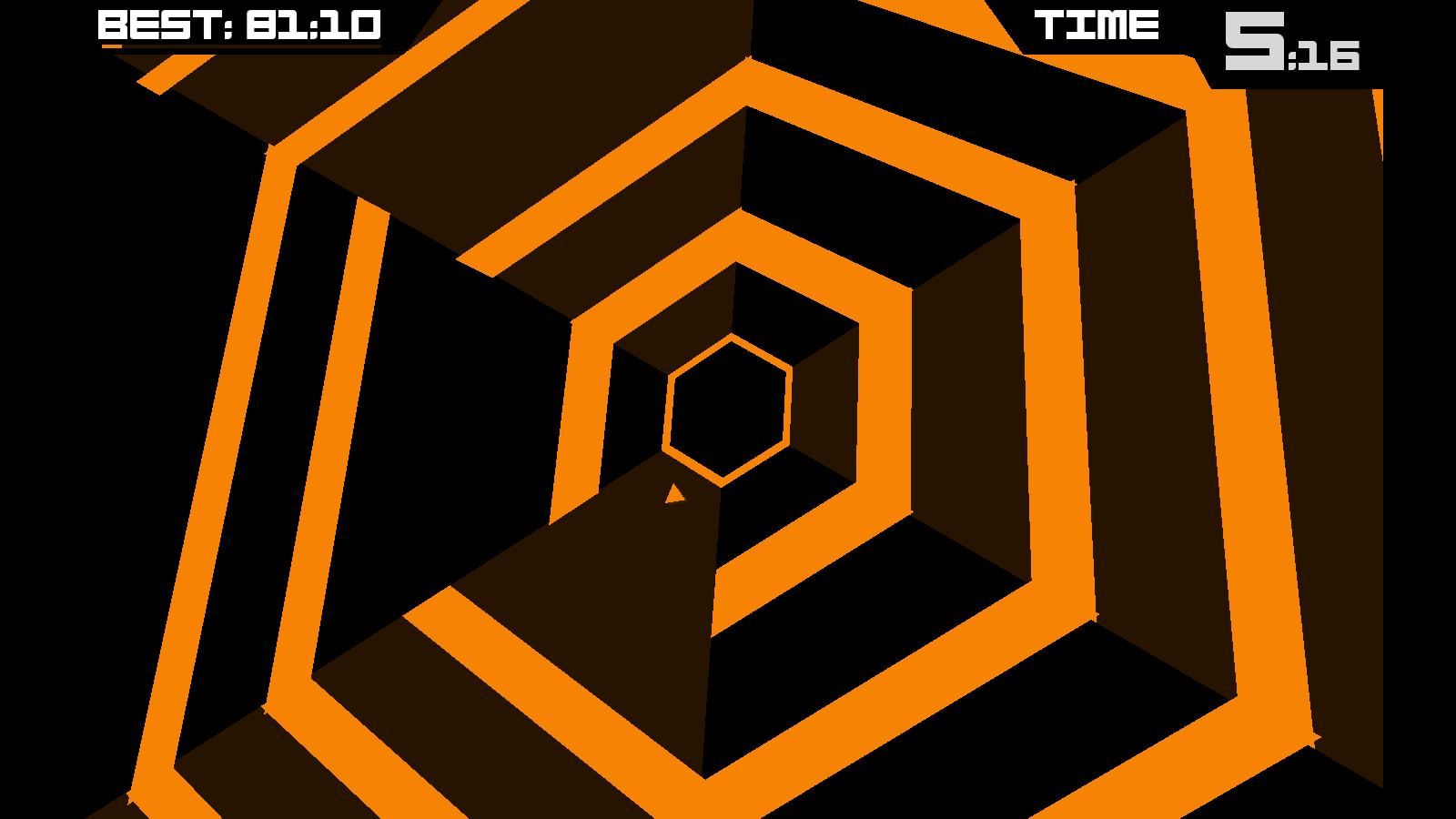
I guess you could call it a rhythm action game, because like Guitar Hero or Dance Dance Revolution, it’s all about doing the exact right thing at the exact right time. Only, here it’s not hitting notes or dance moves as they fly towards the top of the screen – it’s rotating a tiny triangle around the centre of the screen while geometry contracts around you at hyper-speed. My god, that didn’t make any sense. Just watch the video:

The first time you play Super Hexagon you might spend an hour before you can last fifteen seconds on the first stage. But by practice – by improving your reaction time and by learning the patterns of its randomised stages – you’ll stop failing every five seconds, and slowly start to make your way towards better and better scores. Forty seconds, fifty seconds, maybe even sixty seconds. My god, maybe more. And once you hit sixty seconds and it’s perfect and your heart starts beating again you can move onto the next stage.

And then you’re back at the beginning, and everything is incredibly painful again.There are new patterns to learn. The screen rotates more suddenly and more often. And things are faster – so much faster.
221640_2013-04-27_00009

But you get better. And you become precise. And you do it again and again and again (and again (and again (and again))). But it’s not a grind. And while you could call it addictive it’s not the bullshit Skinner-box addictiveness of many (most) RPGs and MMOs. It’s not ‘I need to get ten wolf stomachs to turn in for this quest so that I can level up, which will qualify me for this next quest where I have to find ten wolf stomachs’. It’s perfect, arcade-style compulsion on par with Pac Man, or Space Invaders, or Tetris. You’ll want to keep playing over and over again not so that you can level up or get some arbitrary reward, but because holy shit this game.

It’s intoxicating in a very real way, and it does strange, fascinating things to your brain. It makes time expand and contract without your prior consent. You’ll be going for ten seconds and then immediately hit the one-minute mark. A particularly lucky run will make you think you’re the king of the world, then you’ll fail and realise you were only alive for six and a half seconds. You’ll gradually shift from constant all-out panic to steely, focused calm, your whole body motionless, the outside world missing, presumed dead, and your pulse pounding along to the beat of the music. And when you come back to an early level after playing later stages you’ll swear the entire world around you is moving in slow motion. What seemed objectively too fast for your reactions two hours ago is now slow, slow, slow. Because you’ve moved that much closer to perfection.

221640_2013-04-27_00006

Posted in Games Blather | Tagged , , | Leave a comment

Things of the Year: Part Two

Mechanic of the Year: First Draft of the Revolution Letter Editing – First Draft of the Revolution (Emily Short, design and coding by Liza Daly)

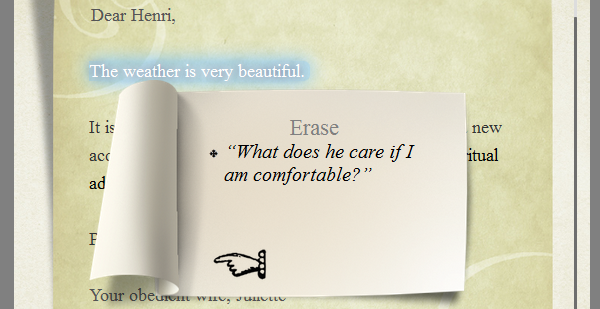
First Draft of the Revolution is a game about editing. It hands you a series of letters written by various interlinked characters, and tasks you with refining them before they’re sent. For each letter the game gives you a series of choices – from changing the tone of certain parts of the text, to focusing on one topic over another, to adding or removing sections entirely. Initially this seems to offer the player a large amount of freedom to alter the text as they like, but it quickly becomes clear that the boundaries of the choices you’re presented are extremely limiting.

You simply can’t turn a quiet, unassuming letter to a husband into a scathing demand for justice, or a veiled rebuke to a wife into an heartfelt apology. Each character has their own personality, and their own life independent of the player, and this limits the kinds of edits you can make. So it’s not a game about allowing the player to write what they want – it’s a game about well-defined characters, and coming to understand them through the way they write, and the way they edit what they write. You can assert control over the details, but ultimately it’s not your story.

The limitations the game places on the choices the player can make are mirrored in the story of the its central character. She’s forced both by her husband and wider society to take on the role of the quiet and demure wife, even as she’s being ignored and pushed away into what is effectively a form of exile. So strong are the societal pressure and expectation she faces that, while others boldly lie to and withhold information from her, she’s forced to edit her letters so that they say what others want to hear, rather than what she actually wants to say. This tension is presented wonderfully, and in large part it’s presented through the letter editing mechanic itself – in the kinds of choices it offers you, and the brief glimpses of her thought process that you’re shown as you edit her work. As a result playing the game is sometimes heartbreaking – forcing you as it does to slowly excise any kind of flare or rebellion in the words she writes, in favour of quiet acceptance and achingly subtle displays of sadness and frustration.

It’s at moments like these that the strength of the mechanic really hits home, both as a way of furthering narrative, and as a way of exploring characters, relationships, and societal pressures in intelligent, affecting ways. I’d love to see Emily Short, or someone else if need be, take this mechanic and run with it, because my god does it have legs as a storytelling form.

Runners Up: RepubliaTimes Newspaper Editing – The Republia Times (Lucas Pope)

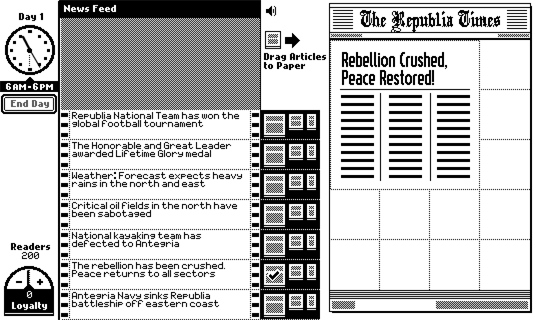
The Republia Times sets you up as a newspaper editor serving an autocratic and potentially violent, unstable political power. Each day you’re given a selection of news stories, and tasked with laying them out to construct that day’s paper. It’s your job to gauge the effects of each story, both on the paper’s popularity and on the political loyalty it inspires in its readers. Running pro-government or anti-revolutionary stories will help sway public opinion, but too much straight, dry propaganda will cause your readership to lose interest in the paper. Similarly, while popular topics like sports and celebrity gossip will keep the readers happy, space is extremely limited, and your family’s safety depends on your unwavering positive portrayal of your government overseers.

Things never really get particularly difficult, or particularly complex, and so it remains easy to manage the paper successfully throughout the entire course of the game. But complexity or challenge isn’t really the point. As as a mechanic, the act of editing newspapers feels incredibly rich, and it’s great at fleshing out the world of Republia organically through the act of play. Like letter editing in First Draft of the Revolution, newspaper editing feels like it has real legs, and I’d love to see it used to tell further stories.

Awake - Kerry Turner Typing Tutorial – Awake (Kerry Turner)

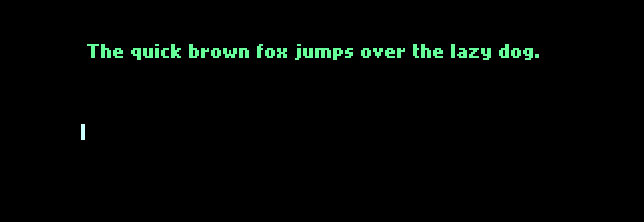
Made in the ‘One Hour Game Jam’ at last year’s Rezzed, Awake manages to turn the typing tutorial into a surprising experiment. When I saw it last year I marvelled at how smart an idea this was: to take such a mundane example of player input and co-opt it, using it instead to present the player with something genuinely unsettling.

A similar, and similarly effective, approach has recently been used in the two short games ‘Gurney’ and ’30 Flights of Loathing’ from Pippin Barr’s fantastic ‘Mumble Indie Bundle’.

Best Use of Music

Tribes: Ascend

This choice feels kind of weird, because Tribes: Ascend isn’t a game with a particularly memorable soundtrack.  Most of the time when it is there it’s just there, to be honest. But the moment you swoop down and take the enemy’s flag is the moment that mundanity turns into The Most Exciting Moment of Your Life.

There was nothing more exhilarating for me this year than hurtling away from an enemy’s base at over two hundred kilometres an hour, their flag safely in hand, that music suddenly blaring in my headphones. Each time I executed a perfect flag-grab, only to hear this music kick in, I felt my pulse accelerate at the speed of sound, and not drop back down to safe levels until good minutes later.  Similarly, there was nothing more hilarious this year than respawning as a heavy soldier, finding an enemy flag dropped near my base, and slowly trudging the twenty or so feet back to score, all to the sound of the most bombastic dubstep the game could throw at me.

Runners Up:

Super Hexagon

Super Hexagon

Hotline Miami

Hotline Miami

Posted in Games Blather | Tagged , , , , , , , | Leave a comment

The Games of 2012: Slave of God

SlaveOfGod 2013-03-20 13-40-43-00

Stephen Lavelle – the man behind Increpare – is a fascinating and undoubtedly gifted developer. He’s also extremely difficult to pin down. The hundred or so games on his site are wildy disparate things. Some, like Missing and The Terrible Whiteness of Appalachian Nights, are brief exercises in building atmosphere. Others, like the blindingly intelligent untris and English Country Tune, are abstract puzzles based around tight, novel mechanics. And others still, like Kettle and Home, are strange combinations of the two approaches.

What’s most impressive is not that he dabbles in these different realms of game design, but that, more so than anyone other developer I know, he’s a master of them all. Not only does he routinely invent, use, and discard mechanics that other developers might base an entire career around, but his less mechanics-and-systems-heavy games are equally impressive. He’s an expert at capturing a certain feeling, or a certain place, or a certain moment in time.

SlaveOfGod 2013-03-20 13-40-19-39

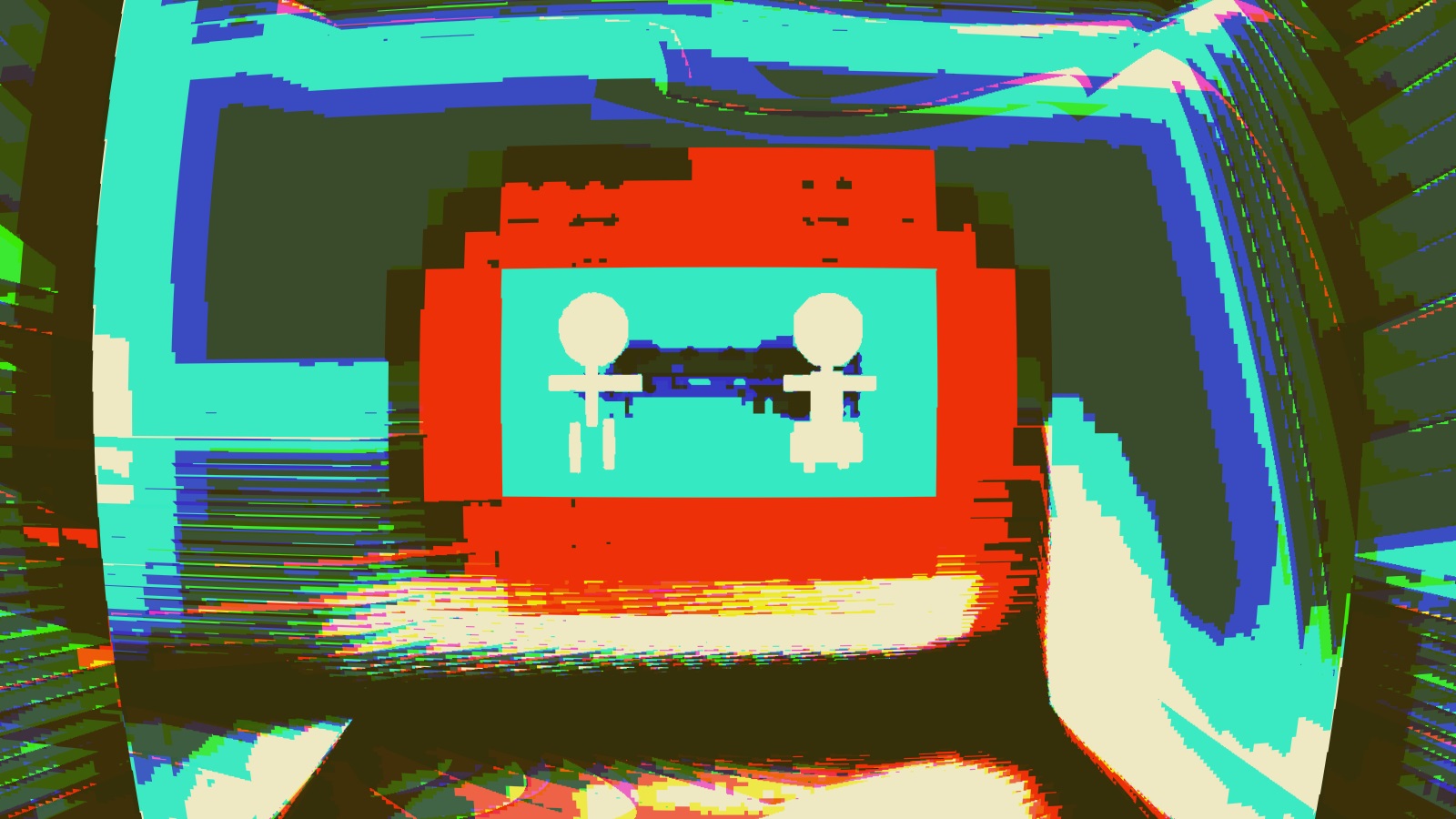
Slave of God is a game about a feeling and a place and a certain moment in time. Like Activate The Three Artefacts And Then Leave it’s an instant assault on the senses, with every sight and sound moving and contorting, doing their best at all times to leave you feeling lost. But where Activate The Three Artefacts could be best described as an abstract fever dream or some kind of geometric purgatory, this is a game about going to a nightclub while completely off your face. It’s a game about getting drunk, possibly more, and seeing the walls spin.

The game begins and you find yourself in the lobby. Colours are lurid and neon and absolutely everywhere. They cover every available surface, and they never stay still. It’s a frankly brilliant feat of visual design, and it’s immediately both arresting and overwhelming. But it’s not just there for show. It’s there to capture the feeling of being completely intoxicated in a safe, if unfamiliar place, and it does so perfectly.

If you were to insist that every game needs a central mechanic I’d say that Slave of God’s central mechanic is ‘knowing where you are’. Sometimes simply retracing your steps down a corridor can be the hardest thing in the world, and the moment you find yourself stumbling into some new place is often the moment you completely lose your bearings.  So, it can be remarkably difficult to tell where you are, or just what’s going on, but it never feels wrong. Sure, you may get the occasional bout of drunken paranoia, and it may even get so confusing at times that you feel like you’ve said a permanent goodbye to Euclidean space, but that’s really all part of a good night out, isn’t it? Without the lows the highs just wouldn’t be as high.

SlaveOfGod 2013-03-20 13-37-38-48

And just as the game captures the confusion and disorientation of a good night out, it also captures the highs. Because not only does the game’s visual style work to make you feel confused and intoxicated, it also helps to recreate the illusive feeling of euphoria that can come to you, dumb and  light-headed on the dance floor.

As soon as you step up onto that dance floor everything changes. Lights and colours flare. The people around you shift and strobe rhythmically. The music, elsewhere a constant, mercilessly hypnotic background noise, becomes something altogether different. And then you lock eyes with that one person and, in an instant, it feels like you’re the only two people on earth.

It’s a game that recreates the feelings and the experiences of the entire arc of the world’s most intense night out, but it’s made out of small, wonderfully realised moments: from stepping onto the dance floor for the first time, to getting lost somewhere you know you’re not supposed to be, to heading for the toilets to cool down because everything is just too intense. These moments arise from such clever use of the game’s visual and audio presentation that it’s tempting to describe them all in detail, but unfortunately talking about them risks undermining their surprise, and their magic, so I’ll cut this short and let you discover them for yourself.

I’ll finish, then, by saying that this is one of the year’s most imaginative, impressive games, from one of the medium’s most consistently impressive, surprising talents. And by saying that you really should play it. Though, um, very much a seizure warning on this one.

SlaveOfGod 2013-03-20 13-40-28-50

Posted in Games Blather | Tagged , , , , | Leave a comment