2018: The Year in Books – ‘NW’ by Zadie Smith

(In part seven of our 2018: The Year in Books series, we look at the best Zadie Smith novel I read in 2018 (I read three). Is it good? (yes) Is it very good? (also yes) Will you like it? (maybe) How many parentheses can I nest inside other parentheses in a single paragraph? (this many))

The Best Posh Boy in a Novel Award 

Zadie Smith – NW
NW

NW follows the lives of three people in North-West London, each the focus of one of the novel’s major sections. First, Leah Hanwell struggles with her strained marriage, her strained relationship with her mother, and various other sources of gnawing strain. Next, Felix Cooper encounters reminder after reminder of his troubled past (and also encounters the best-written posh boy in all of fiction). Finally, Natalie Blake is a high-powered lawyer in the city with a guilt-inducing family life, a (you guessed it) guilt-inducing marriage, and various other sources of gnawing guilt.

Like every Zadie Smith novel I’ve read, at times the plot ambles along pleasantly, and at other times seems to completely disappear for long stretches. But this is exactly what I want from a Zadie Smith novel. Smith is, in my opinion at least, the best in the business at writing characters. Not necessarily ‘strong’ or likeable characters (though many of them are), but always astonishingly unique, well-sketched, flaws-and-all people.

Her books aren’t plotty by any means. An unfair negative criticism would say that nothing happens in a Zadie Smith novel. But my (entirely fair, objective, handsome) response would be that exactly enough happens. Her plots don’t need to do anything more than offer up enough varied opportunities to get to know the characters, who are the true stars of the show. And that’s exactly what they do.

NW is no different. Reading it is basically just a way of mainlining its protagonists – injecting interestingly-written, unique central characters directly into your veins at the expense of everything else. (if that sounds like torture to you, then maybe pull the ripcord on this book right now, because that’s Zadie Smith)

We spend the whole of NW getting to know the central three (arguably four) characters – getting into their brain, learning their tics and their hangups, and seeing how they react to the world around them. In almost any other writer’s hands this simply wouldn’t be enough. But with Smith it just is, because her characters are so good.

Take the aforementioned posh boy – he’s a minor character who appears in one scene and is then quickly forgotten. But he’s so incredibly well-observed that he comes alive on the page in a way central characters of other novels can’t manage. And so does Felix’s ex. And Leah’s mother. And every other person in the entirety of NW.

I read NW almost a year ago now, and I still think about how utterly perfectly that posh boy captures the classic human archetype of ‘friendly, bumbling, incredibly frustrating posh boy’ I’ve met so many times. I really don’t think I’m exaggerating when I say that Zadie Smith is a genius at observing human behaviour and putting it down on a page in a way that is so true to life it hurts.

So impressive is Smith’s skill at writing characters that it’s easy to forget that her skill at writing sharp, page-turner prose is (also) nearly unmatched. Her writing is sardonic, but understanding; concerned with digging into the nitty gritty of complex, sweeping social problems and individual human psychology, but easy and breezy reading where many of her contemporaries can only be called (if we’re being generous) hard bloody work. She does what other writers can only dream of: write incredibly fun novels that are also considered capital S capital F ‘Serious Fiction’.

I suppose it makes sense that someone so good at understanding what makes people tick would also be good at being funny and engaging, but it really is remarkable how enjoyable it is to read a Zadie Smith book. Hell, White Teeth (which I also read this year, and also highly recommend) is nearly 550 pages, and I breezed through it. 550 pages! Normally 550-page books are the kind of ‘eat your vegetables before you can have pudding’ books I convince myself I have to read, and then convince myself were worth reading despite being dry discussions of how hard it is to be a 60+ year-old creative writing professor who is having an affair with a sexy 20-year-old female student. (with a few pages about leaves meaningfully falling from a tree or something)

Where was I? Anyway, Zadie Smith is great. You should read her books. Especially this one.

That’s pretty much it for this review. If you’re interested in reading about characters that are so well-sketched they jump from the page and lodge in your mind like horrible (fun) brain parasites for months, if not years, then you should read NW. If you’re interested in reading one of the best accounts of what it’s like to live in a specific part of London at a specific moment in time, then you should read NW. If you’re at all interested in contemporary fiction, to be honest, you should probably give Zadie Smith a read – and NW is a really great place to start.

Thanks for reading. If you liked this post, and like using Twitter for some reason, follow me on that awful website here.


Posted in Books | Tagged , , , | Leave a comment

2018: The Year in Books – ‘The Player of Games’ by Iain M. Banks

(In part six of our 2018: The Year in Books series, we look at a science fiction book that is neither ‘space lasers and jedi men’ space fantasy, nor ‘giant abstract babies orbiting earth’ weirdness. Strange, I know. But I think you’ll like it – even if you’re not generally a reader of science fiction.)

The Science Fiction is Good Actually I’ll Have You Know Award 

Iain M. Banks – The Player of Games

The Player of Games

I first started reading The Player of Games a decade ago, but gave up after less than thirty pages. It just seemed to be about some tired man being a bit listless. How could this be science fiction, I thought, considering the blatant lack of lasers and/or proper explosions?

Earlier this year I noticed it languishing at the bottom of my collection, and thought I might as well give it another go. With the added wisdom of ten extra years of definitely-not-wasted life, would I find something to love in this book? (spoiler: obviously yes)

The Player of Games is part of Iain M. Banks’ Culture series – the titular Culture being a post-scarcity, interstellar anarchist-utopia where humans and sentient AI live together in harmony. Since everyone’s needs are met almost instantly, people start looking for something to occupy their time. For many, games fill this space, and for some they become an obsession.

Jernau Morat Gurgeh (I promise this book has the minimum of bullshit science fiction names in it) is perhaps the greatest game player in the entire Culture, able to master even the most complex, esoteric board and card games from across the galaxy.

Tired of his easy life of luxury, Gurgeh signs up for Contact – the organisation tasked with establishing and maintaining relations with non-Culture societies. Soon he’s sent to the Empire of Azad (this is the last weird name I’m going to use, please trust me) – a militaristic autocracy where one’s ranking at a single impossibly-complex board game determine one’s station in life. Everything from civil servants, to top generals, to the very emperor himself, are chosen by how well one does in this game.

It’s Gurgeh’s job to master this impossible game, and hold his own as representative of the Culture against this backward, murderous regime.

So, The Player of Games is about games – how the games a culture creates, and the way they play them, can say something fundamental about that culture’s philosophical or political outlook. And how a single game can become all-important – eclipsing any other concern – to the two playing it. But, like many great science fiction novels, it’s also about encountering another culture – another utterly alien worldview and way of life – and coming away from it changed.

The first third of the book, before Gurgeh leaves the safety of the Culture, is good reading, but very listless. It’s never explicitly stated to the reader, (this book is impressively subtle and restrained for a book about alien societies competing via made-up board game) and everyone seems to be having an all right time, but the Culture is boring.

In a world where no one wants for anything, what gives our lives meaning? What can you do to fill up the time, except fritter it away on games and travel and lots and lots of parties? Is this a bad life? Of course not, but to Gurgeh, at least, it’s increasingly unfulfilling.

But in the proletariat-crushing, alien race-massacring, violently sexist culture of Azad, he finds something he was lacking. A strong purpose – to rebuke this awful worldview, as champion of the egalitarian Culture? Maybe just that, at first. But as the novel goes on, and Gurgeh spends more time on this foreign world, he starts to understand how these people think, and how that’s reflected in the way they play the game. And it starts to have an influence on his own way of thinking.

Because despite (or perhaps because of) the inequality, violence, and staggering unfairness of Azad, it’s impossible to argue that it’s not more interesting than the Culture. The Culture is boring, safe, comfortable – Azad is full of the kind of conflict and struggle that can give one’s life meaning.

One of the most interesting threads in The Player of Games is how malleable our way of thinking can be – how our environment determines a large part of who we are, and how a new environment can change just as much of us. As someone living halfway around the world in an extremely different culture, there’s a lot I recognise. (not so much the ‘evil interstellar empire’ part, though)

The Player of Games loves dealing with high concepts – warring ideologies; the difficulty of finding meaning in a world of automated luxury; the power of games to define people and cultures. But Banks is also exceptionally good at the personal – his characters are multifaceted, complicated, and at times baffling in that way only great characters can be. His depiction of the boring-yet-safe-and-perfect-yet-boring Culture, and the savage-but-you-have-to-admit-kind-of-cool Empire of Azad are nuanced, and thoughtful – very nearly approaching Ursula K. Le Guin’s anthropology-science fiction masterpiece The Left Hand of Darkness.

And as I said before, all this is approached with an admirable subtlety that prevents the Great Battle of Cultures from descending into farce. You’re never told the message, nor even expected to figure out the author’s Singular Message for yourself. This is very much ‘your own conclusions’ territory – ‘applicability rather than allegory’ territory – which in my books is the very best territory to be in.

Thanks for reading. If you liked this post, and do the whole regrettable Twitter thing, follow me on Twitter here.

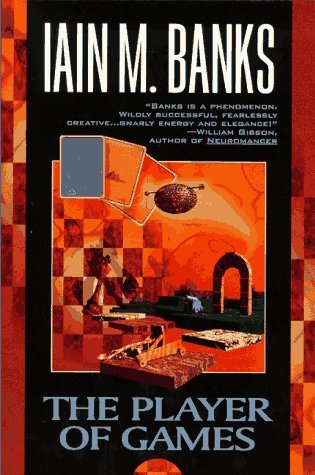
To end this post, let’s play a game of ‘No One Knows What the Hell To Do With Science Fiction Book Covers’. I mean, just look at these ones I found online. You can tell the illustrators heard ‘sci fi novel’ and immediately stopped listening and drew a laser blowing up a ship, only to be told sternly ‘no, it’s actually about board games’ before panicking for a month and drawing something an hour before the deadline.

Vote for your favourite in the comments below. My personal favourite is ‘Ponytail Guy and Man Sitting On Transparent Box of Fossils Play Board Game Next to Big Fire’, but I also have space in my heart for ‘Cool Man Posing Next to Incongruous Pink Statue’.

18630

theplayerofgames

2012-01-27_image1

Posted in Books | Tagged , , , , | Leave a comment

2018: The Year in Books – ‘The Things They Carried’ by Tim O’Brien

(In part five of our 2018: The Year in Books series, we look at a collection of stories about the Vietnam war. It’s really good. I honestly don’t have any jokes for this first part so I’m just going to get started.)

The Buy The Audiobook Version Because Bryan Cranston Narrates It and He Does a Great Job Award 

Tim O’Brien – The Things They Carried

The Things They Carried

Tim O’Brien was an infantryman in the 23rd Infantry Division of the US Army during the Vietnam war. The Things They Carried is a series of linked short stories that follows the 23rd Infantry Division; O’Brien himself regularly, but not always, appearing as the viewpoint character.

Each story describes some true event in O’Brien’s experience of the war: the death of his fellow soldier Ted Lavender; Henry Dobbins wearing the stockings of his girlfriend around his neck as a kind of good-luck talisman; O’Brien’s first experience of killing an enemy soldier, and imagining the life life that man must have lived before he took it away.

Only, they’re not true events. In a later story O’Brien tells us that he didn’t in fact kill that man – he merely saw him die. Why, then, write the story that way? Why – if these stories are fiction, not fact – place himself in them as a central character? Because these stories are true, even if they’re not.

O’Brien introduces us to what he calls ‘story truth’ and ‘happening truth’. The stories in The Things They Carried are true, in large part because they didn’t technically happen, or at least didn’t happen in exactly the way described. They truthfully describe the war, and how it felt to be there, far more so than a factual account of what happened from day to day ever could.

And he’s right. Or else, why would anyone write fiction? To quote The History Boys: “with a poem or any work of art we can never say ‘in other words.’ If it is a work of art there are no other words.” Stories are – at their very heart – ways of communicating important things that can’t be said any other way. You can’t describe what it’s like to look at the world through your eyes; to see what you see; to be on the other side of the world with a rifle in your hands, watching someone – a stranger – your enemy – a person – die. But a story can.

And O’Brien’s stories do. They tell you about long days of nothing –  monotonous walking from point A to point B, then from point B to point C, and onwards. They tell you about someone being there, and then you turn away and there’s a flash of light and they’re not anymore, and you spend the rest of the day gathering what’s left of them to send back on the next helicopter home. They tell you about sinking into waist-deep mud under enemy fire, just waiting out the night. Do I know what war is like? Not one bit, but I know something of what Tim O’Brien’s war was like.

The stories in The Things They Carried are beautifully written – at times funny, at others genuinely devastating. They’re lies – possibly all of them. But they’re the kind of lies that tell you the truth.

Thanks for reading this post. Go and read (or ideally listen to the audiobook – the narration might actually be Bryan Cranston’s best work, in my opinion) The Things They Carried. If you liked this post, and do the whole regrettable Twitter thing, follow me on Twitter here.


Posted in Books | Tagged , , , | Leave a comment